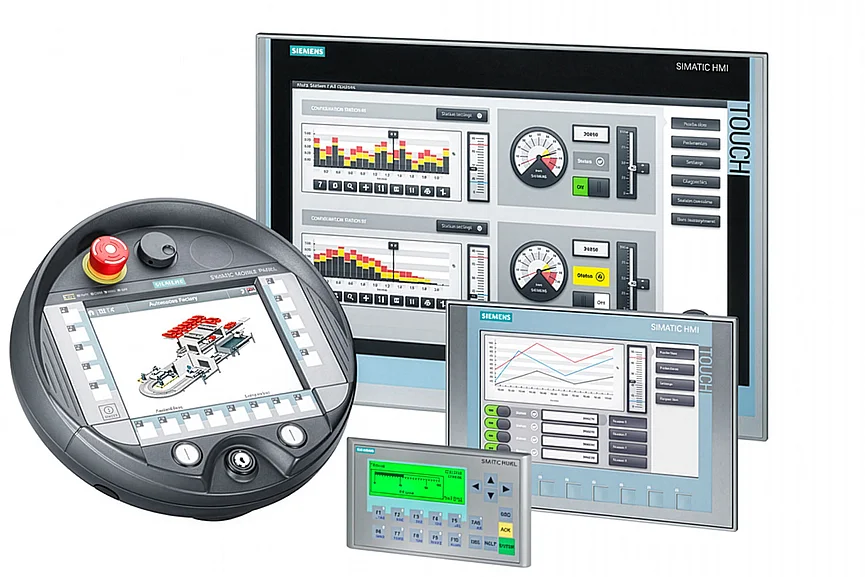
End-of-life: Siemens has discontinued these 19 SIMATIC HMIs with effect from 1 October 2026

KTP, OP, TP, MP; These 19 Siemens SIMATIC HMIs were discontinued on 1 October 2026. For operators and maintenance staff, this means: checking installed devices, assessing the spare parts strategy and determining in good time whether repair, replacement, stocking up or modernisation is the most appropriate course of action.

Key facts at a glance

  • As at 1 October 2026, Siemens had configured a total of 19 SIMATIC HMIs on P.M490.
  • The models affected are the KTP400/600 Basic, OP/TP/MP x77 and Mobile Panel x77.
  • Discontinuation of a product does not automatically mean that devices have to be replaced straight away.
  • Operators should check which of the 19 HMIs are installed in their systems.
  • The full item number of the relevant HMI is crucial.
  • Possible courses of action include repair, replacement, stockpiling or modernisation.
  • Carrying out checks at an early stage reduces time pressure in the event of a failure, replacement or migration.

These 19 popular Siemens SIMATIC HMIs were discontinued on 1 October 2026

With effect from 1 October 2026, Siemens has set the lifecycle status of a total of 19 SIMATIC HMI devices and variants to P.M490. This affects operator terminals from three poduct groups: SIMATIC KTP400/600 Basic, SIMATIC OP/TP/MP x77 and SIMATIC Mobile Panel x77.

For operators and maintenance personnel, this product discontinuation is more than just a formal piece of lifecycle information. It affects operator terminals that are still in active use in many systems. Anyone using these HMIs should now check which devices are installed, how critical they are to operations, and what strategy for spare parts, repairs or modernisation would be appropriate.

Short answer: What does the discontinuation of these 19 Siemens SIMATIC HMIs mean?

These 19 Siemens SIMATIC HMIs were discontinued or set to lifecycle status P.M490 with effect from 1 October 2026. This does not automatically mean that the devices must be replaced immediately. However, operators do need to take specific action: check the installed base, record part numbers, assess the criticality of the systems, and clarify options for repair,  replacement units, stockpiling or modernisation.
According to this list, 19 Siemens SIMATIC HMI devices and variants were assigned lifecycle status P.M490 with effect from 1 October 2026. This affects KTP400/600 Basic Panels, devices from the OP/TP/MP x77 series, and Mobile Panels x77.

No. A product discontinuation does not automatically mean that a device must be removed immediately. However, operators should assess how critical the HMI in question is to the system and what replacement, repair or migration options are available.

Yes. These are standard industrial products that can be repaired by specialist service providers such as EICHLER. Whether they can be repaired depends on the nature of the fault, the condition of the equipment, the feasibility of technical testing and the availability of components. A reliable assessment can only be made once the specific piece of equipment has been inspected.

Key factors include the item number, interface, display size, project status, firmware and compatibility with the existing control system. The availability of the project files should also be clarified in advance.

The 19 HMIs in question are identified by specific part numbers. Minor differences in the interface, display size or variant may determine whether a replacement unit is suitable or whether further technical adjustments are required.

Modernisation may be a sensible option if several units are affected, spare parts are becoming difficult to source, or refurbishments are already planned. Before proceeding, the cost, compatibility and breakdowns should be assessed.

What does P.M490 mean in relation to these Siemens SIMATIC HMIs?

P.M490 is a lifecycle milestone in Siemens Product Lifecycle Management. It is crucial for operators to note that the products in question are either in the product discontinuation phase or at the end of their regular product lifecycle.

This does not automatically mean that any of the 19 affected HMI devices will no longer be technically usable or repairable from 1 October 2026. However, it does mean that the regular manufacturer support, the supply of spare parts and predictable procurement may become increasingly difficult.

Operators should therefore not simply look for potential replacement products. It makes more sense to carry out a comprehensive assessment of the maintenance strategy: continue operating, repair, replace, keep in stock or modernise.

Why the commissioning of these 19 HMIs is relevant to operators and maintenance staff

HMI control units are often small components with a big impact. If a panel fails, in the worst-case scenario it is not just the display that stops working. Control functions, fault acknowledgement, recipe changes, operating mode selection or diagnostics may be directly affected.

Older SIMATIC HMIs, in particula, are often deeply integrated into machine designs, control programmes and operating procedures. Replacing them at short notice is therefore not always a simple one-to-one process. In practice, interfaces, project status, installation conditions, communication links and operating logic must all be compatible.

This arises a number of questions for operators:

  • Is any of the 19 affected Siemens SIMATIC HMIs installed in your own system?
  • Is the unit still available as a replacement?
  • Is there a compatible replacement unit?
  • Can the existing panel be repaired cost-effectively?
  • Is the HMI project available in its entirety and in a usable version?
  • Can interfaces, communication and installation dimensions be managed during a modernisation?

These issues should not be addressed only when a problem arises. By then, there is often not enough time to properly assess technical interdependencies.

What risks arise from the discontinuation of products in existing systems?

The greater risk lies not in the deadline itself, but in a lack of preparation. Many systems have been running reliably for a long time using tried-and-tested HMI technology. The situation becomes critical if one of the affected operator terminals fails and neither a suitable replacement unit nor a tested repair or migration solution is available at short notice.

Typical risks are:

  • unplanned breakdowns due to HMI failure,
  • longer lead times for replacement units,
  • missing or outdated project files,
  • uncertain compatibility with the control system, bus, firmware or engineering system,
  • mechanical modifications when replacing units with newer models,
  • additional coordination efforts between maintenance, procurement and production.

HMIs are particularly critical in bottleneck systems, stand-alone machines, packaging lines, test benches, specialised machinery and systems with little redundancy. In such cases, a single operator terminal can determine whether a system remains operational or not.

What maintenance staff should check now

The first step is to carry out an inventory. This should involve recording not only item numbers, but also the installation location, the criticality of the system, the project status and the spare parts strategy.

1. Check whether any of the 19 affected HMIs are installed

The exact part number is the most important starting point. Operators should check whether any of the 19 Siemens SIMATIC HMIs listed are in use in their systems. Simply checking spare parts lists is often not sufficient for this. It is also advisable to carry out a cross-check directly on the machine, in control cabinet documentation and in existing project documents.

2. Prioritise critical systems

Not every HMI is equally important to operations. The key factors are which machines would come to a standstill immediately in the event of a failure, where operation is not possible without the panel, and where a prolonged outage would result in high consequential costs.

3. Clarify project and backup statuses

When replacing or migrating equipment, it is crucial that project files, backups, passwords and the engineering environment are available. Without reliable project data, even a technically suitable replacement device can become a problem.

4. Have the reparability assessed

Whether a repair is possible and economically viable depends on the nature of the fault, the condition of the equipment, the feasibility of testing it, and the availability of suitable components.

5. Define a spare parts and stockholding strategy

For critical systems, targeted stockholding may be advisable. In doing so, it is important to assess which items are actually required and what alternatives are available in the event of a fault. Stockholding based on gut feeling is rarely reliable. It makes more sense to prioritise items according to system criticality, risk of failure and availability.

Why the exact item number is crucial

When it comes to HMI devices, the product family alone is not enough. A KTP400 Basic, a TP177B, an MP277 or a Mobile Panel 277 may have different interfaces, display sizes, operating concepts or operating conditions, depending on the variant.

The full item number is therefore crucial for procurement and maintenance. This is particularly true in the event of a fault. If only a general description is known, the search for a replacement may take longer. If, on the other hand, the item number, installation location, project status and system criticality are documented, repairs, replacements or stocking requirements can be assessed much more quickly.

Repair, replace or modernise?

The discontinuation of these 19 Siemens SIMATIC HMIs does not mean that operators are automatically required to upgrade. Once a product has been discontinued, there is rarely just one correct answer. The key factors are technical feasibility, the criticality of the system, the risk of breakdowns and the budget.

Repair is a viable option if the existing panel is compatible with the system, the operating concept is to remain unchanged, and technical refurbishment is possible. Particularly in the case of older HMIs, repair can help to ensure that existing systems continue to operate without the need to embark on a comprehensive migration straight away.

Replacement devices can be a solution if a compatible device is required at short notice. It is important that the item number, interface, project status and condition of the device all match exactly.

Stockpiling is suitable for critical systems where a failure would result in high breakdown costs. However, stock should not be held indiscriminately. It is essential to prioritise items according to risk.

Modernisation becomes relevant when several HMIs are affected, spare parts become difficult to source, or modifications to the machine, control system or visualisation are already planned. However, it requires a thorough technical assessment, as communication, project planning, installation and operating logic may need to be adapted.

How EICHLER provides support for affected SIMATIC HMIs

EICHLER supports operators of industrial systems with the assessment, repair and supply of spare parts for end-of-life industrial electronics. For affected SIMATIC HMI devices, a technical assessment can determine whether repair at component level is possible and economically viable.

This provides operators with a basis for decision-making before approval is granted. Depending on the situation, various options may be considered: repairing the existing equipment, providing a suitable replacement unit, supplying spare parts, stocking critical components, or making structured preparations for modernisations.

The aim is to reach a sound decision tailored to the specific system context.

Conclusion: These 19 Siemens SIMATIC HMIs should now be added to the checklist

These 19 Siemens SIMATIC HMIs were discontinued on 1 October 2026. Many of these devices may still be in active use in systems. This is precisely why the product discontinuation should not only become an issue when the next failure occurs.

Those who now review their installed base, prioritise critical HMIs and assess repair, replacement or stockpiling options will reduce the risk of unplanned breakdowns. For maintenance, procurement and operations management, the most important step is to create transparency. Which of the 19 HMIs are installed? Which systems are critical? WHich replacement strategy makes sense from both a technical and economic perspective?

Important documents

Repair accompanying note

Download the repair accompanying note as a PDF, or use the digital repair registration and send your defective modules to the EICHLER Service Centre for repair.

Laughing Eichler technician points to green PDF with special sale of automation technology

Your shopping basket

Loading shopping basket