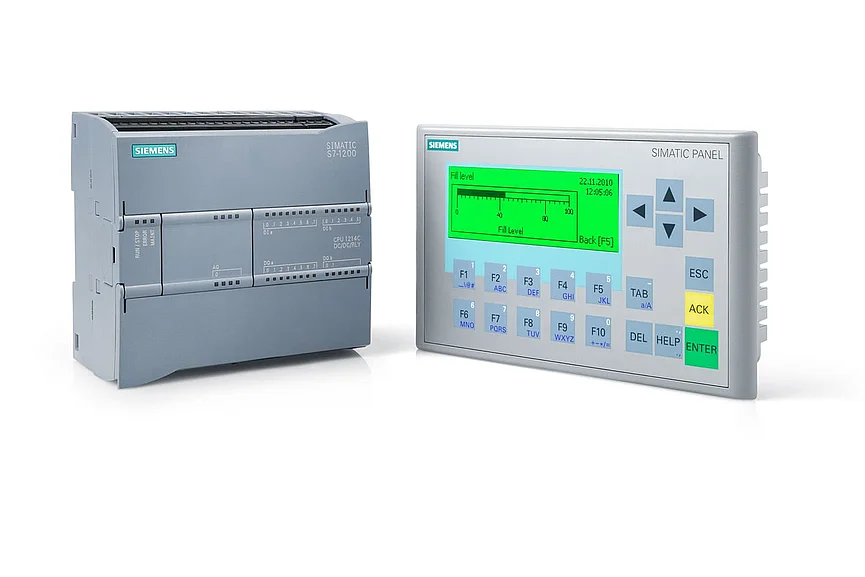
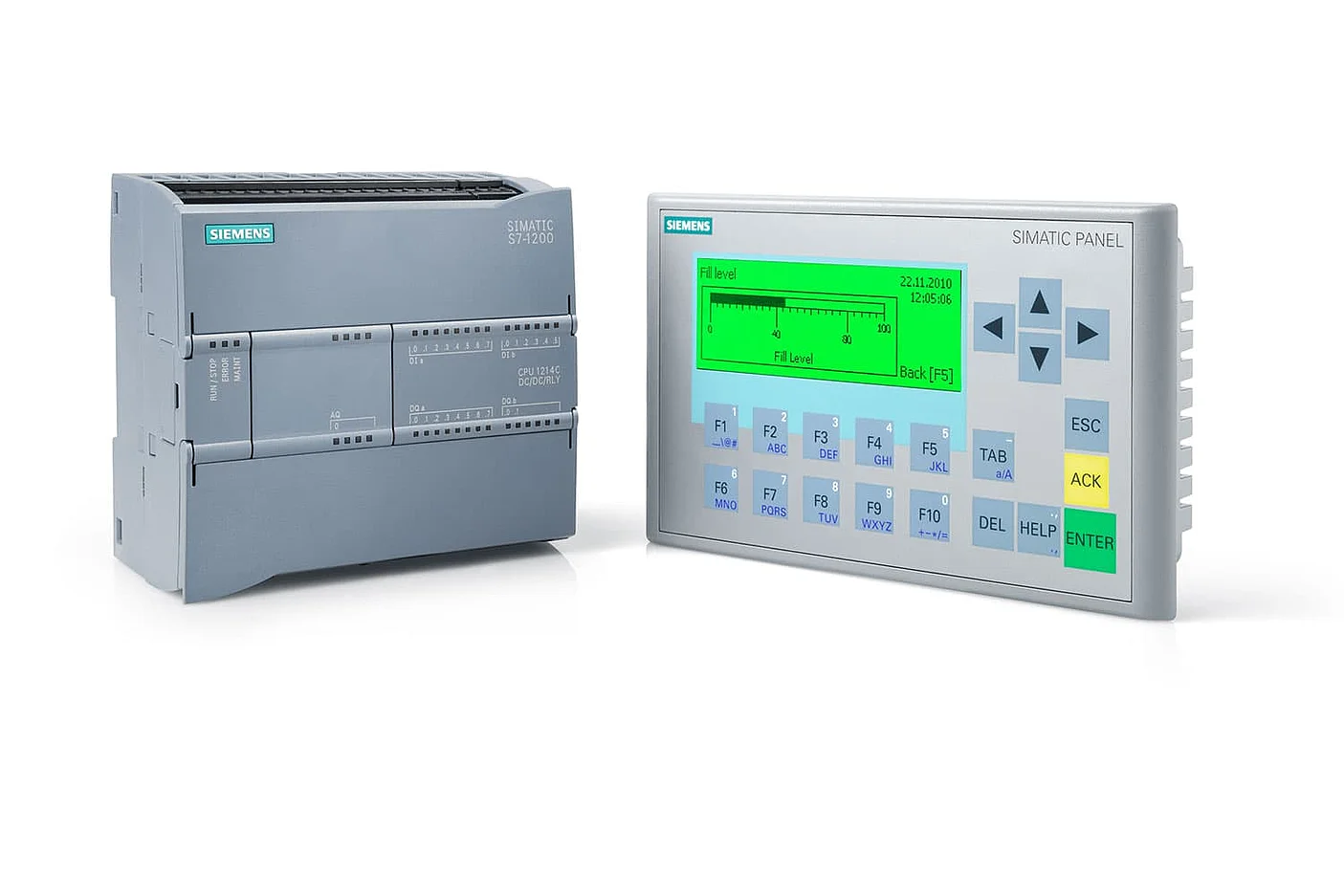
SIMATIC HMI KP300 and KP400: To be phased out from October 2026

For the SIMATIC HMI KP300 Basic mono PN and the SIMATIC HMI KP400 Basic Color PN will reach end-of-life on 1 October 2026. The part numbers affected are 6AV6647-0AH11-3AX1 and 6AV6647-0AJ11-3AX1. Operators should now check where these panels are in use, whether the projects are up to date, and which strategy - repair, replacement, stockpiling or migration - is most appropriate.

SIMATIC HMI KP300 and KP400: obsolescence from October onwards

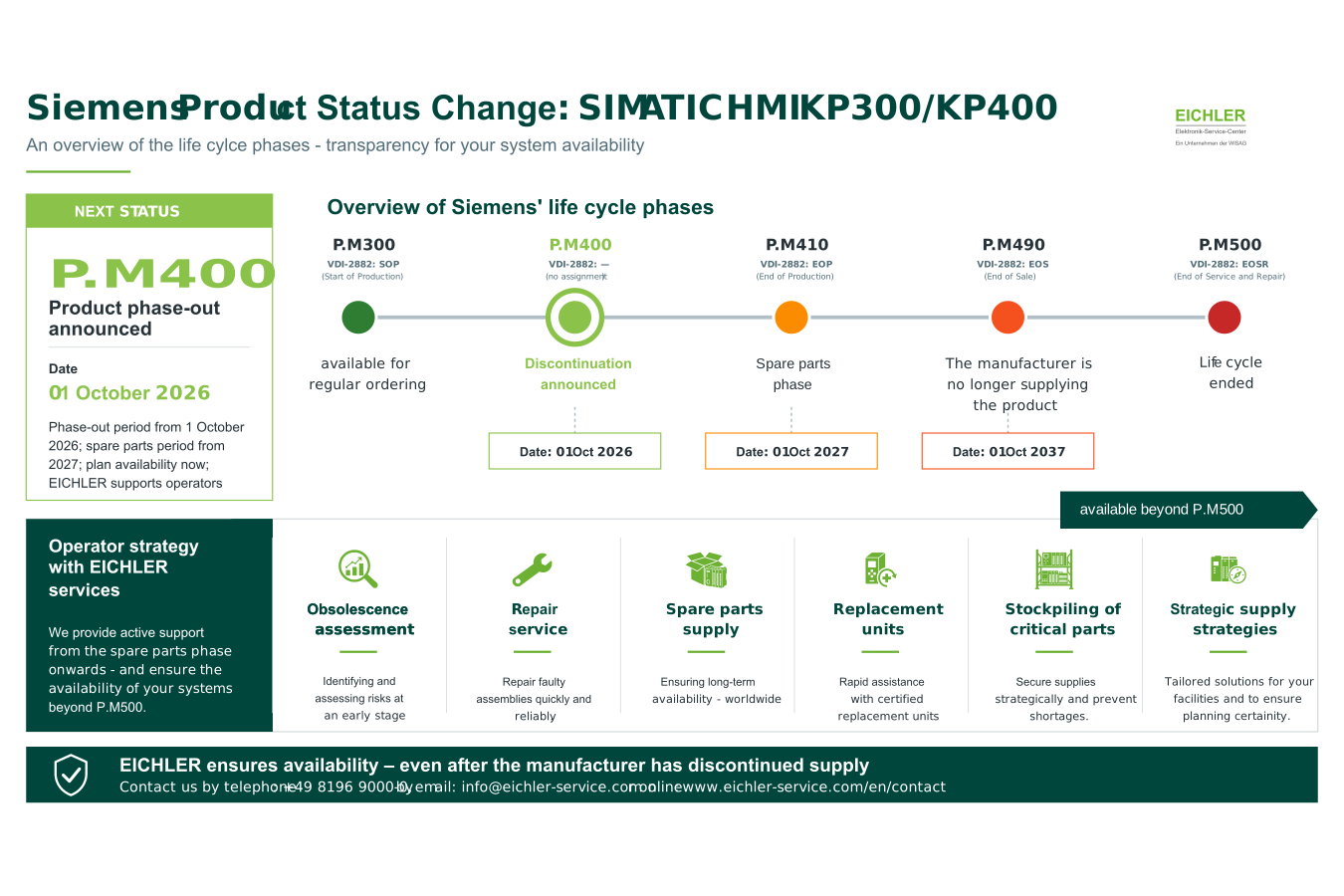
Siemens has announced a status change for two compact SIMATIC HMI operator panels: The SIMATIC HMI KP300 Basic mono PN and the SIMATIC HMI KP400 Basic Color PN will be reclassified as P.M400 on 1 October 2026. This means that both panels will become obsolete.

From today's perspective - 14 September 2026 - operators have only a short time left to check their installed base. The next step will take place on 1 October 2027: on that date, both devices will change to status P.M410. From that point onwards, they will be considered discontinued and will only be available as spare parts.
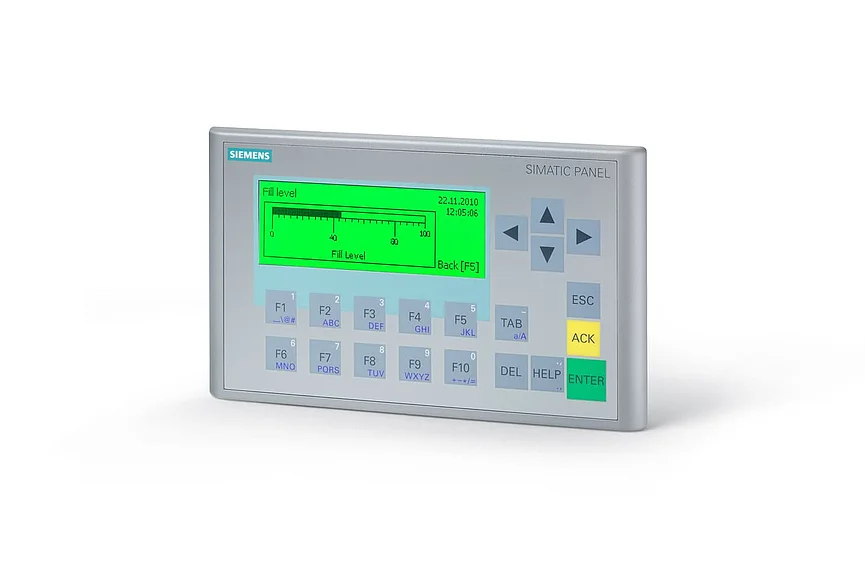
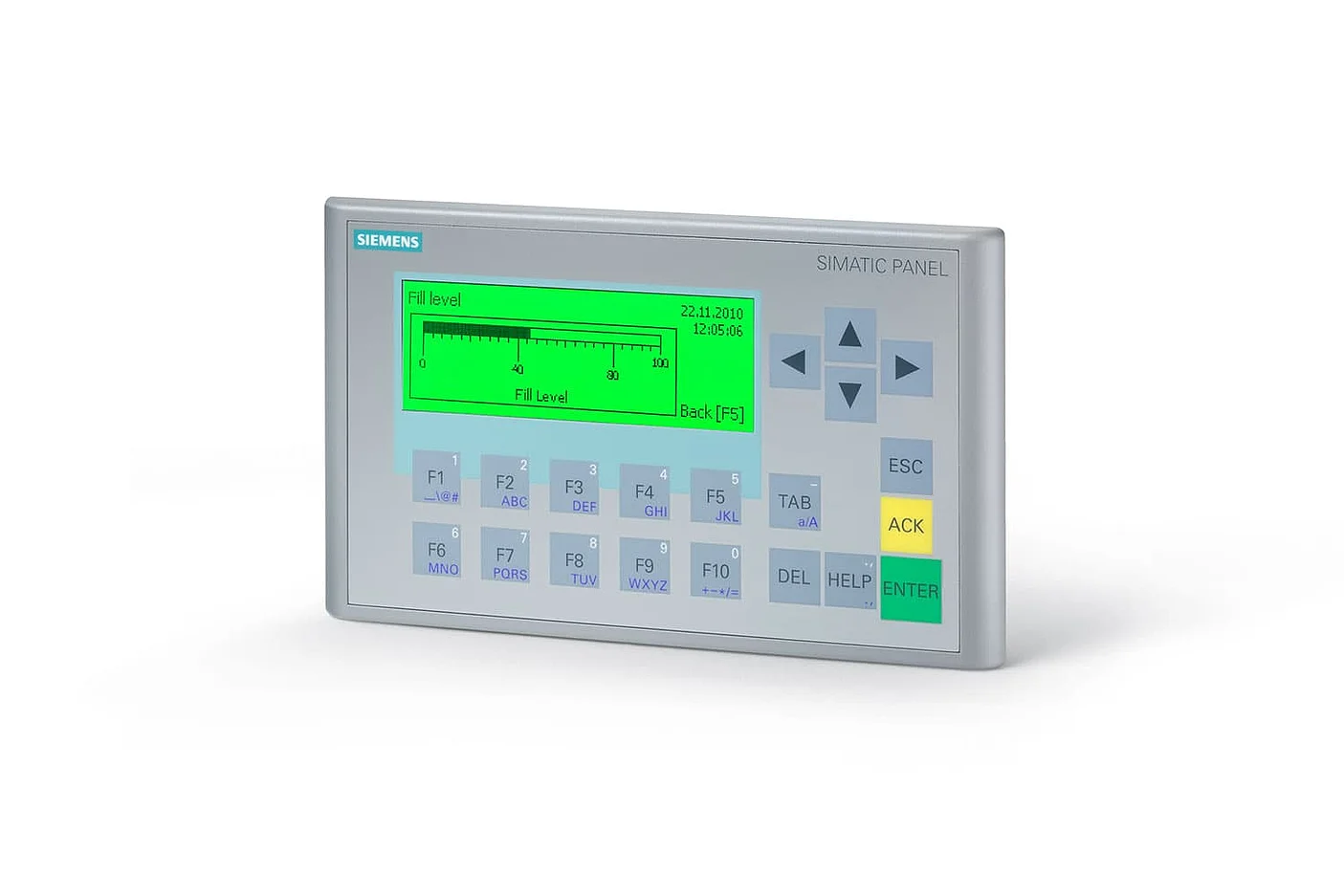
Which SIMATIC HMI devices are affected?

Download the inforgraphic on the end-of-life of the SIMATIC HMI KP400 Basic Colour PN


Two control panels from the SIMATIC HMI family are affected:

ProductPart numberStatus change
SIMATIC HMI KP300 Basic mono PN6AV6647-0AH11-3AX1P.M400 from 1 October 2026, P.M410 from 1 October 2027
SIMATIC HMI KP400 Basic Color PN6AV6647-0AJ11-3AX1P.M400 from 1 October 2026, P.M410 from 1 October 2027

Legend Siemens PLM status

StatusMeaning
P.M300Delivery status: The product is available to order as normal and is currently on sale.
P.M400End-of-life announcement: The product is reaching the end of its useful life. Operators should review their spare parts strategy, repair options, stock levels and migration plans.
P.M410Product discontinuation: This product is no longer available as a standard item and is now only available as a spare part.
P.M490Spare part discontinuation: New spare parts will no longer be supplied. Availability is now limited to existing stock.
P.M500Product discontinuation/ End of product life cycle: The product has been discontinued; the supply of spare parts and support have ceased or are no longer provided.

The KP300 Basic mono PN is a compact keypad with a monochrome display and a PROFINET interface. The KP400 Basic Color PN is a keypad with a colour display and a PROFINET interface.Both devices are frequently used in machines and systems where simple operating and monitoring functions are sufficient.

For operators, the part number is crucial. In practice, similar equipment designations, older models or successor models can easily lead to confusion. Maintenance and procurement teams should therefore not only search by model series, but also check the full MLFB on the equipment itself, in the spare parts list or in the system documentation.

What does the discontinuation of the P.M400 product mean for operators?

With the transition to P.M400, the product becomes obsolete. This does not mean that an installed panel needs to be replaced immediately. However, it dies mean that, from a product life cylce perspective, the device should no longer be treated as a standard production model.

For maintenance, this marks the start of the planning phase. The key factors are whether the panel is installed in a production-critical system, whether a replacement unit is available, and whether the project configuration has been backed up. If there is no up-to-date project backup, a subsequent replacement may prove considerably more complex than the mere procurement of hardware would suggest.

The procurement outlook is changing. Equipment entering the obsolescence phase should not be assessed only once a failrure has occured. The closer the next stage in the product lifecylce apporaches, the more important it becomes to have reliable sources of supply, tested replacement units and clear coordination with the technical team.

What role will P.M410 play from October 2027?

On 1 October 2027, the KP300 Basic mono PN and the KP400 Basic Color PN will be assigned status P.M410. From this date onwards, these devices will be considered discontinued and will only be available as spare parts.
For system operators, this is an important distinction. With P.M400, the mains focus is on impending obsolescence and planning. With P.M410, the focus shifts more towards the supply of spare parts, repairability and inventory strategy. Anyone who only begins the assessment after P.M410 has less room for manoeuvre.

The period up to October 2027 should thereforebe used to prioritise critical equipment. Not every panel needs to be replaced immediately. However, every panel relevant to production should be identified, assessed and included in a spare parts strategy.

Why user interfaces are often underestimated in Obsolescence Management

HMI panels rarely attract attention during normal operation. They are integrated into the control panel, fulfil their function and only become a problem when the display, keyboard, electronics or interface fail. In such cases, whilst the machine may still be in good working order in terms of its mechanical and control systems, it can no longer be operated as intended.

Replacing an operator panel is also rarely just a matter of hardware. Engineering, operator screens, function keys, interfaces, the mounting cut-out, parameterisation and system approval all need to be taken into account. Particularly with older machines, it is not always clear whether the original project files are complete and up to date.

This makes the change in status of the KP300 and KP400 relevant to both maintenance and procurement teams. A panel identified at an early stage can be assessed without time pressure. An unplanned failure, by contrast, often creates pressure to coordinate between engineering, procurement, production and those responsible for the system.

What steps should operators take now?

The first step should be to check whether SIMATIC HMI KP300 Basic mono PN or SIMATIC HMI KP400 Basic Color PN panels are installed in your systems. Key information includes the device type, full article number, system location and criticality, as well as whether the corresponding project configuration has been securely backed up.

A suitable strategy should then be defined for each system. For less critical machines, it may be sufficient to prepare for replacement as part of a planned modernisation. For production-critical systems, it may be advisable to have a tested replacement unit, a defined repair option or a suitable spare unit held in stock.

Migration should also be assessed at an early stage. This involves not only identifying a potential successor device, but also considering project conversion, the operating concept, the mechanical installation requirements, interfaces and internal approvals. The better these aspects are prepared in advance, the lower the risk of a device replacement resulting in extended downtime in the event of a failure.

Possible solutions - repair, replacement or migration?

Which option is most appropriate depends on the individual case. Component-level repair can be a suitable solution for industrial electronics where the nature of the fault, the condition of the device and the ability to test it technically support this approach. However, it should not be assumed to be viable option in every case.

A replacement unit can be a suitable option if the system needs to be brought back into operation quickly and a compatible, tested device can be sourced. Keeping a spare unit in stock can be beneficial if several identical panels are in use or if the system is critical to production. Migration is particularly worth considering if other components are already being modernised or of the operator interface is due to be revised anyway.

For operators, it is essential to compare these options before a failure occurs rather than waiting until the equipment is down. A technical assessment process and a detailed quotation prior to approval provide maintenance and procurement teams with a sound basis for decision-making.

The affected products are the SIMATIC HMI KP300 Basic mono PN, article number 6AV6647-0AH11-3AX1, and the SIMATIC HMI KP400 Basic Color PN, article number 6AV6647-0AJ11-3AX1.

Both panels will reach the end of their service life on 1 October 2026. On that date, the units will change to status P.M400.

The product will be discontinued on 1 October 2027 with status P.M410. From that date onwards, the units will only be available as spare parts.

No. An immediate replacement is not automatically required. However, operators should check where the devices are in use, how critical the respective system is, and whether a replacement device, repair option or migration path has been prepared.

This can only be assessed following a technical inspection. The decisive factors are the nature of the fault, the condition of the component, whether it can be inspected, and whether it makes economic sense. A repair at component level may be an option, but this cannot be assumed across the board. In over 90 per cent of cases, a repair is possible and makes economic sense.

The most important step is to carry out an inventory check. Companies should check the relevant item numbers in their system, spare parts lists and stock records, and then prioritise critical systems.

How EICHLER can help

EICHLER supports operators in the assessment and repair of industrial electronics. For end-of-life or obsolete HMI devices, this includes technical inspection, repair assessment, the supply of spare parts and the identification of possible replacement options.

For the SIMATIC HMI devices concerned, this means: clearly identifying the device, assessing the fault symptoms, evaluating whether it can be repaired, and considering alternatives such as a replacement device, stocking or migration. The aim is to reach a sound decision that is appropriate for the system, the criticality of the situation and the available timeframe.

Conclusion: Actively factoring in obsolescence

The SIMATIC HMI KP300 Basic mono PN and the SIMATIC HMI KP400 Basic Color PN will reach end-of-life on 1 October 2026. They will be discontinued on 1 October 2027. This makes now the right time to take stock of the installed base and define a spare parts strategy.

Operators do not need to retrofit every installation immediately. However, they should be aware of where the affected panels are installed, the current status of each project, and what options are realistically available in the event of a fault. Those who clarify these issues before a failure occurs will have greater flexibility when it comes to repairs, replacements, stockpiling and migration.

Important documents

Repair accompanying note

Download the repair accompanying note as a PDF, or use the digital repair registration and send your defective modules to the EICHLER Service Centre for repair.

Laughing Eichler technician points to green PDF with special sale of automation technology

Your shopping basket

Loading shopping basket