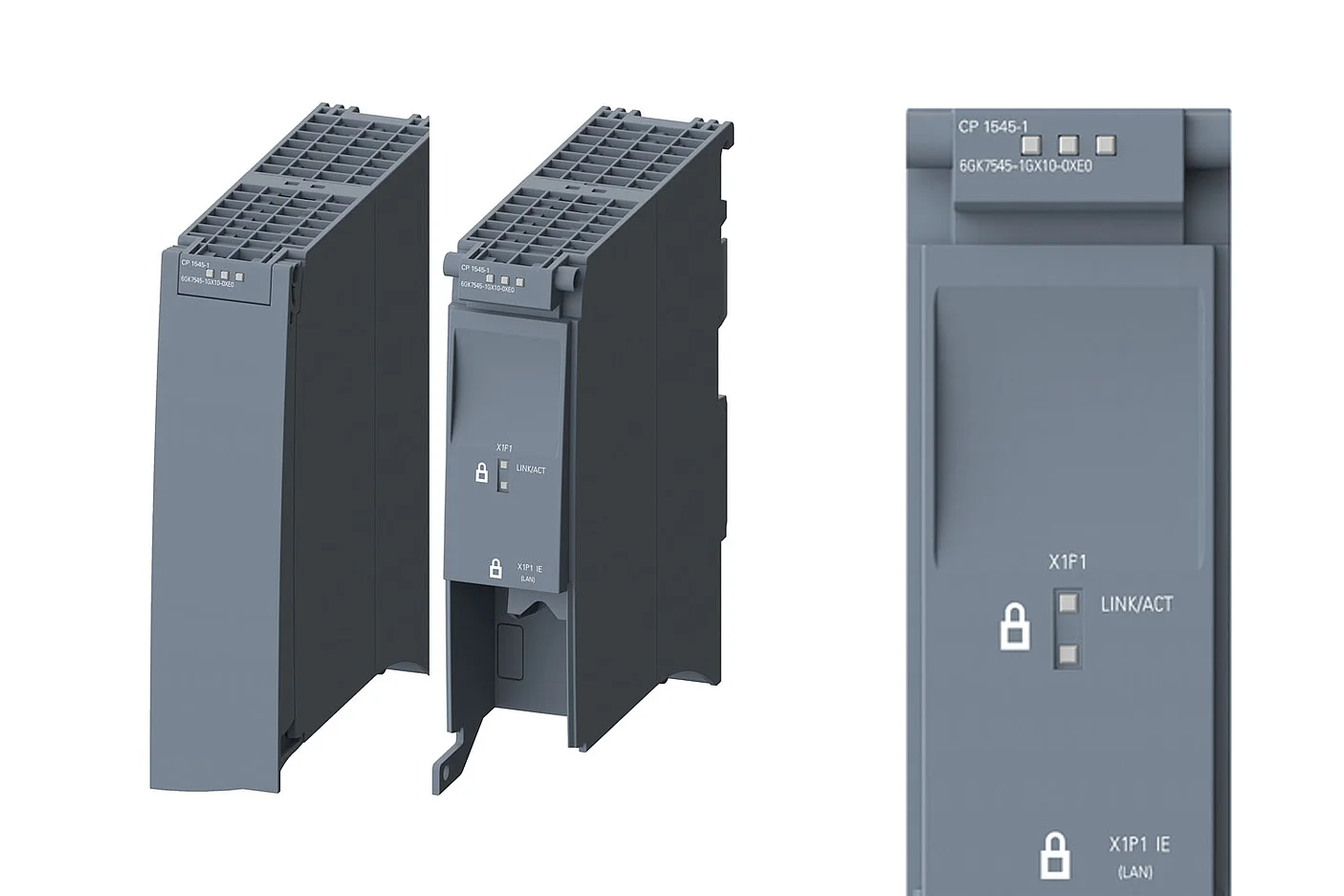
Siemens CP 1545-1 product discontinuation: 6GK7545-1GX00-0XE0 affected

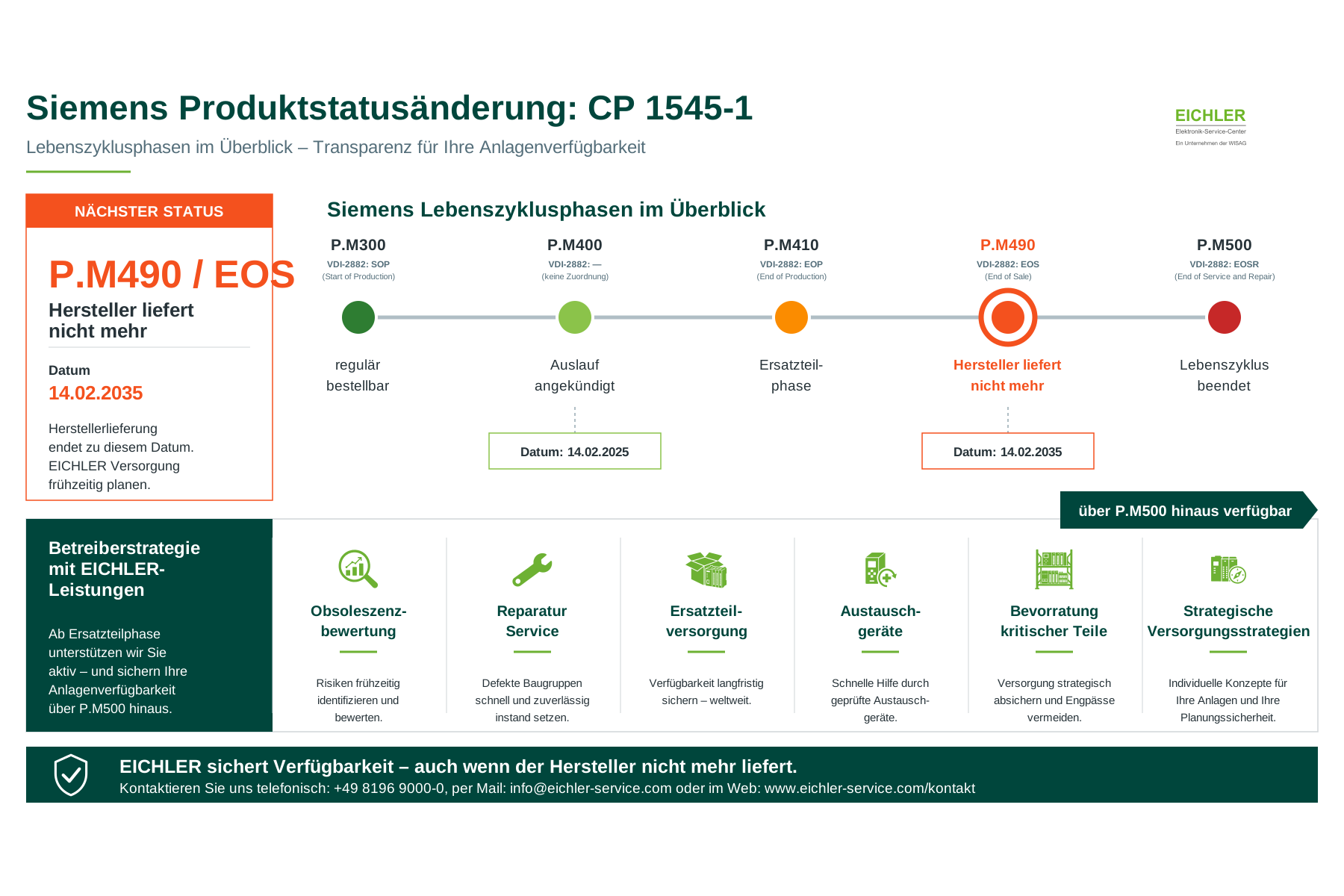
The product will become obsolete on 1 September 2026

The CP 1545-1 product discontinuation affects variant 6GK7545-1GX00-0XE0. The assembly is used in SIMATIC-S7-1500 systems as a communication processor for industrial ethernet. Operators should now check where the assembly is installed, which communication functions it handles, and whether repair, replacement, stockpiling or a planned migration is technically and economically viable.

Key facts at a glance

  • Siemens has announced that the CP 1545-1 GX00 is being phased out.
  • The item number affected is 6GK7545-1GX00-0XE0.
  • Assemblies that have been fitted do not necessarily have to be replaced.
  • Assess the switch to GX10 from both a technical and project management perspective.
  • Spare parts strategy: repair, replacement unit or stockpiling.

Siemens CP 1545-1 product discontinuation: GX00 affected

Siemens has published an announcement on industry online support regarding the end-of-life of the CP 1545-1 communication processor, with part number 6GK7545-1GX00-0XE0. The Siemens post is dated 1 September 2026. For operators of SIMATIC-S7-1500 systems, this is no cause for a hasty retrofit, but it is an important consideration for spare parts strategy, project planning status and technical risk asssessment.
Which Siemens assembly is affected?

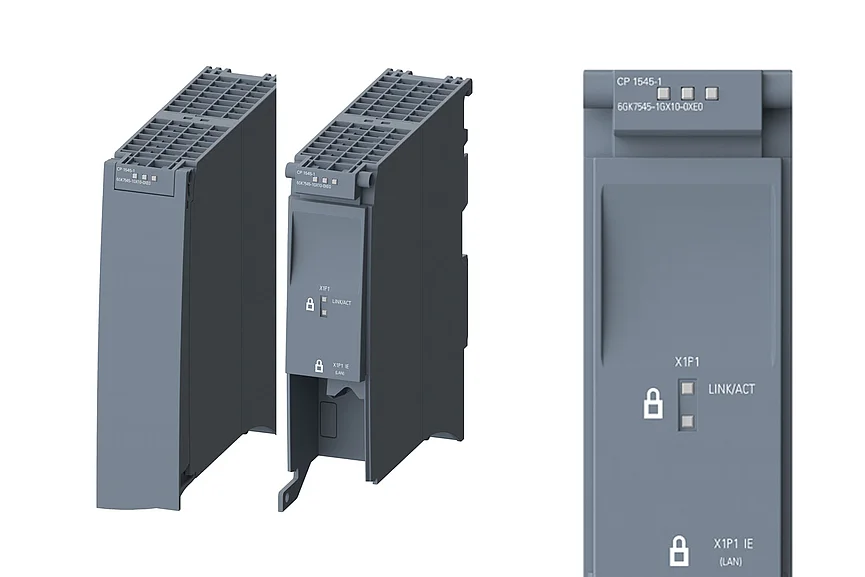
The device affected is the Siemens CP 1545-1 GX00 with item number 6GK7545-1GX00-0XE0. According to Siemens operating instructions, this is a communication processor for connecting the SIMATIC S7-1500 to industrial ethernet. The supported protocols include, amongst others, TCP/IP, UDP, S7 communication, FTP client/server, email and cloud access via MQTT.

The current Siemens operating manual also lists the CP 1545-1 GX10 variant with the part number 6GK7545-1GX10-0XE0. Siemens describes this variant as having firmware version V2.0; for the 05/2025 release, Siemens lists, amongst other things, improvements to security functions, network authentification in accordance with IEEE 802.1X and integration with SINEMA Remote Connect.

No. Components that have already been fitted do not necessarily need to be replaced. However, the notification is a clear indication that it is time to review the supply of spare parts, repair options and possible alternatives.

It is not a one-size-fits-all situation. In the current operating instructions, Siemens lists the GX00 and GX10 as variants of the CP 1545-4, albeit with different firmware versions. Whether a replacement is possible in a specific system depends on the project configuration, firmware, engineering version, communication functions and system approvals.

According to Siemens, the GX00 variant with firmware V1.1 can be programmed using STEP 7 professional V17. The full functionality of the GX10 variant with firmware V2.0 can be programmed using STEP 7 professional V19.

This can only be assessed following a technical inspection. The key factors are the nature of the fault, the condition of the component, whether it can be tested, and whether repair is economically viable. EICHLER can inspect the assembly and, if it can be repaired, provide a cost estimate for approval.

Why the announcement of the product's discontinuation is relevant

In many systems, communication processors are not merely a single component in the control cabinet. They can support data comunication, remote access, diagnostics, cloud connectivity or security functions. If such a module fails and no suitable replacement is available, this affects not only the hardware but also the coordination between maintenance, automation, IT/OT and production, depending on the project configuration.

For this reason, the announcement of the product's end-of-life should not be considered only in the event of a fault. It makes sense to carry out a stock-take: In which systems is item number 6GK7545-1GX00-0XE0 installed? What are the current firmware and configuration versions? Which communication functions are active? And which systems would take priority in the event of a failure?

What needs to be considered in the event of a potential change

A decision to switch to a newer variant should not be based solely on a similar product designation. In the operating instructions, Siemens distinguishes between the GX00 with firmware V1.1 and GX10 with firmware V2.0. For project configuration, SIemens specifies STEP 7 professional V17 for the GX00 variant with firmware V1.1; according to Siemens, the full functionality of the GX10 variant with firmware V2.0 can be configured using STEP 7 professional V19.

In practice, operators should check, prior to any migration, whether the hardware configuration, firmware, TIA Portal/STEP 7 version, IP configuration, security settings, certificates, firewall rules and communication assemblies are compatible. Particularly in the case of networked systems, it is also important to clarify whether the CP 1545-1 is integrated into remote maintenance, cloud or segmentation concepts.

A spare parts strategy rather than individual decisions

For maintenance and procurement, it is not simply a question of which piece of equipment can be procured in the short term. The key factor is which strategy is appropriate for the asset risk. For less critical assets, a planned transition may be sufficient. For production-critical lines, a verified stockholding stragety or a coordinated replacement plan may be more appropriate.

Where hardware is difficult to source, repairing the existing assembly may also be an option. However, whether a repair at component level is possible and economically viable can only be assessed folowing a technical inspection. The decisive factors are the fault pattern, the condition of the assembly, testability and the availability of relevant components.

How EICHLER can support operators

EICHLER supports operators in assessing industrial electronics when assemblies are affected by the announcement of a product end-of-life. This includes technical testing, component-level repairs, spare parts supply, replacement units and stockpiling strategies.

A technical assessment must be carried out before a decision on repairs is made. If a repair appears feasible, a detailed cost estimate serves as the basis for approval. This enables technical, procurement and system management staff to make a sound decision as to whether repair, replacement, stocking or a planned modernisation is the appropriate course of action.

What operators should do now, in practical items

The first step is to draw up a clear list of equipment and spare parts. In addition to the part number, the location, firmware version, configuration status and function of the assembly should be documented. This makes it possible to assess whether existing spare parts are sufficient, whether a replacement unit should be prepared, or whether a switch to a newer model needs to be planned.

At the same time, the procurement department should assess which uspply channels are still reliable. Individual remaining stocks may resolve an immediate problem, but they are no substitute for a long-term strategy covering multiple systems, production lines or sites.

Important documents

Repair accompanying note

Download the repair accompanying note as a PDF, or use the digital repair registration and send your defective modules to the EICHLER Service Centre for repair.

Laughing Eichler technician points to green PDF with special sale of automation technology

Your shopping basket

Loading shopping basket