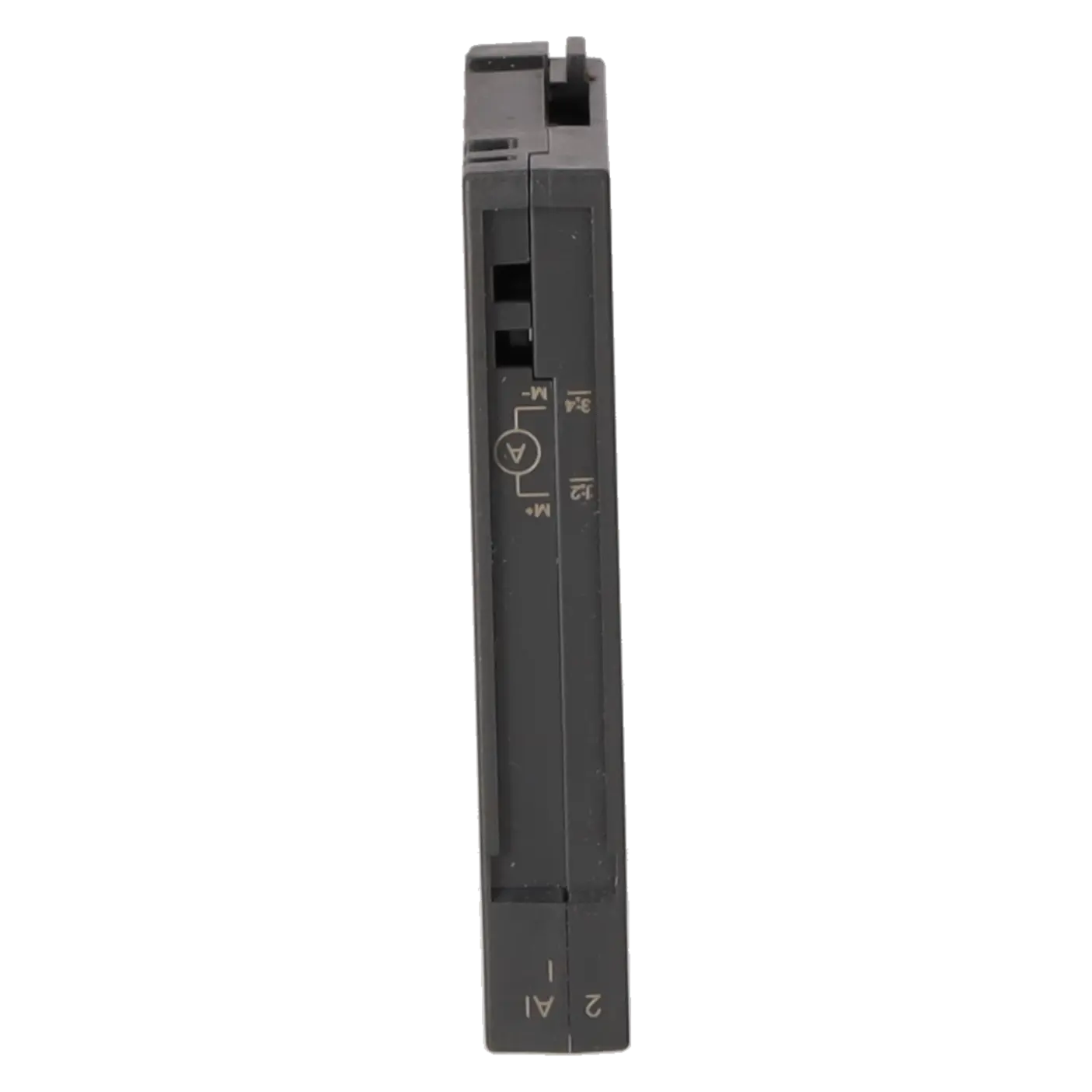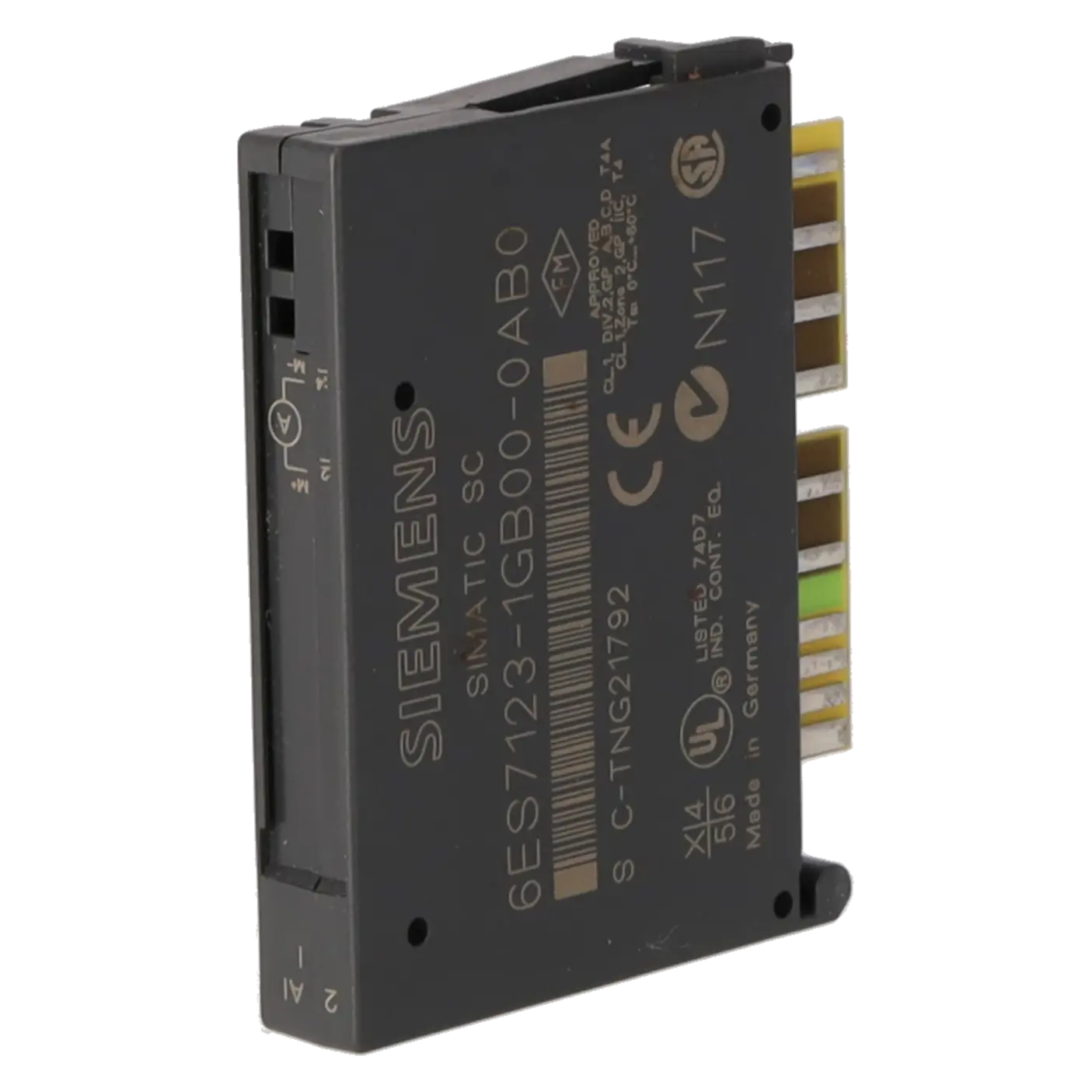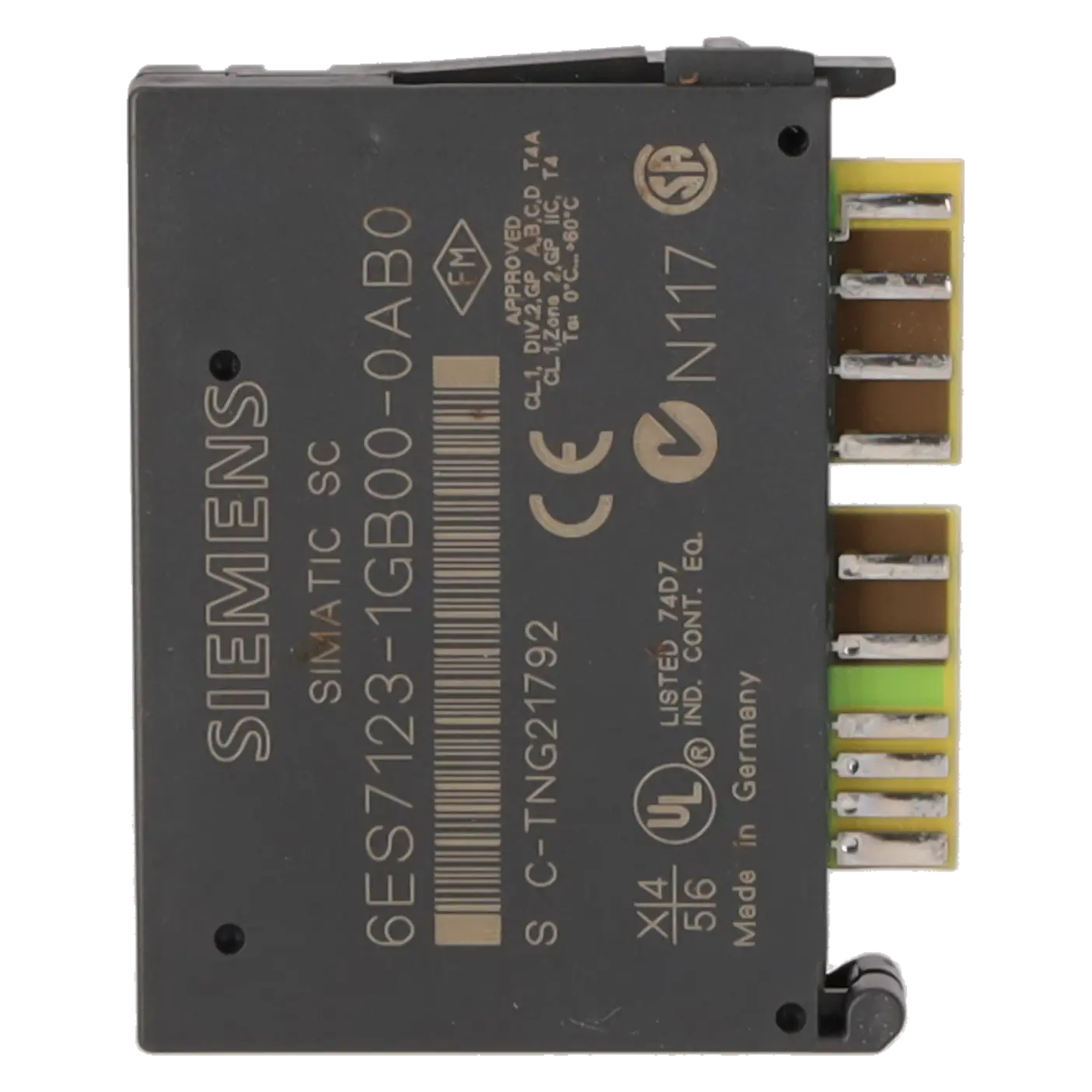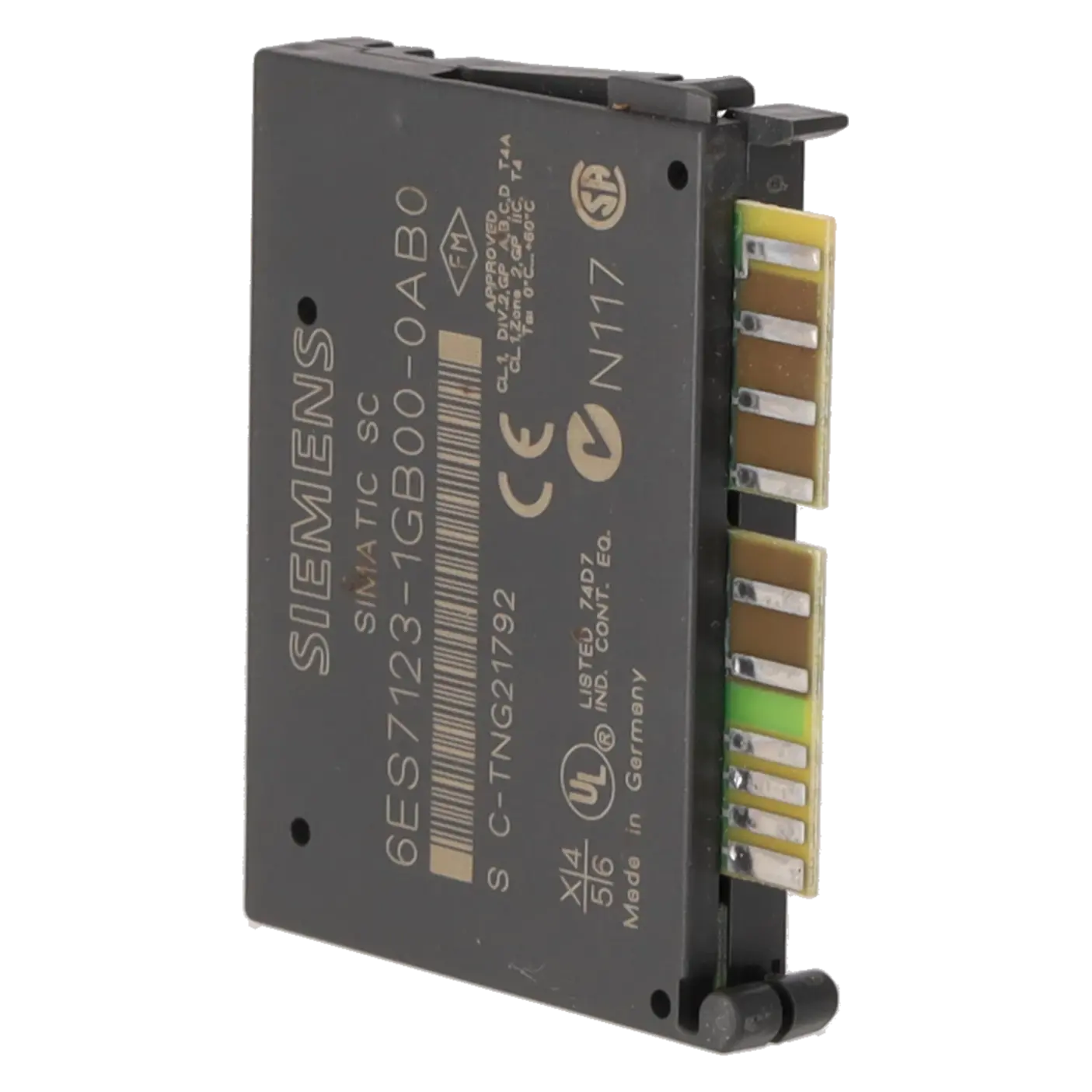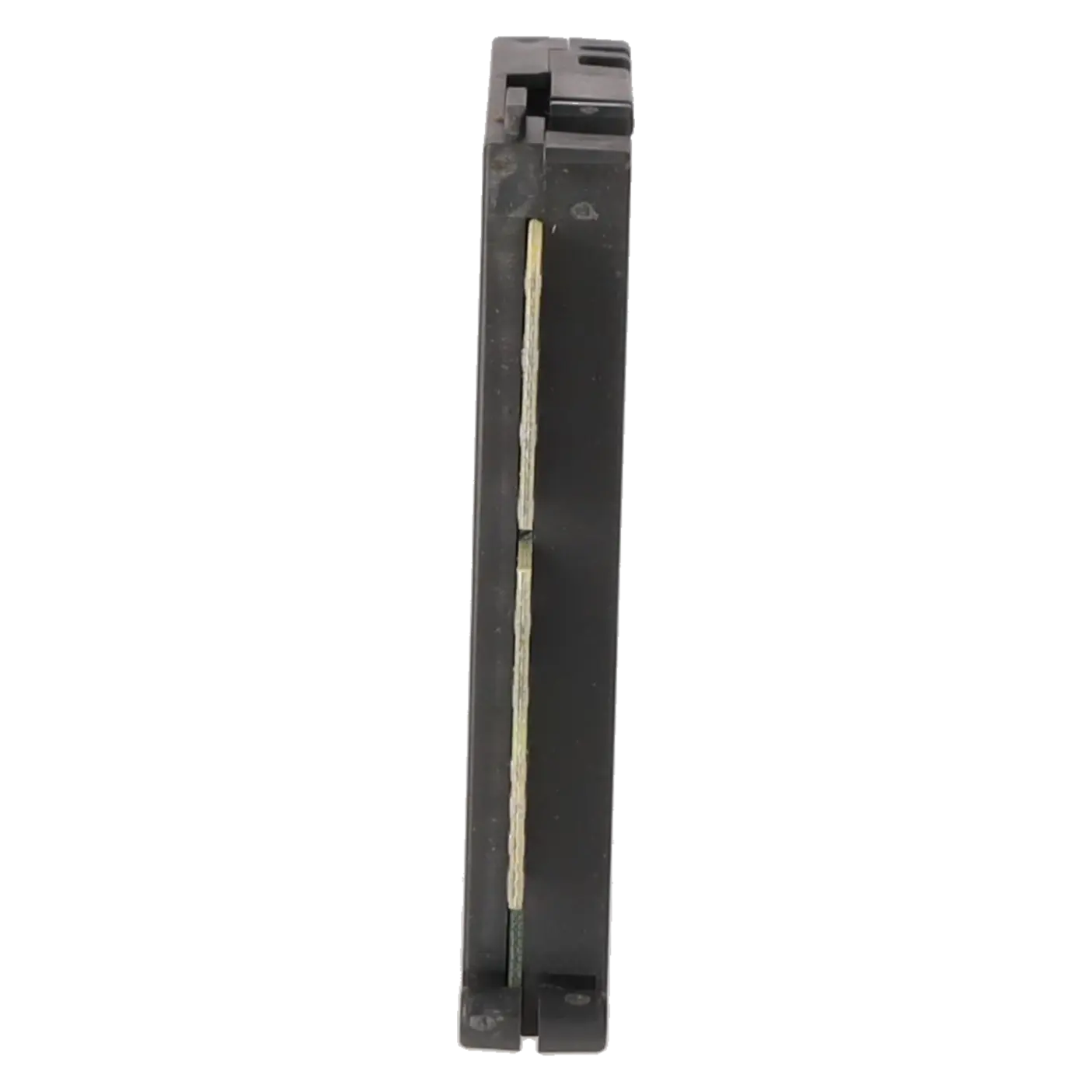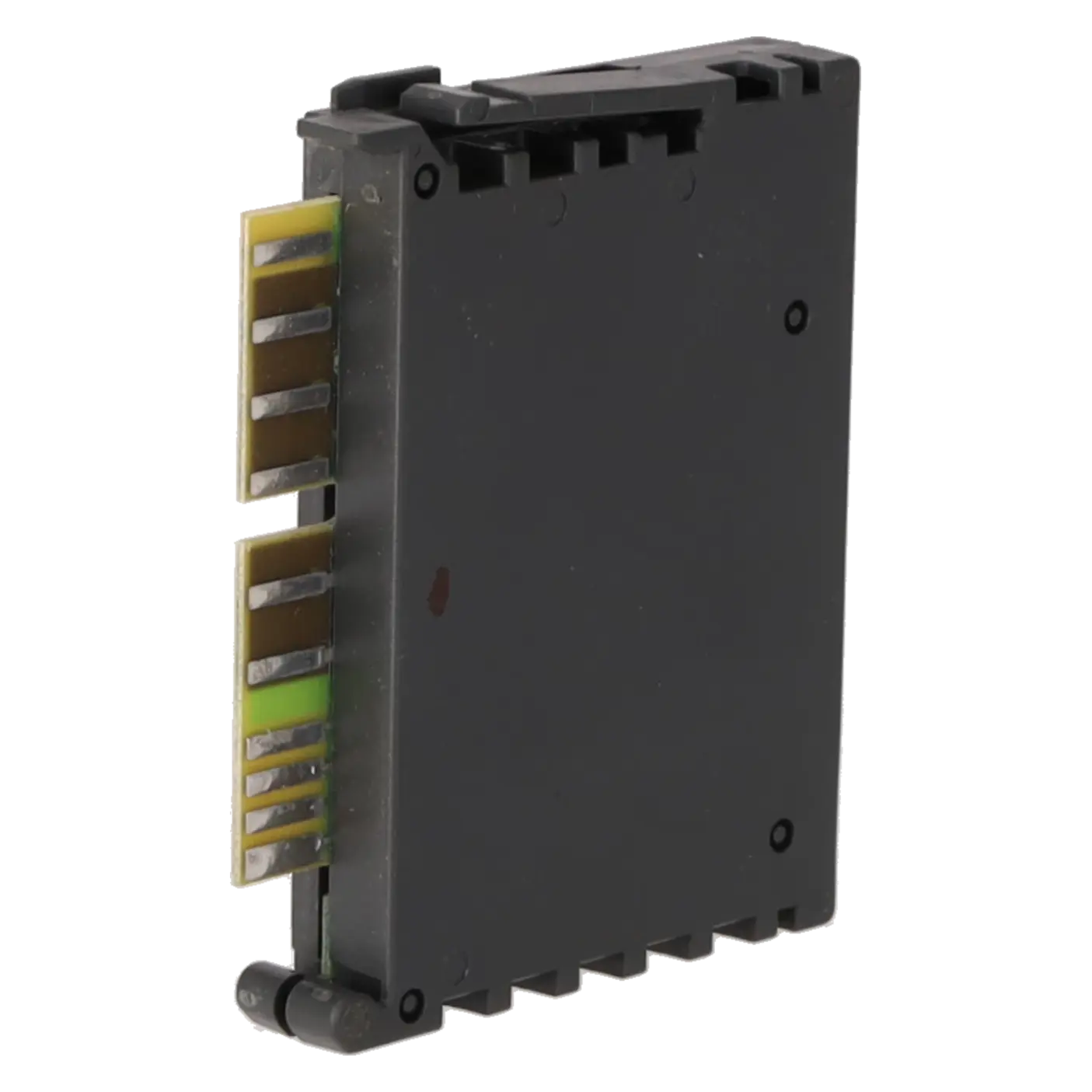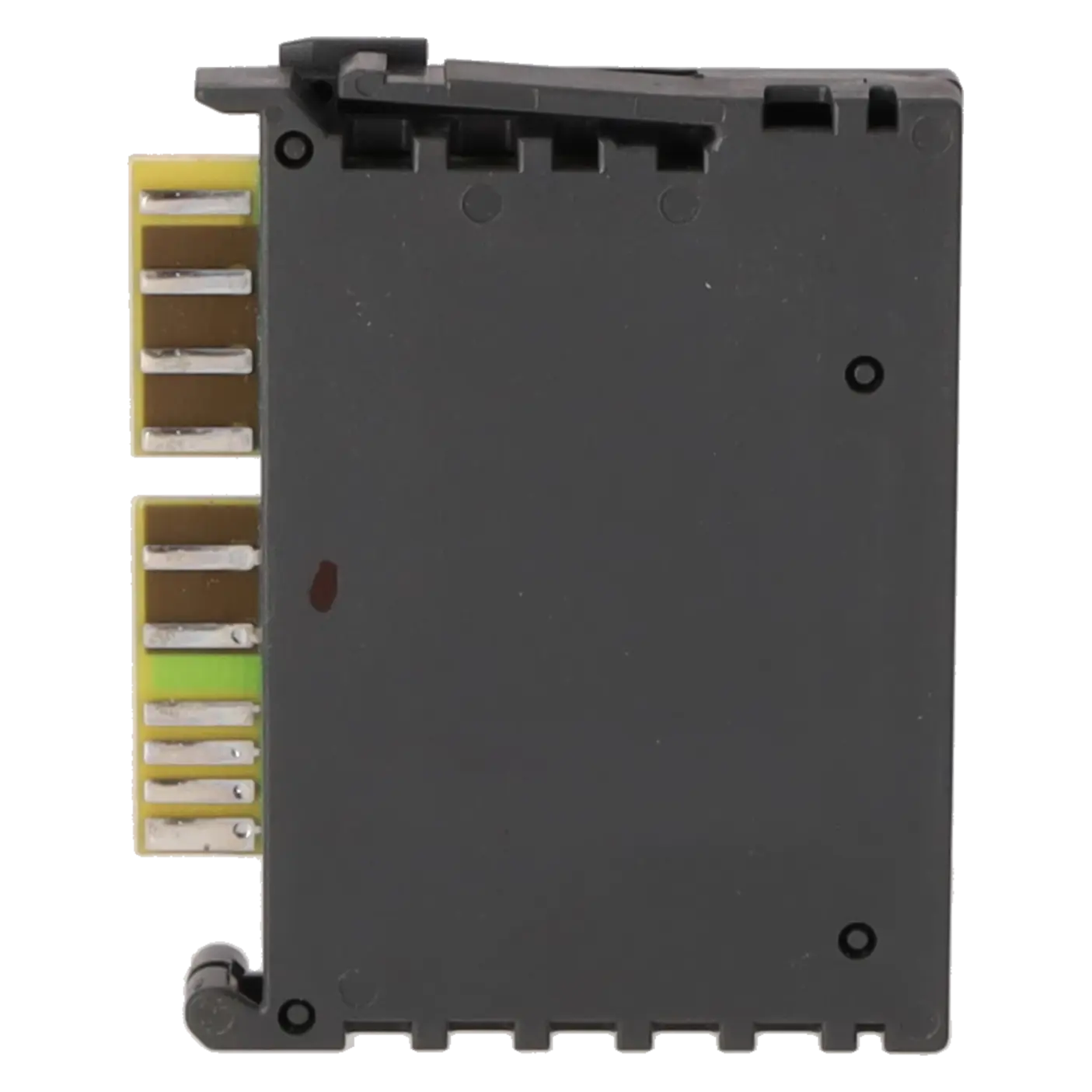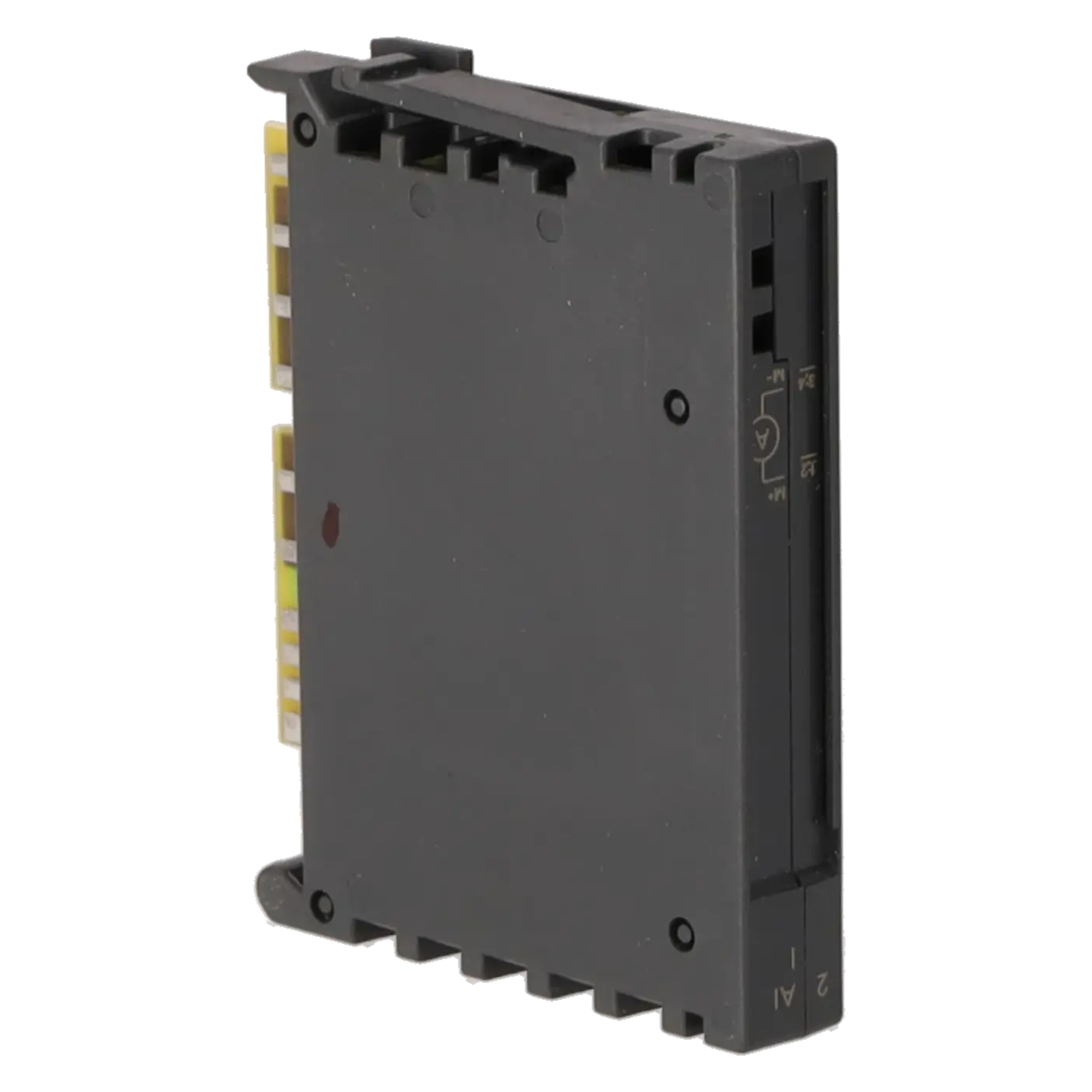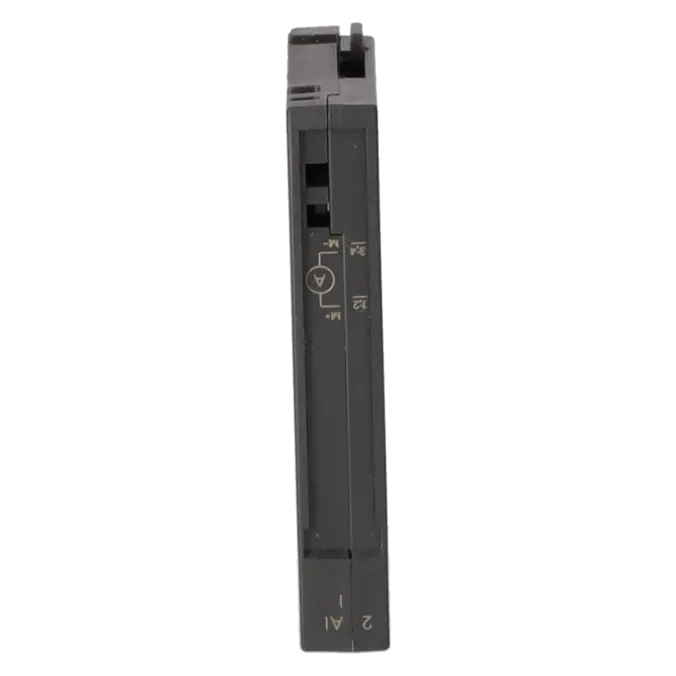
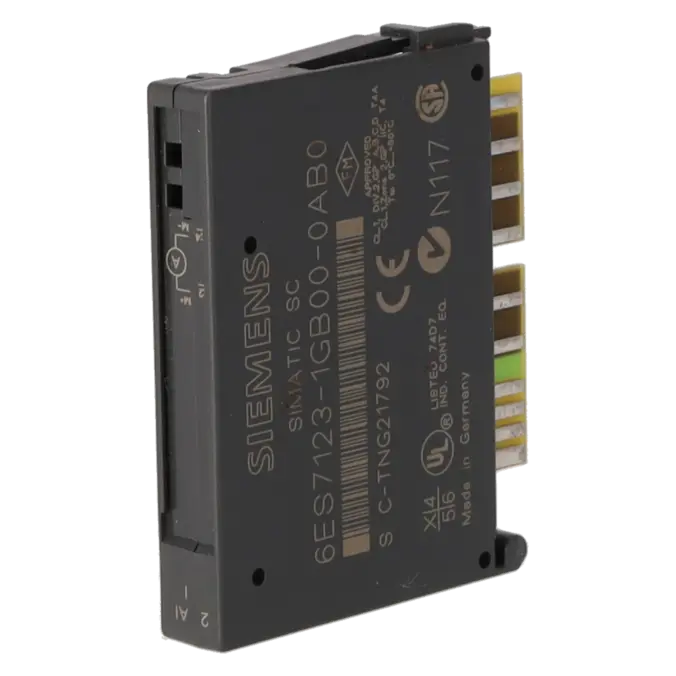
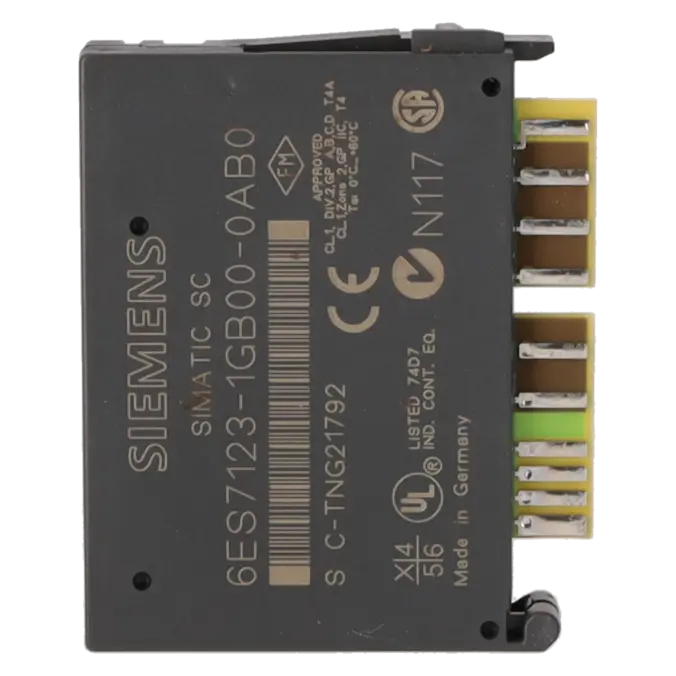
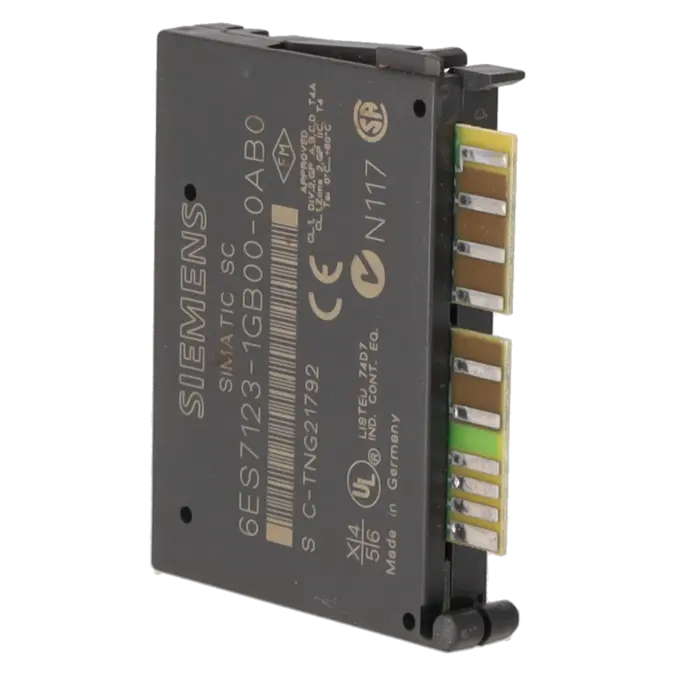
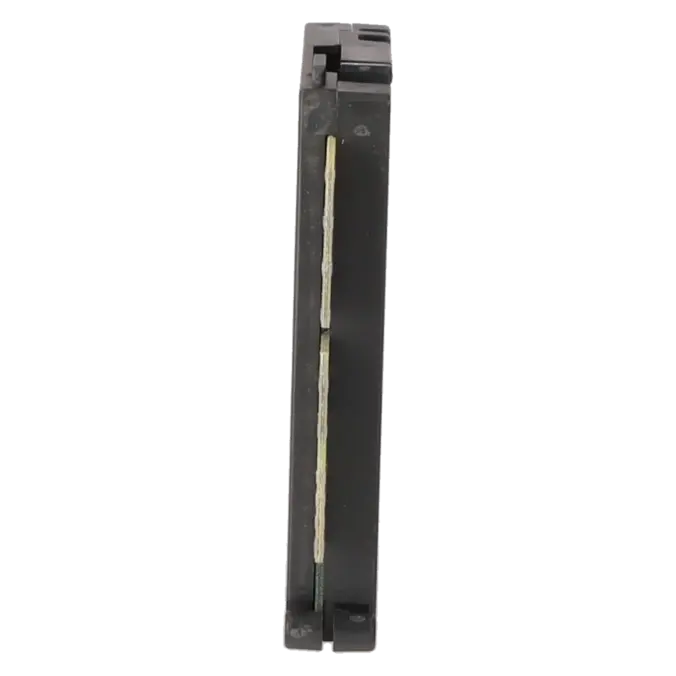
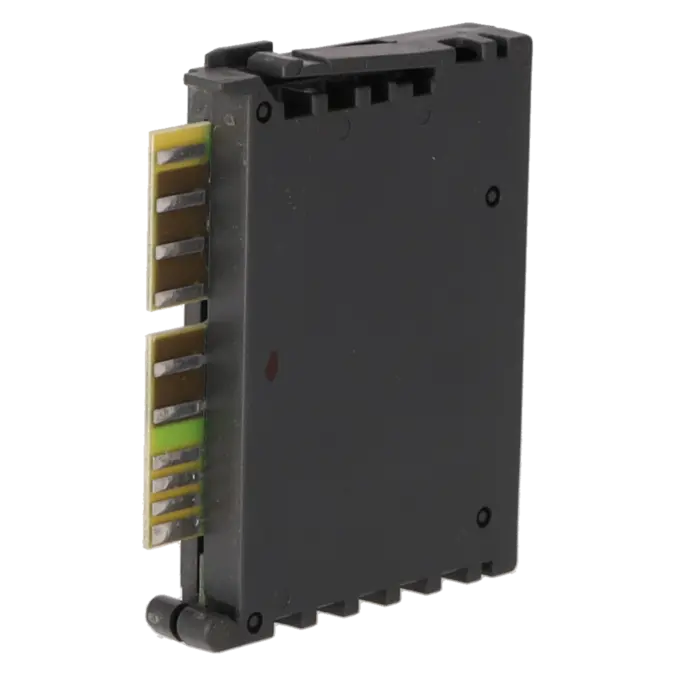
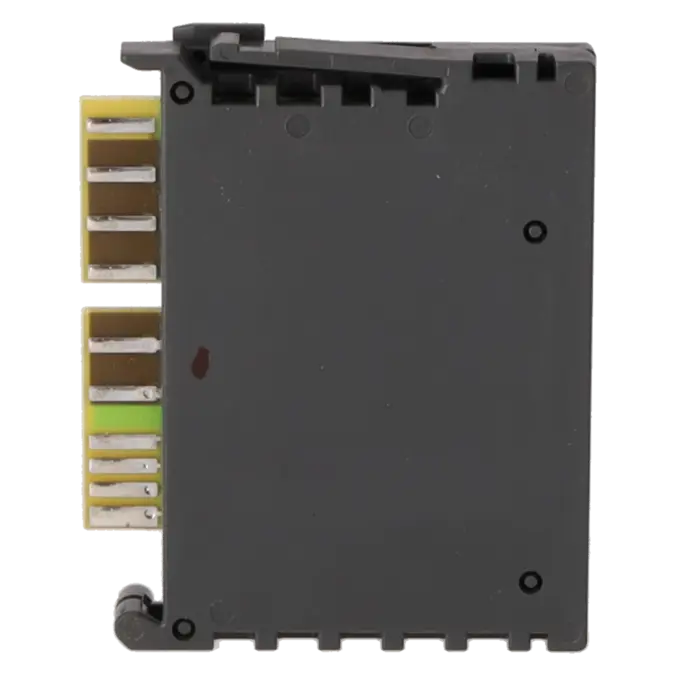
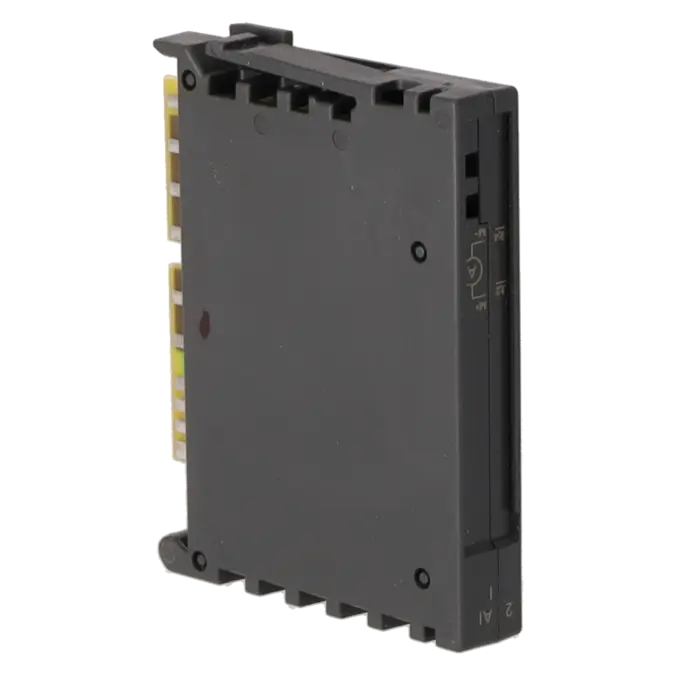
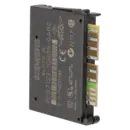
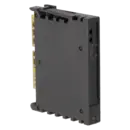
SIEMENS 6ES7123-1GB00-0AB0
- EICHLER-art.no.: K0118039
- EAN: 4025515057796
Product description
SIMATIC SC,ELECTRONIC SUBMODULE 2 AI, 4..20MA, +/-20MA
Services for SIEMENS 6ES7123-1GB00-0AB0
SIEMENS |
6ES7123-1GB00-0AB0 –
additional product information
| Delivery information | |||
|---|---|---|---|
| Export identifier | AL: ECCN: | ||
| Net weight | 0.025 | ||
| Quantity | 1 Stück | ||
| Packaging quantity | 1 | ||
| Additional product information | |||
|---|---|---|---|
| Product status | EOP: 2006-10-01 | ||
| EAN | 4025515057796 | ||
| UPC | / | ||
| Static lot number | 85389091 | ||
| List indicator | / | ||
| Product group | 4467 | ||
| Country of origin | DE | ||
| Compliance with the substance restrictions according to RoHS directive | Since: / | ||
| Product classifications | Version | Classification | |
|---|---|---|---|
| eClass | 4 | / | |
| eClass | 5.1 | / | |
| eClass | 6.0 | / | |
| ETIM | 3 | / | |
| ETIM | 4 | / | |
| ETIM | 5 | / | |
What is 6ES7214-1AD23-0XB0 and where is it used?
The 6ES7214-1AD23-0XB0 is a SIMATIC S7-200 CPU 224 from Siemens in a compact design. The system operates on 24 V DC and combines 14 digital inputs and 10 digital transistor outputs within a single CPU. This makes it particularly suitable for compact machine and system control applications requiring robust standard logic, fast digital signal processing and moderate expandability. Typical applications include legacy systems where existing S7-200 architectures, PPI communication networks or installed peripheral equipment are to be retained. For operators of older machinery, this CPU is often not only a spare part but a key component for restoring system availability quickly.
Overview of the key technical data and what it means
The CPU operates on 24 V DC with a permissible voltage range of 20.4 to 28.8 V. It provides 12 kB of program memory, or 8 kB when Run-Time Edit is active, together with 8 kB of data memory. The 10 digital outputs are transistor outputs, making them suitable for fast switching applications. In addition, the CPU includes 2 pulse outputs up to 20 kHz and 6 high-speed counters up to 30 kHz, which is particularly useful for counting, timing and basic positioning tasks. Via the integrated RS-485 interface, the CPU supports PPI, MPI slave operation and free programmable serial communication. The unit can be expanded with up to seven S7-22x expansion modules. For control cabinet design, important specifications include IP20 protection, dimensions of 120.5 × 80 × 62 mm, and an operating temperature range up to 55°C in a horizontal mounting position.
Product status, life-cycle status and obsolescence
The life-cycle status of this order number is clearly defined. Siemens lists the 6ES7214-1AD23-0XB0 as a spare part, while the product has been marked Product Cancellation / EOP since 01 October 2017. For operators of existing machines, this means that the CPU remains relevant for maintenance and spare-parts support but is considered a discontinued product from the manufacturer's perspective. For new installations, Siemens recommends the SIMATIC S7-1200 as the successor platform to the S7-200 family. However, no fully documented 1:1 successor for this exact MLFB could be verified. Any modernisation project should therefore be regarded as a migration rather than a simple hardware replacement, particularly because of differences in communication interfaces and engineering software.
Available EICHLER services and when they are relevant
For the 6ES7214-1AD23-0XB0, EICHLER offers several practical options to minimise production downtime: repair, exchange, used equipment and new units on request. Repair is particularly suitable when the original CPU should remain in service and a cost-effective refurbishment is preferred. According to EICHLER, the repair process includes technical cleaning, preventive maintenance, comprehensive functional testing and a minimum 24-month warranty. Exchange services are the preferred solution in cases of urgent downtime because they provide a faster route back into operation. Used units can be attractive when availability and budget are the primary considerations. For decision-makers, these services are especially valuable because they help maintain spare-parts availability even after the manufacturer has discontinued the product line.
| Attribute | Value |
|---|---|
| Usable terminal block | TB 16SC |
| Supply voltage | |
| Rated value (DC) | 24 V |
| Reverse polarity protection | Yes |
| Input current | |
| from supply voltage L+, max. | 30 mA |
| Power loss | |
| Power loss, typ. | 0.6 W |
| Hardware configuration | |
| Slots | |
| ● required slots | 1; from 8 |
| Analog inputs | |
| Number of analog inputs | 2 |
| permissible input current for current input (destruction limit), max. | 40 mA; Permanent |
| Input ranges | |
| ● Current | Yes |
| Input ranges (rated values), currents | |
| ● -20 mA to +20 mA | Yes |
| — Input resistance (-20 mA to +20 mA) | 50 Ω |
| ● 4 mA to 20 mA | Yes |
| — Input resistance (4 mA to 20 mA) | 50 Ω |
| Thermocouple (TC) | |
| Temperature compensation | |
| — parameterizable | No |
| Characteristic linearization | |
| ● parameterizable | No |
| Cable length | |
| ● shielded, max. | 200 m |
| Analog value generation for the inputs | |
| Measurement principle | integrating |
| Integration and conversion time/resolution per channel | |
| ● Resolution (incl. overrange) | ±20 mA: 13 bit, 4 to 20 mA: 12 bit |
| ● Resolution with overrange (bit including sign), max. | 13 bit |
| ● Integration time, parameterizable | Yes |
| ● Basic conversion time (ms) | 55 / 65 ms |
| ● Integration time (ms) | 50 / 60 ms |
| ● Interference voltage suppression for interference frequency f1 in Hz | 50 / 60 Hz |
| Smoothing of measured values | |
| ● parameterizable | Yes; parameterizable in 4 stages by means of digital filtering |
| ● Step: None | Yes; 1x cycle time |
| ● Step: low | Yes; 8x cycle time |
| ● Step: Medium | Yes; 64x cycle time |
| ● Step: High | Yes; 128x cycle time |
| Encoder | |
| Connection of signal encoders | |
| ● for voltage measurement as 2-wire transducer | Yes; 4-wire transformer with external transmitter feed |
| ● for current measurement as 2-wire transducer | Yes; with external transmitter supply |
| ● for current measurement as 4-wire transducer | Yes |
| Errors/accuracies | |
| Linearity error (relative to input range), (+/-) | 0.05 % |
| Temperature error (relative to input range), (+/-) | 0.01 %/K |
| Crosstalk between the inputs, min. | 50 dB; At 50/60 Hz |
| Repeat accuracy in steady state at 25 °C (relative to input range), (+/-) | 0.1 % |
| Operational error limit in overall temperature range | |
| ● Current, relative to input range, (+/-) | 1 % |
| Basic error limit (operational limit at 25 °C) | |
| ● Current, relative to input range, (+/-) | 0.8 % |
| Interference voltage suppression for f = n x (f1 +/- 1 %), f1 = interference frequency | |
| ● Series mode interference (peak value of interference < rated value of input range), min. | 70 dB |
| ● Common mode interference (USS < 2.5 V), min. | 90 dB |
| Interrupts/diagnostics/status information | |
| Alarms | No |
| Diagnostics function | No |
| Potential separation | |
| Potential separation analog inputs | |
| ● between the channels | No |
| ● between the channels and backplane bus | No; Optocoupler |
| ● between the channels and the power supply of the electronics | No |
| Permissible potential difference | |
| Between the inputs and MANA (UCM) | 2 V DC / 2 Vpp AC |
| Isolation | |
| Isolation tested with | 1 500 V AC |
| Dimensions | |
| Width | 10 mm |
| Height | 64 mm |
| Depth | 51 mm |
| Weights | |
| Weight, approx. | 20 g |
| Fault description | Possible solution |
|---|---|
| Why is the SF/DIAG LED on my S7-200 CPU 224 red and the CPU remains in STOP? | In the event of a serious fault, the S7-200 stops program execution, switches on the SF/DIAG and STOP LEDs, and places the outputs into a safe state. First check whether the CPU can still be diagnosed using STEP 7-Micro/WIN. Then verify the supply voltage, wiring, expansion modules and any recently changed program or hardware configurations. If the CPU is no longer accessible during the fault condition but operates again after a power cycle, a hardware defect within the CPU may be the cause. |
| Why can't STEP 7-Micro/WIN establish a connection to the CPU 224 via PPI? | Check the adapter type, COM port, baud rate and configured PG/PC interface. On the CPU 224, the communication port may be configured in a way that prevents access by STEP 7-Micro/WIN. Siemens specifically notes that Port 0 cannot be used simultaneously for Micro/WIN access when operating as a Modbus slave. In such cases, placing the CPU in STOP mode or reinitialising the interface for PPI communication can help. When using older adapters, also verify that a compatible Multi-Master or USB/PPI cable is being used. |
| Why are expansion modules on my S7-200 CPU 224 not recognised or no longer controlled? | During startup, the CPU reads the I/O configuration of all expansion modules and compares it with the actual hardware configuration during operation. If a discrepancy is detected, the CPU generates a configuration error and stops reading from or writing to the affected module until the configuration matches again. Therefore, check the module type, module order, correct seating of all expansion modules, the module power supply and whether only approved S7-22x series expansion modules are installed within the specified system limits. |
| Why does my CPU 224 lose retentive data or startup values after power-off? | The user program is stored permanently in the integrated EEPROM, but current data, retentive markers, timers and counters are retained only for a limited period by the internal high-performance capacitor or, optionally, by a battery module. Without the optional battery, the retention period is significantly shorter; with a battery module installed, it is considerably extended. Check whether the required data areas have actually been configured as retentive and whether an optional battery module is installed and functioning correctly. |
| Why does my S7-200 CPU 224 switch to STOP at low temperatures and run normally again after warming up? | If the CPU only enters STOP mode at low temperatures and operates normally again once warmed up, this typically indicates an age-related hardware or contact problem. First verify that the specified environmental conditions are being maintained and check for condensation, loose terminals or power supply issues. If the behaviour can be reproduced consistently as a function of temperature, repair or replacement of the CPU is usually more effective than software-based troubleshooting. |
Which software do I need for 6ES7214-1AD23-0XB0?
For the S7-200 CPU 224, the standard engineering software is STEP 7-Micro/WIN 4.0. Siemens explicitly references the S7-200 System Manual for STEP 7-Micro/WIN Version 4.0. In more recent Siemens application examples covering communication between S7-200 and S7-1200 systems, the installation of Service Pack 7 for STEP 7-Micro/WIN is also recommended. For maintaining existing installations, Micro/WIN 4.0 remains the primary engineering environment. In mixed-system environments or migration projects, however, the software version should be checked carefully to ensure compatibility.
Is 6ES7214-1AD23-0XB0 still available or already discontinued?
From the manufacturer's perspective, the CPU has been discontinued. Siemens classifies the order number as a Spare Part and identifies 01 October 2017 as the product discontinuation date. From a practical procurement perspective, however, the CPU remains relevant because EICHLER offers repair, exchange, used units and new units on request. For purchasing and maintenance departments, this means that factory-new manufacturer supply is no longer the standard route, but availability can still be maintained through service solutions, exchange programmes and tested used inventory.
Can I directly replace 6ES7214-1AD23-0XB0 with an S7-1200?
Not as a simple plug-and-play replacement. Siemens identifies the S7-1200 as the successor platform to the S7-200 family, but the migration documentation highlights significant differences in hardware, communication and engineering. The S7-200 typically uses RS-485/PPI communication, whereas the S7-1200 includes an integrated PROFINET interface. There are also differences in engineering tools, programming concepts and system functions. As a result, a modernisation project should be treated as a planned migration in which the I/O structure, communication interfaces, HMI integration and application software are thoroughly reviewed.
What communication and expansion options does the CPU 224 offer?
The CPU includes an integrated RS-485 interface and supports PPI, MPI slave operation and free programmable serial communication using ASCII protocols. It can also be expanded for PROFIBUS-DP communication. The CPU supports up to seven expansion modules, and Siemens specifies that only modules from the S7-22x series may be used. Depending on the application, additional digital or analogue signals can therefore be integrated without immediately replacing the existing control architecture. For legacy installations, this is a significant advantage when existing field wiring and communication structures need to be retained.
When is repair more economical than replacement?
Repair is often the preferred option when the existing CPU should remain in service, the fault can clearly be attributed to the hardware itself and a cost-effective refurbishment is sufficient. EICHLER combines its repair service with technical cleaning, preventive maintenance, comprehensive functional testing and a minimum 24-month warranty. Replacement is generally the better option when the machine must return to operation as quickly as possible and the cost of downtime exceeds the difference between repair and exchange solutions. Because the product family has already been discontinued, a structured repair or exchange strategy also helps reduce long-term obsolescence risks within the installed machine base.