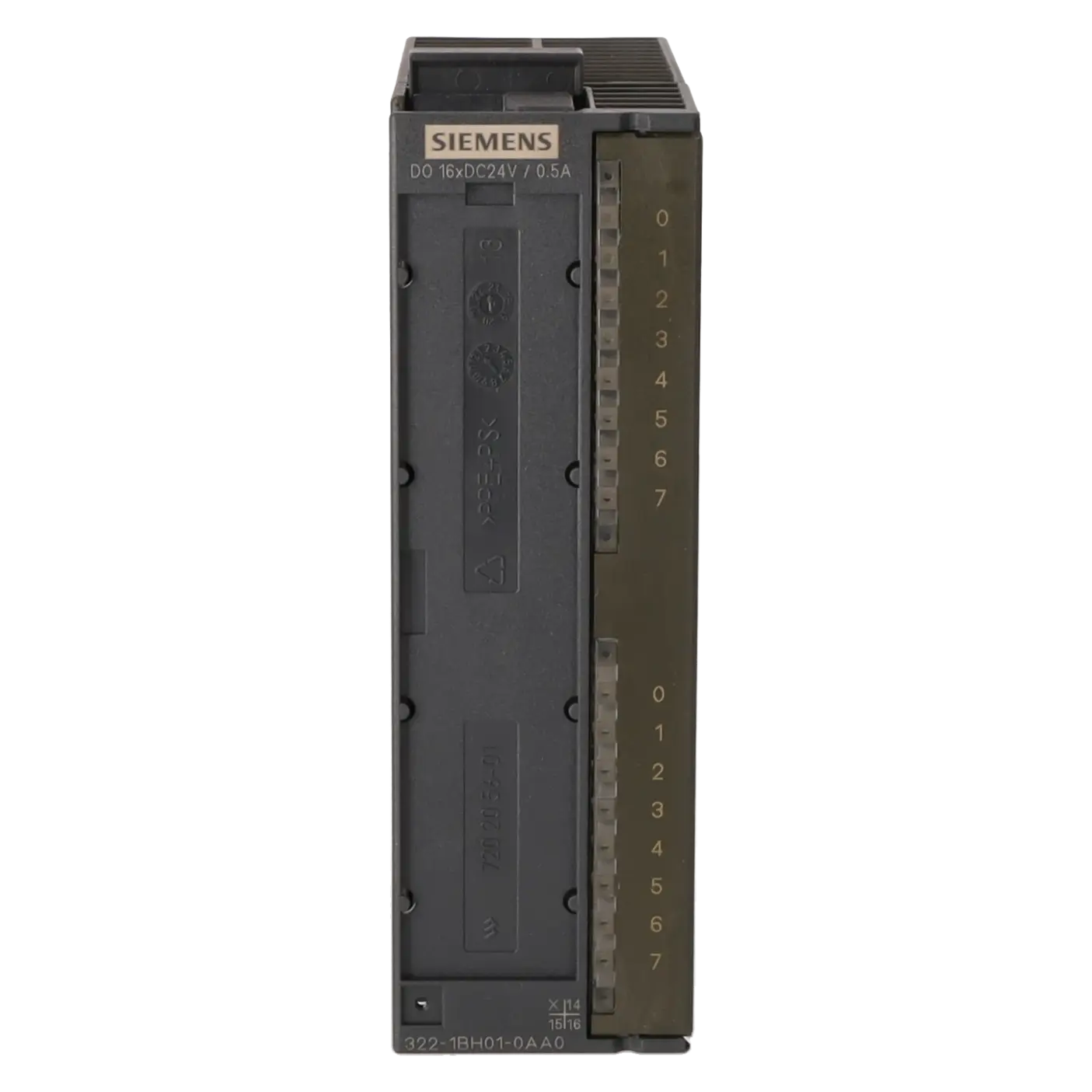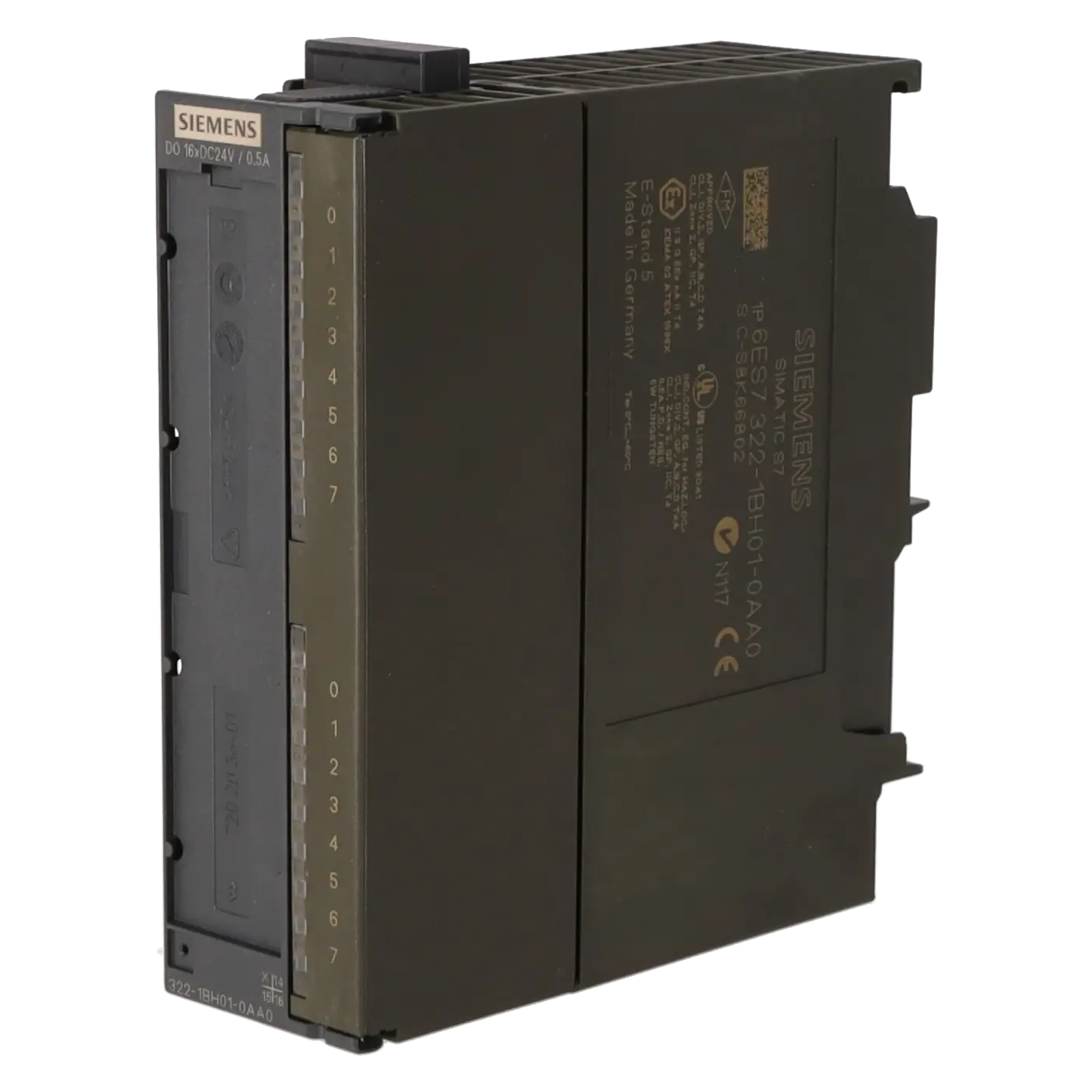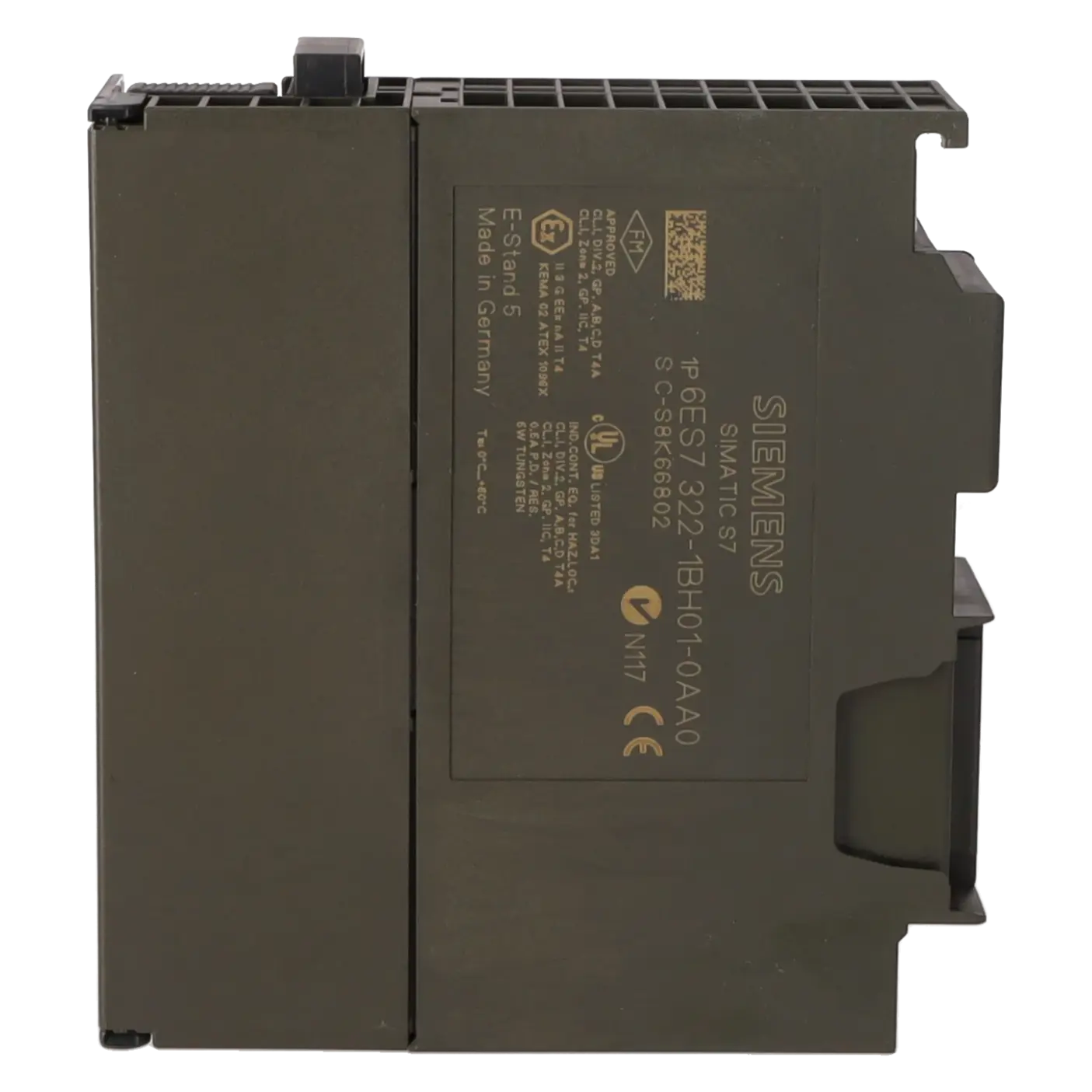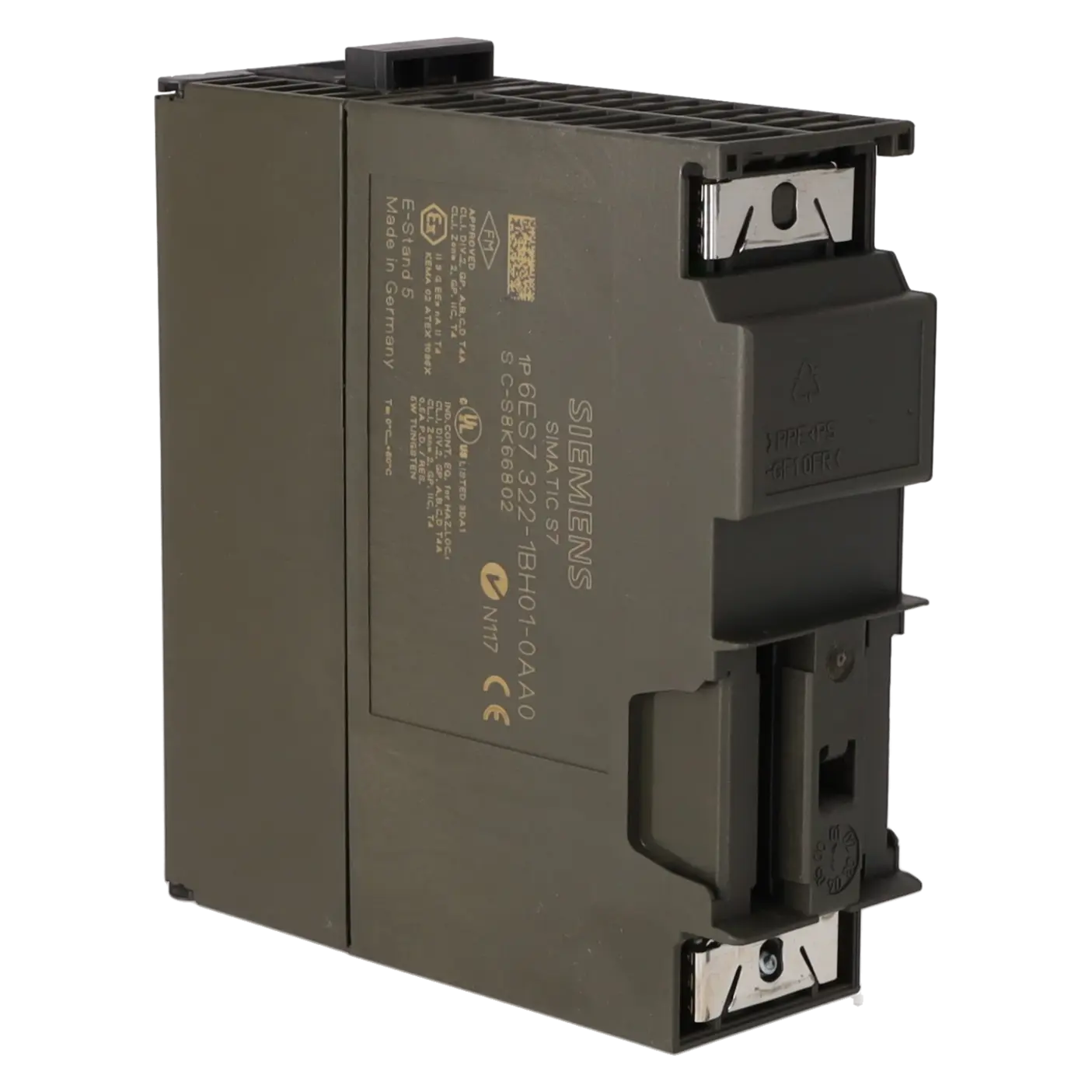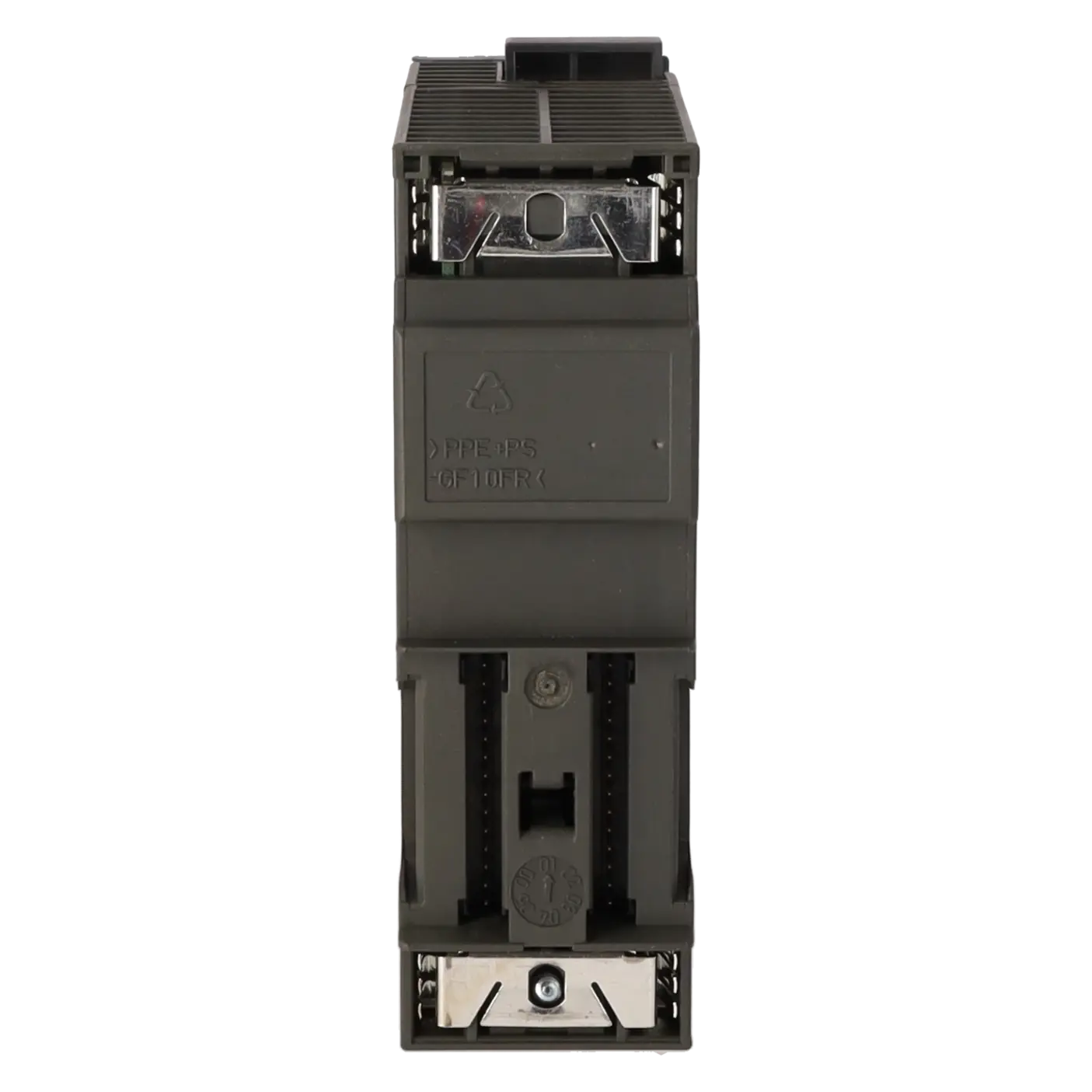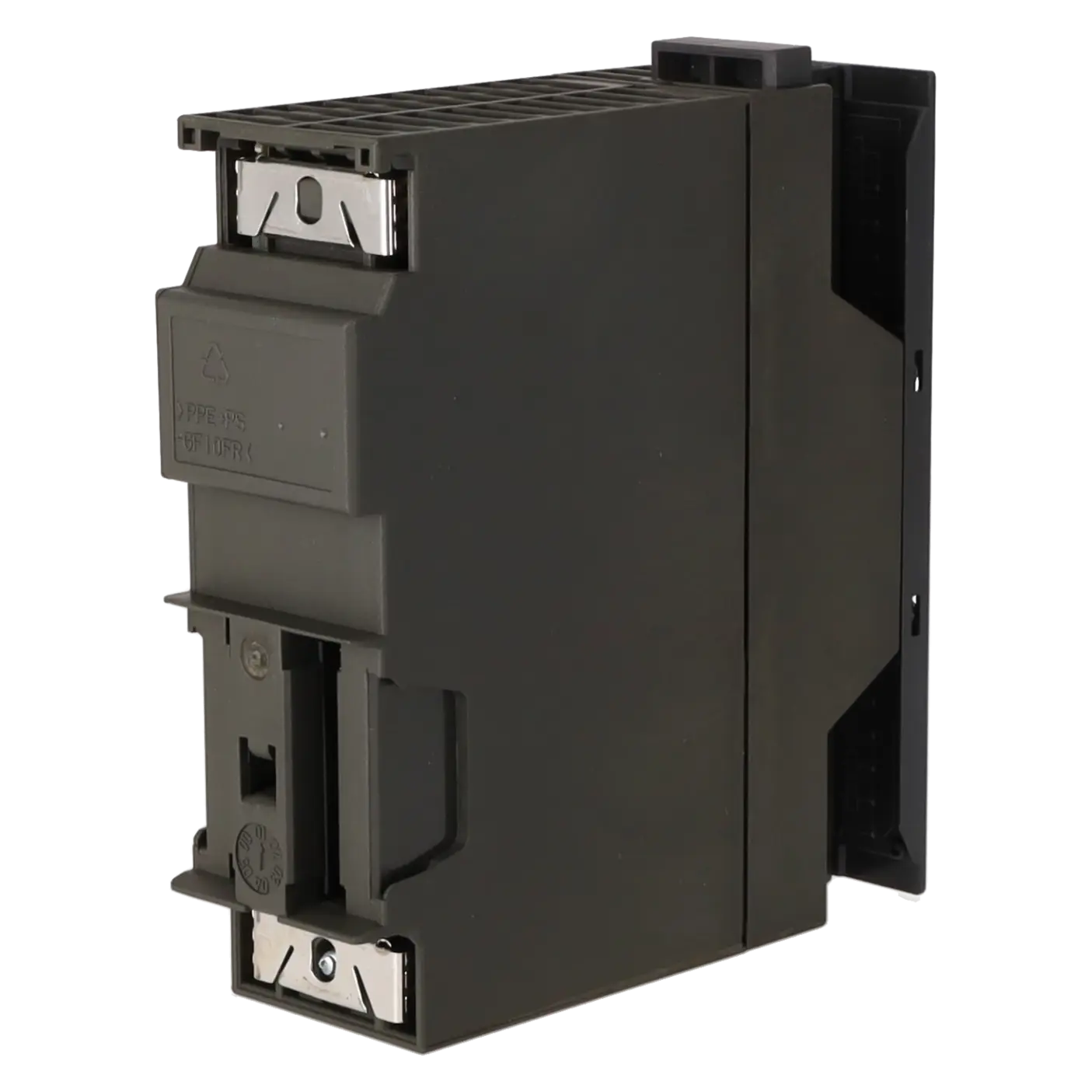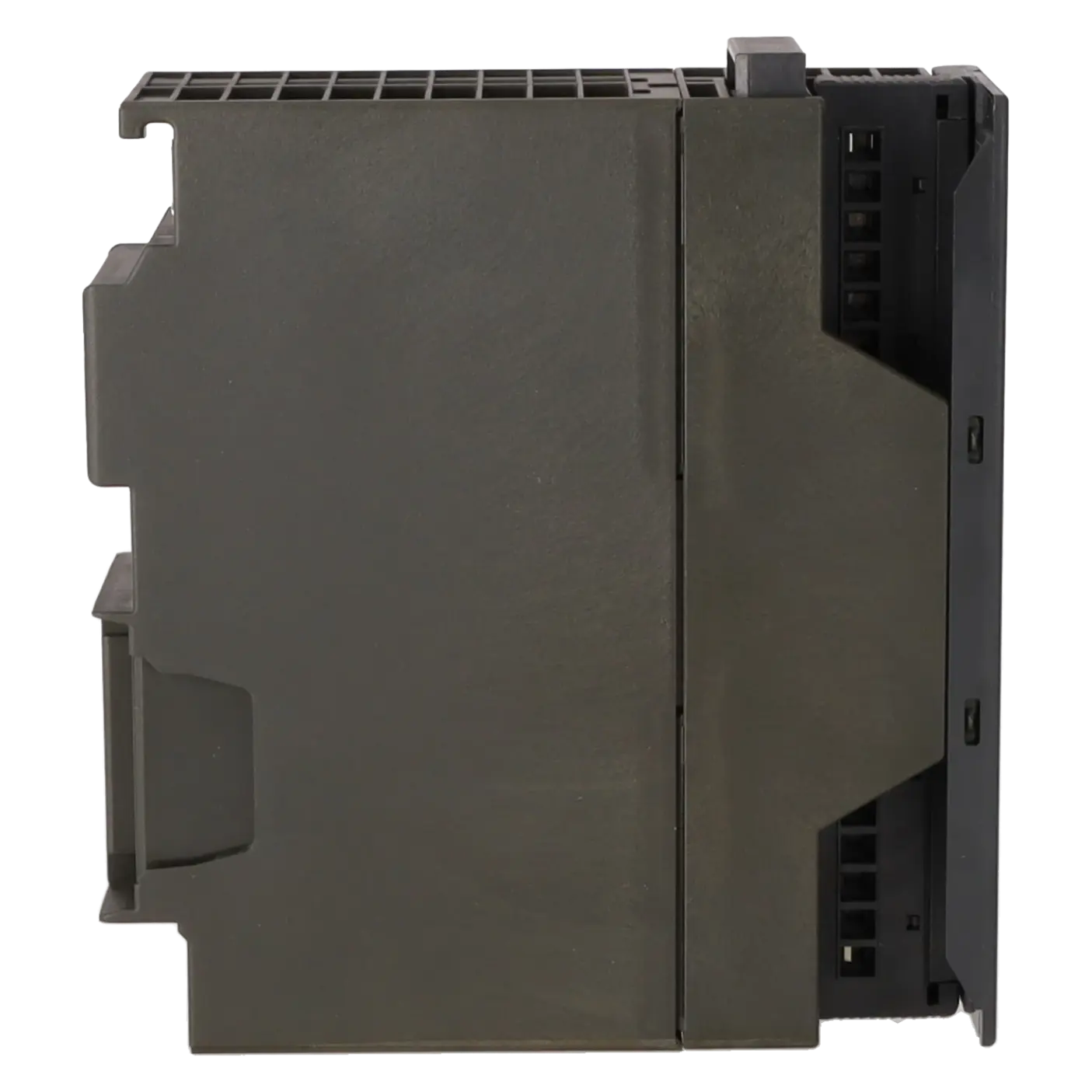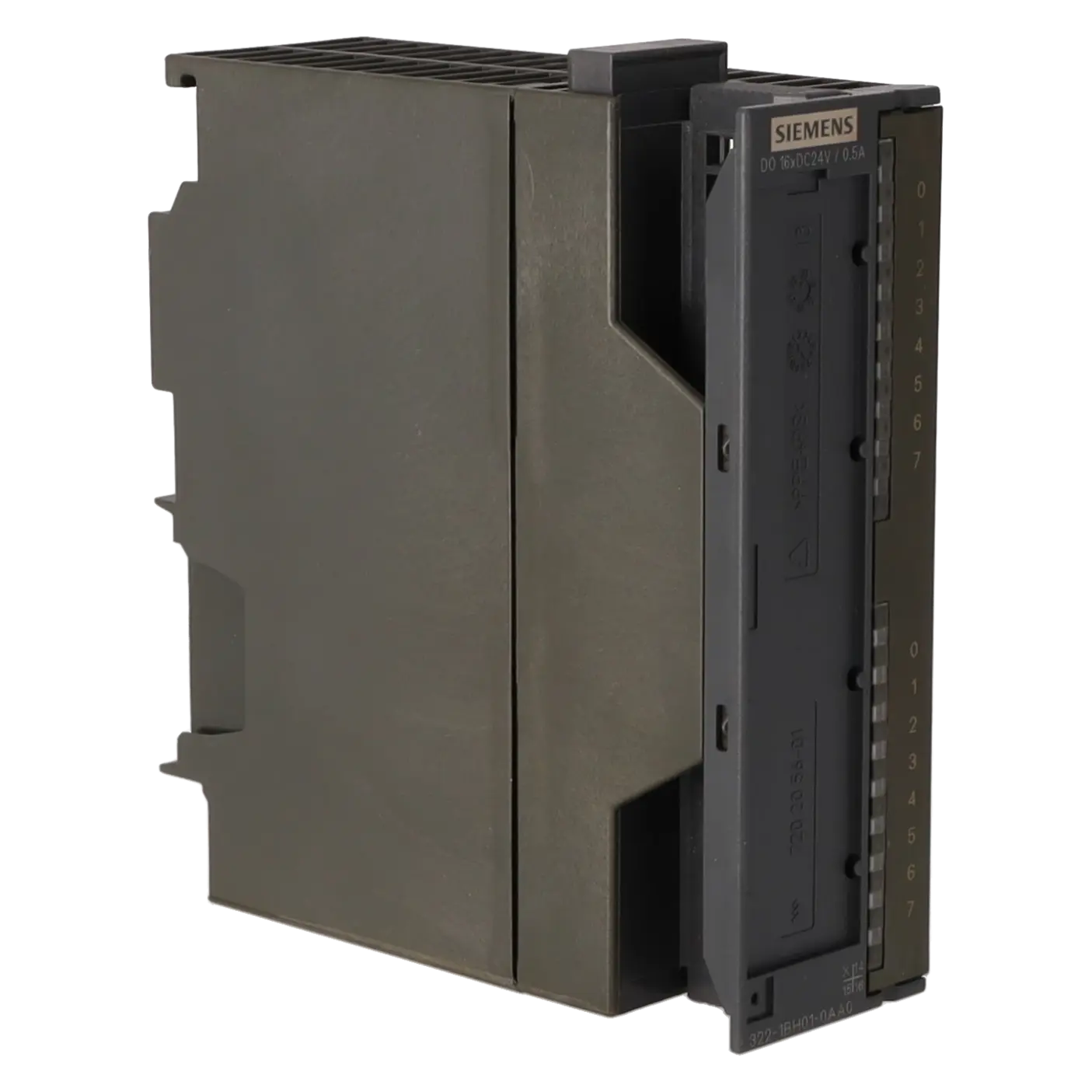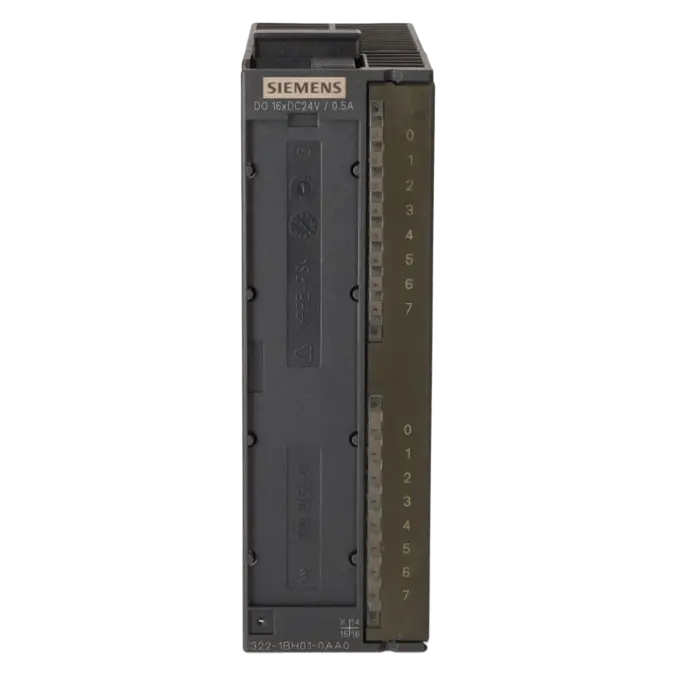
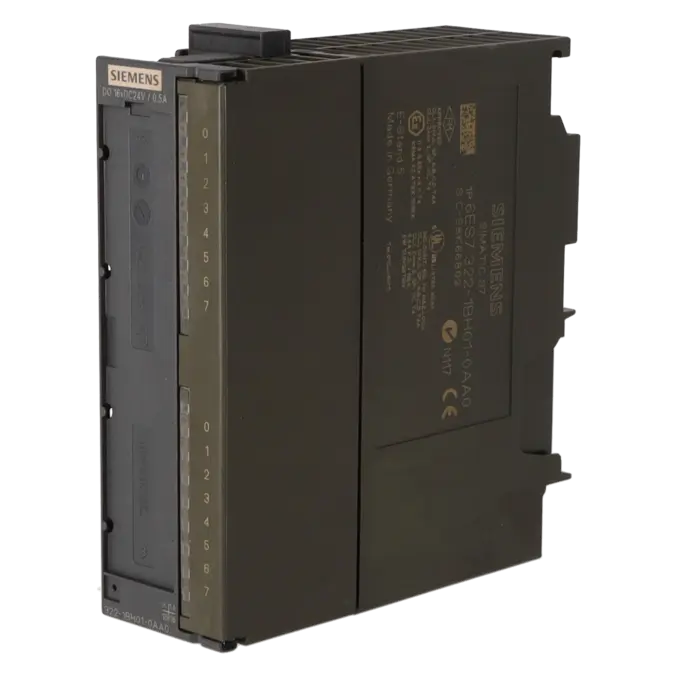
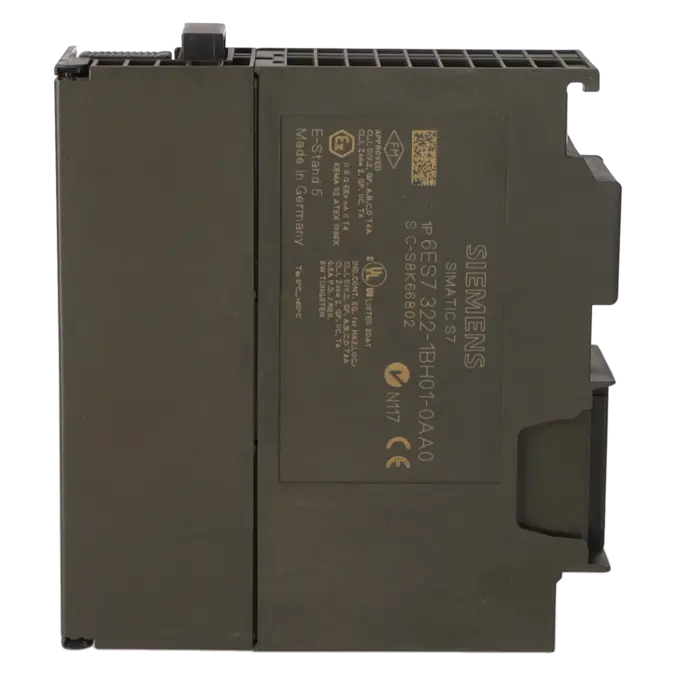
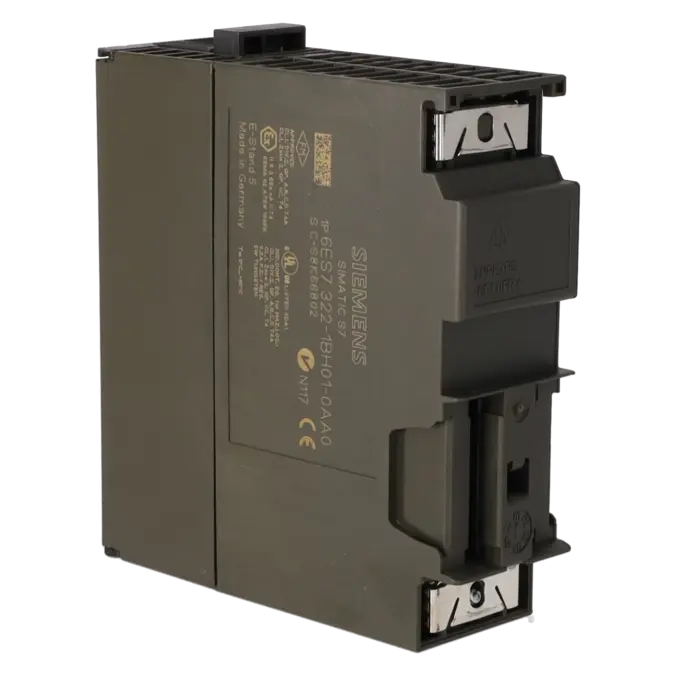
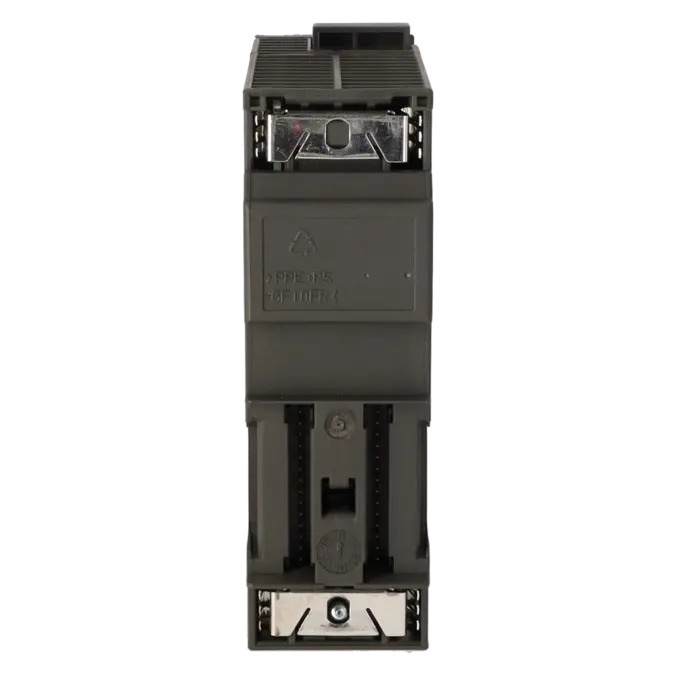
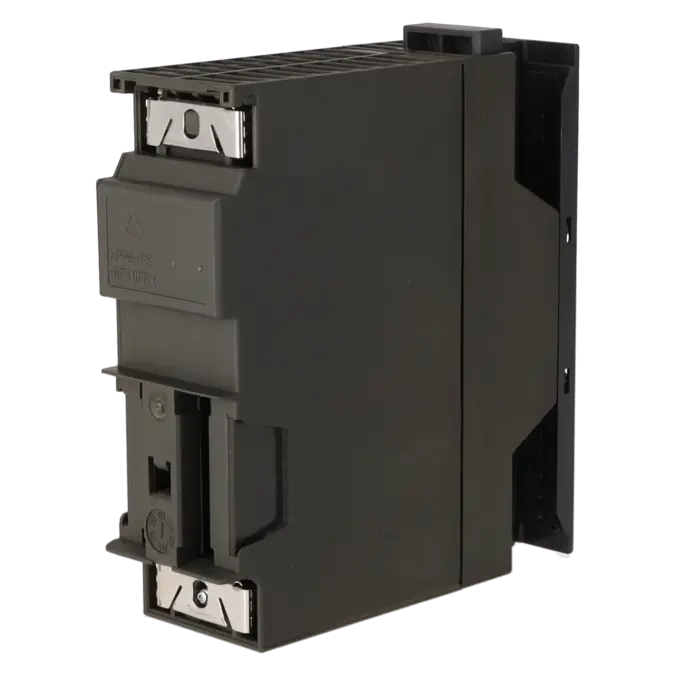
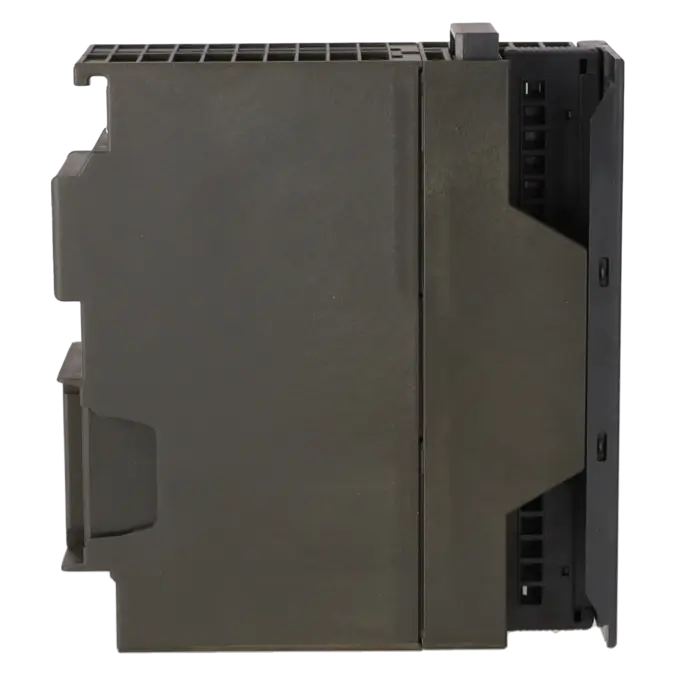
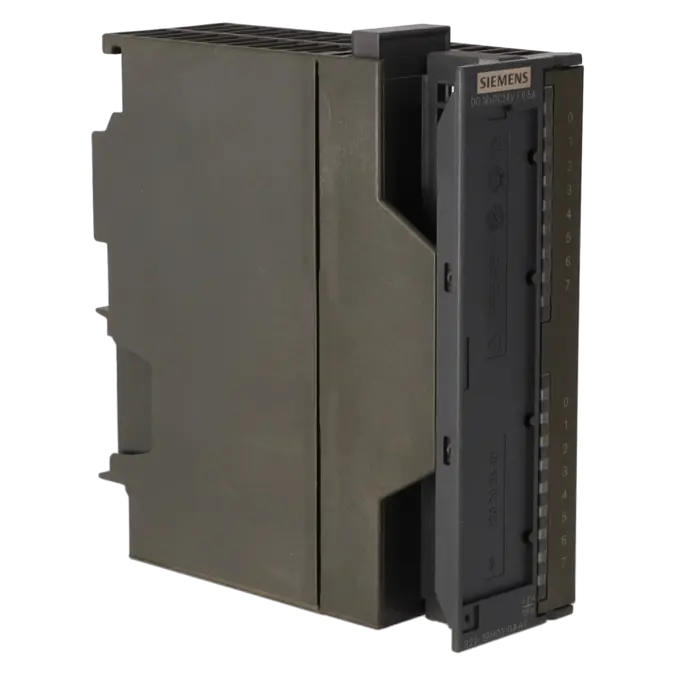
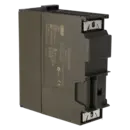
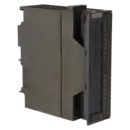
SIEMENS 6ES7322-1BH01-0AA0
- EICHLER-art.no.: K0118542
- EAN: 4025515060918
- UPC: 040892560640
Product description
SIMATIC S7-300, DIGITAL OUTPUT SM 322, ISOLATED, 16 DO, 24 V DC, 0.5A, 1X 20-POLE, TOTAL CURRENT 4 A/GROUP (8 A/MODULE)
Services for SIEMENS 6ES7322-1BH01-0AA0
Repair
from 249,61 €
to 449,29 €
Replacement
338,59 €
253,94 €
Used
376,20 €
282,15 €
New
418,00 €
313,50 €
SIEMENS |
6ES7322-1BH01-0AA0 –
additional product information
| Delivery information | |||
|---|---|---|---|
| Export identifier | AL: N ECCN: EAR99H | ||
| Net weight | 0.244 | ||
| Quantity | 1 Stück | ||
| Packaging quantity | 1 | ||
| Additional product information | |||
|---|---|---|---|
| Product status | EOP: 2025-10-01 | ||
| EAN | 4025515060918 | ||
| UPC | 040892560640 | ||
| Static lot number | 85389091 | ||
| List indicator | ST73 | ||
| Product group | 4561 | ||
| Country of origin | DE | ||
| Compliance with the substance restrictions according to RoHS directive | Since: 20080331 | ||
| Product classifications | Version | Classification | |
|---|---|---|---|
| eClass | 4 | 27-24-03-04 | |
| eClass | 5.1 | 27-24-22-04 | |
| eClass | 6.0 | 27-24-22-04 | |
| ETIM | 3 | / | |
| ETIM | 4 | EC001419 | |
| ETIM | 5 | EC001419 | |
What is the 6ES7322-1BH01-0AA0 and where is it used?
The 6ES7322-1BH01-0AA0 is a SIMATIC S7-300 SM 322 digital output assembly from Siemens. The module provides 16 digital 24 V DC outputs with 0.5 A per channel and features galvanic isolation. It is used in S7-300 control systems wherever actuators such as solenoid valves, DC contactors or signal lamps need to be switched reliably. Typical applications include packaging machinery, conveyor systems, manufacturing plants, test rigs and retrofit projects where existing S7-300 architectures continue to be operated. For maintenance and procurement teams, the assembly is particularly relevant when an existing module must be identified 1:1, replaced at short notice or repaired economically. Siemens currently classifies the module as a spare part.
Overview of the key technical data and what it means
The assembly operates with a 24 V DC load voltage (L+) and permits a voltage range of 20.4 to 28.8 V DC. Each of the 16 outputs provides a nominal current of 0.5 A, with a permissible operating range of 5 mA to 0.6 A per output. Important for engineering is the total current limit of 4 A per group and 8 A per module. The outputs are arranged in two galvanically isolated groups of eight channels, utilise a 20-pin front connector and feature green status LEDs for each channel. Equally important in practice is that resistive loads may be switched at up to 100 Hz, while inductive loads are limited to 0.5 Hz. Permissible cable lengths are 600 m unscreened and 1,000 m screened. These specifications are important when selecting loads, designing wiring and determining installation conditions.
Product status, life-cycle status and obsolescence
Siemens classifies the 6ES7322-1BH01-0AA0 as a spare part and identifies its lifecycle status as PM410: Product Cancellation. According to Siemens, the product has been discontinued since 01 October 2025. For operators of existing systems, this means that the assembly remains relevant for installed equipment, but supply should be actively secured through tested replacement units, repair services, spare-parts stockholding or migration planning. Siemens does not identify a direct plug-compatible 1:1 successor on the product page itself. However, within the official Siemens migration guide for moving from S7-300/S7-400 to S7-1500, the modules 6ES7522-1BH01-0AA0 and 6ES7522-1BH00-0AB0 are listed as migration options. These represent a technical migration path rather than a universal plug-and-play replacement without engineering and hardware validation.
Available EICHLER services and when they are relevant for the target audience
For the 6ES7322-1BH01-0AA0, EICHLER offers several practical options to ensure operational continuity. Repair is particularly suitable when the existing assembly should be retained from both a system and version perspective and where maintaining the current installation is more economical than migration. Exchange service is the preferred option during critical downtime situations because it enables a faster return to operation. Used and new units are relevant when procurement and maintenance departments need to balance budget, availability and equipment condition. According to the product page status of 28 May 2026, EICHLER offers repair within 2–5 days, while exchange, used and new units are available within 1–3 days. Repair services include technical cleaning, preventive maintenance, comprehensive functional testing and a minimum 24-month warranty.
EICHLER services with regard to obsolescence and operational reliability
Particularly for a discontinued S7-300 assembly, the key issue is not only obtaining a replacement but also ensuring that the installation can be returned to stable operation quickly while managing obsolescence risks. An exchange unit helps minimise downtime when every hour of lost production is costly. Repair is particularly valuable when the existing hardware architecture should remain unchanged and the module is still required in the field. Used equipment can be a practical choice for planned spare-parts stockholding, while new equipment is often preferred where equipment condition and documentation are priorities. EICHLER also offers an optional digital input/output test report, which can be valuable for maintenance teams and decision-makers when documented proof of functionality is required for recommissioning, quality assurance or internal approval processes.
| Attribute | Value |
|---|---|
| Supply voltage | |
| Load voltage L+ | |
| ● Rated value (DC) | 24 V |
| ● permissible range, lower limit (DC) | 20.4 V |
| ● permissible range, upper limit (DC) | 28.8 V |
| Input current | |
| from load voltage L+ (without load), max. | 80 mA |
| from backplane bus 5 V DC, max. | 80 mA |
| Power loss | |
| Power loss, typ. | 4.9 W |
| Digital outputs | |
| Number of digital outputs | 16 |
| Short-circuit protection | Yes; Electronic |
| ● Response threshold, typ. | 1 A |
| Limitation of inductive shutdown voltage to | L+ (-53 V) |
| Controlling a digital input | Yes |
| Switching capacity of the outputs | |
| ● on lamp load, max. | 5 W |
| Load resistance range | |
| ● lower limit | 48 Ω |
| ● upper limit | 4 kΩ |
| Output voltage | |
| ● for signal "1", min. | L+ (-0.8 V) |
| Output current | |
| ● for signal "1" rated value | 0.5 A |
| ● for signal "1" permissible range for 0 to 40 °C, min. | 5 mA |
| ● for signal "1" permissible range for 0 to 40 °C, max. | 0.6 A |
| ● for signal "1" permissible range for 40 to 60 °C, min. | 5 mA |
| ● for signal "1" permissible range for 40 to 60 °C, max. | 0.6 A |
| ● for signal "1" minimum load current | 5 mA |
| ● for signal "0" residual current, max. | 0.5 mA |
| Output delay with resistive load | |
| ● "0" to "1", max. | 100 µs |
| ● "1" to "0", max. | 500 µs |
| Parallel switching of two outputs | |
| ● for uprating | No |
| ● for redundant control of a load | Yes |
| Switching frequency | |
| ● with resistive load, max. | 100 Hz |
| ● with inductive load, max. | 0.5 Hz |
| ● with inductive load (acc. to IEC 60947-5-1, DC13), max. | 0.5 Hz |
| ● on lamp load, max. | 10 Hz |
| Total current of the outputs (per group) | |
| horizontal installation | |
| — up to 40 °C, max. | 4 A |
| — up to 60 °C, max. | 3 A |
| vertical installation | |
| — up to 40 °C, max. | 2 A |
| Cable length | |
| ● shielded, max. | 1 000 m |
| ● unshielded, max. | 600 m |
| Interrupts/diagnostics/status information | |
| Alarms | No |
| Diagnostics function | No |
| Alarms | |
| ● Diagnostic alarm | No |
| Diagnoses | |
| ● Wire break | No |
| ● Short-circuit | No |
| ● Fuse blown | No |
| ● missing load voltage | No |
| Diagnostics indication LED | |
| ● Rated load voltage PWR (green) | No |
| ● Fuse OK FSG (green) | No |
| ● Status indicator digital output (green) | Yes |
| Potential separation | |
| Potential separation digital outputs | |
| ● between the channels | Yes |
| ● between the channels, in groups of | 8 |
| ● between the channels and backplane bus | Yes; Optocoupler |
| Isolation | |
| Isolation tested with | 500 V DC |
| Connection method | |
| required front connector | 20-pin |
| Dimensions | |
| Width | 40 mm |
| Height | 125 mm |
| Depth | 120 mm |
| Weights | |
| Weight, approx. | 190 g |
| Fault description | Possible solution |
|---|---|
| Why does the 6ES7322-1BH01-0AA0 not switch despite the output bit being set? | First check the external load supply of both output groups. On the SM 322, the field side must be supplied separately with 24 V DC; according to practical wiring examples, typical connection points are pins 1/10 and 11/20 for L+ and M. Also verify that the exact part number has been configured in the hardware configuration. If the load voltage is missing or the group is wired incorrectly, the actuator will remain inactive even though the output bit is correctly set. |
| Why is the output LED illuminated, but the valve, contactor or lamp does not switch? | In this case, the load type and load range should be checked. For a logic “1”, the module provides at least L+ minus 0.8 V at the output and is designed for 5 mA to 0.6 A per channel. The load resistance must be between 48 Ω and 4 kΩ, while lamp loads are specified up to 5 W. If the load falls outside these limits or there is no proper return path to M, the LED may indicate an active output while the field device does not operate reliably. |
| Why do the outputs switch on briefly when the 24 V supply is applied? | Siemens notes that when the 24 V supply is switched on via a mechanical contact, a short logic “1” pulse may occur at the outputs of this module. If this behaviour is critical for the application, the power supply design should be reviewed and the start-up behaviour measured under real load conditions before the module is released for production use again. |
| Why do solenoid valves or DC contactors repeatedly fail or switch unreliably? | Although the module is suitable for solenoid valves and DC contactors, inductive loads place significantly greater stress on the output stage. Siemens specifies a maximum switching frequency of only 0.5 Hz for inductive loads and recommends protective measures against inductive voltage spikes. Therefore, check for suitable flyback protection or suppression circuitry close to the load, verify the actual switching frequency and measure the actuator current consumption. These checks often help identify recurring failures and malfunctions on the field side. |
| Why do I not receive a diagnostic alarm even though an output is not functioning in the field? | With the 6ES7322-1BH01-0AA0, this behaviour is entirely expected. Siemens specifies no diagnostic functions, no diagnostic alarms, and no fault indication for wire breaks, short circuits, blown fuses or missing load voltage. Troubleshooting must therefore be carried out directly on the wiring, load supply, front connector and connected load. Consequently, the absence of an alarm on this module is not evidence that the field side is operating correctly. |
Is the 6ES7322-1BH01-0AA0 discontinued?
Yes. Siemens classifies the assembly as a spare part and assigns it the lifecycle status PM410: Product Cancellation, effective from 01 October 2025. For operators, this does not automatically mean that the module is unavailable, but procurement should no longer be regarded as guaranteed. According to the EICHLER product page, repair, exchange, used and new options were still available on 28 May 2026. For existing installations, it is therefore advisable to implement an active strategy covering spare-parts availability, repair capability and migration planning.
Is there a successor to the 6ES7322-1BH01-0AA0?
Siemens does not identify a direct plug-compatible 1:1 successor on the product page itself. However, within the official Siemens migration guide for moving from S7-300/S7-400 to S7-1500, the modules 6ES7522-1BH01-0AA0 and 6ES7522-1BH00-0AB0 are listed as suitable migration options for the function 16 DO, 24 V DC, 0.5 A. For procurement specialists and engineers, the important point is that this is a migration assignment, not a universal replacement without verification of the mechanical design, wiring, engineering configuration and system environment.
What is the difference between the 6ES7322-1BH01-0AA0, 6ES7322-1BH00-0AA0 and 6ES7322-1BH10-0AA0?
Within the PLC user community, the 1BH01 is generally described as the standard version, the 1BH00 as an older standard variant that was not intended for use with active bus modules, and the 1BH10 as the high-speed version with clock-synchronised behaviour. For the 6ES7322-1BH01-0AA0, Siemens explicitly states in the manual that Isochronous Mode is not supported. Therefore, when replacing or configuring an existing module, it is important not only to compare the channel count and voltage specifications but also to verify the exact MLFB part number and the intended engineering environment.
Which loads can the 6ES7322-1BH01-0AA0 switch directly?
According to Siemens, the assembly is suitable for solenoid valves, DC contactors and signal lamps. Each output provides 24 V DC with a nominal current of 0.5 A. Additional operating conditions apply: lamp loads up to 5 W, resistive loads up to 100 Hz, inductive loads up to 0.5 Hz, and a permissible load range of 48 Ω to 4 kΩ. In practice, this means that the module is well suited to conventional 24 V DC actuator applications, but the actual load characteristics should always be checked against the technical data and field wiring before replacement or redesign.
Can I connect two outputs in parallel?
Yes, but not for increasing current capacity. Siemens permits parallel connection only for the redundant control of a load and only within the same output group. The module is explicitly not designed for current sharing through parallel operation. If a load requires more current, it should instead be controlled via a suitable interposing relay, contactor or a properly dimensioned output module. This is particularly important in retrofit projects and troubleshooting situations, as incorrect parallel wiring can easily lead to misinterpretation during spare-parts selection.
When is repair, exchange or purchase the better decision?
Repair is the preferred option when the existing module should remain within the system and a cost-effective restoration is sufficient. Exchange is generally the best choice when a machine must return to operation as quickly as possible and the cost of downtime exceeds the cost of the replacement unit. Used equipment is often attractive for cost-sensitive procurement or spare-parts stockholding, while new equipment is more suitable where a defined condition standard and consistent spare-parts policy are required. According to the EICHLER product page, repair, exchange, used and new options were available for this article on 28 May 2026. In addition, EICHLER specifies a minimum 24-month warranty on repairs. For a module that has been discontinued since 01 October 2025, this range of options is particularly valuable because it helps maintain operational reliability despite increasing obsolescence.