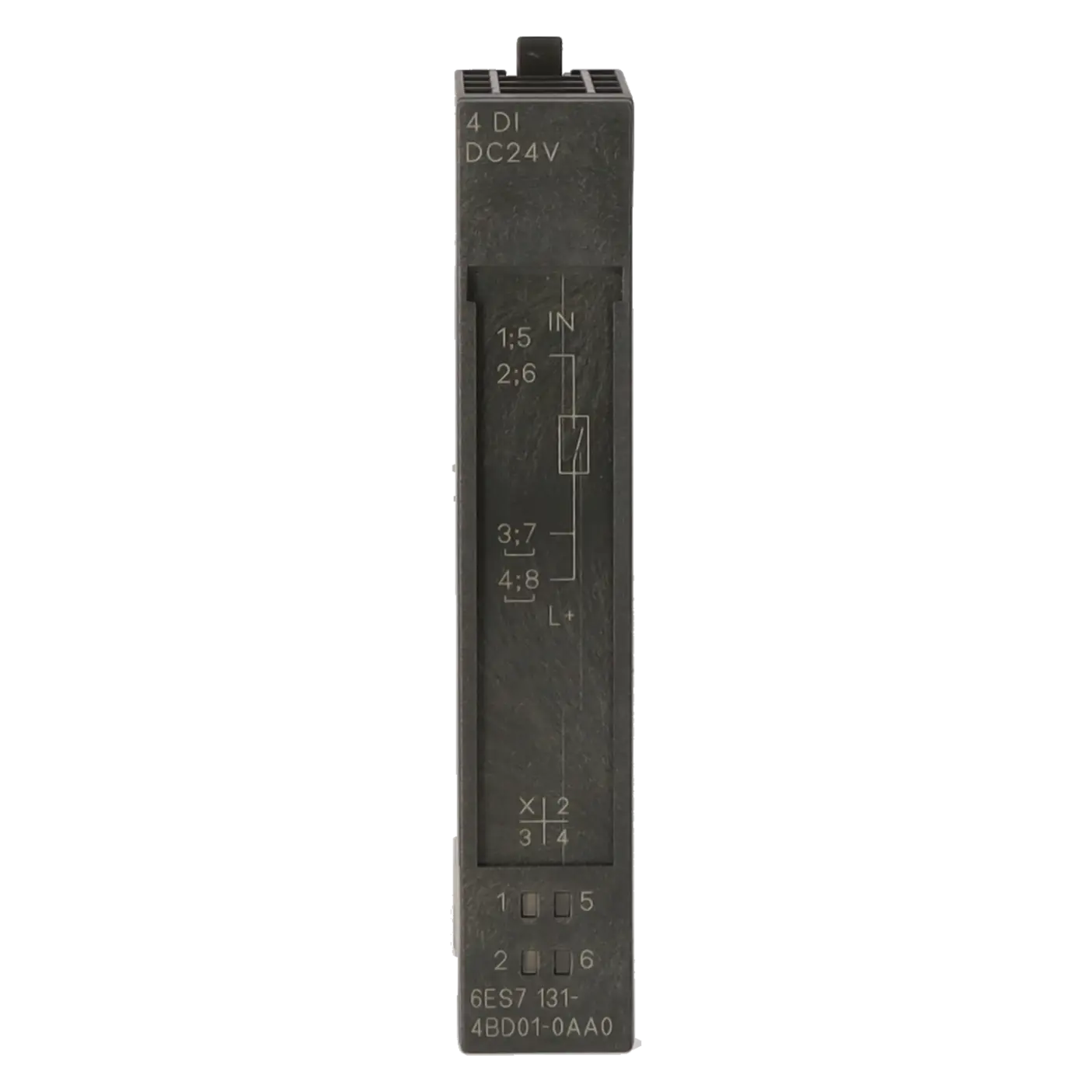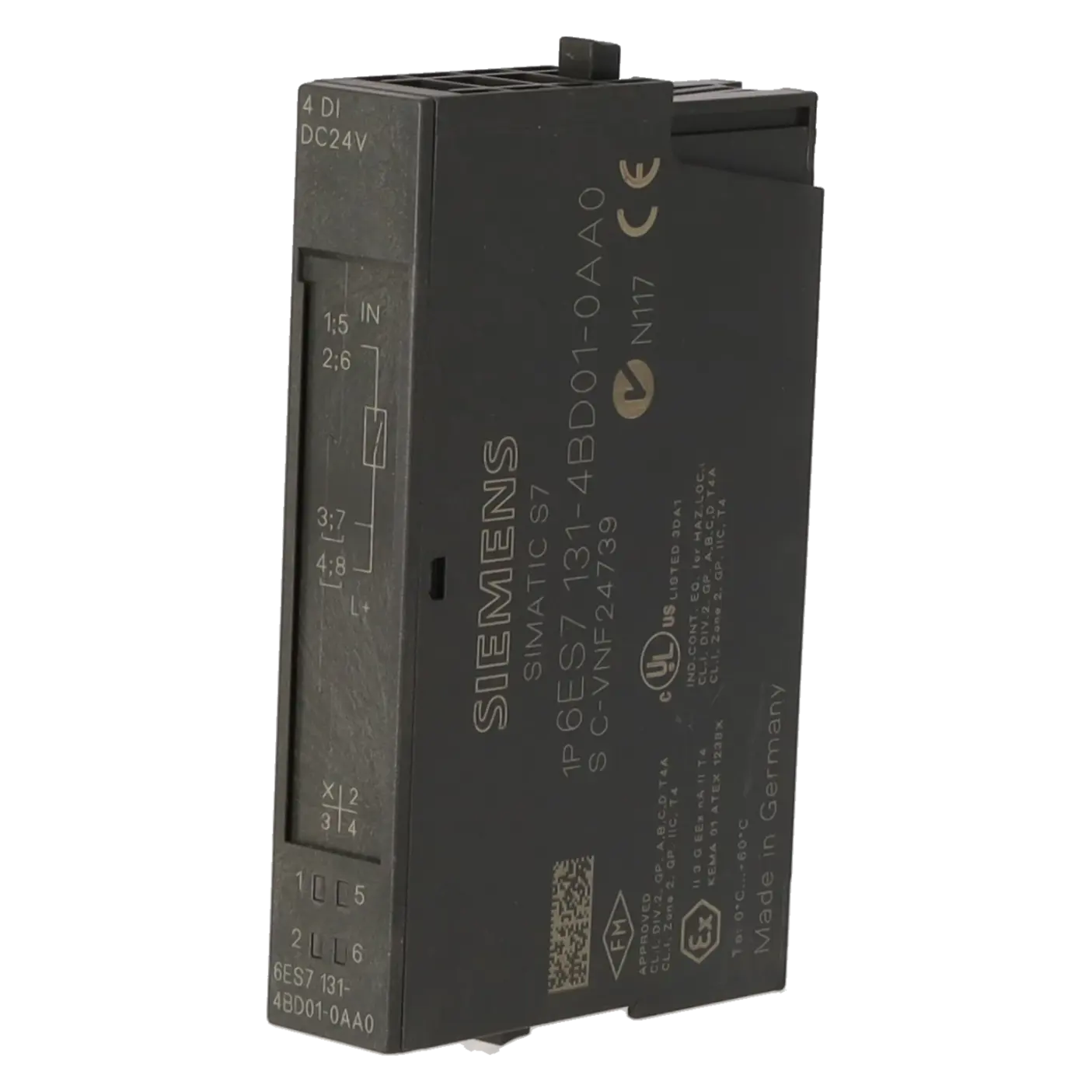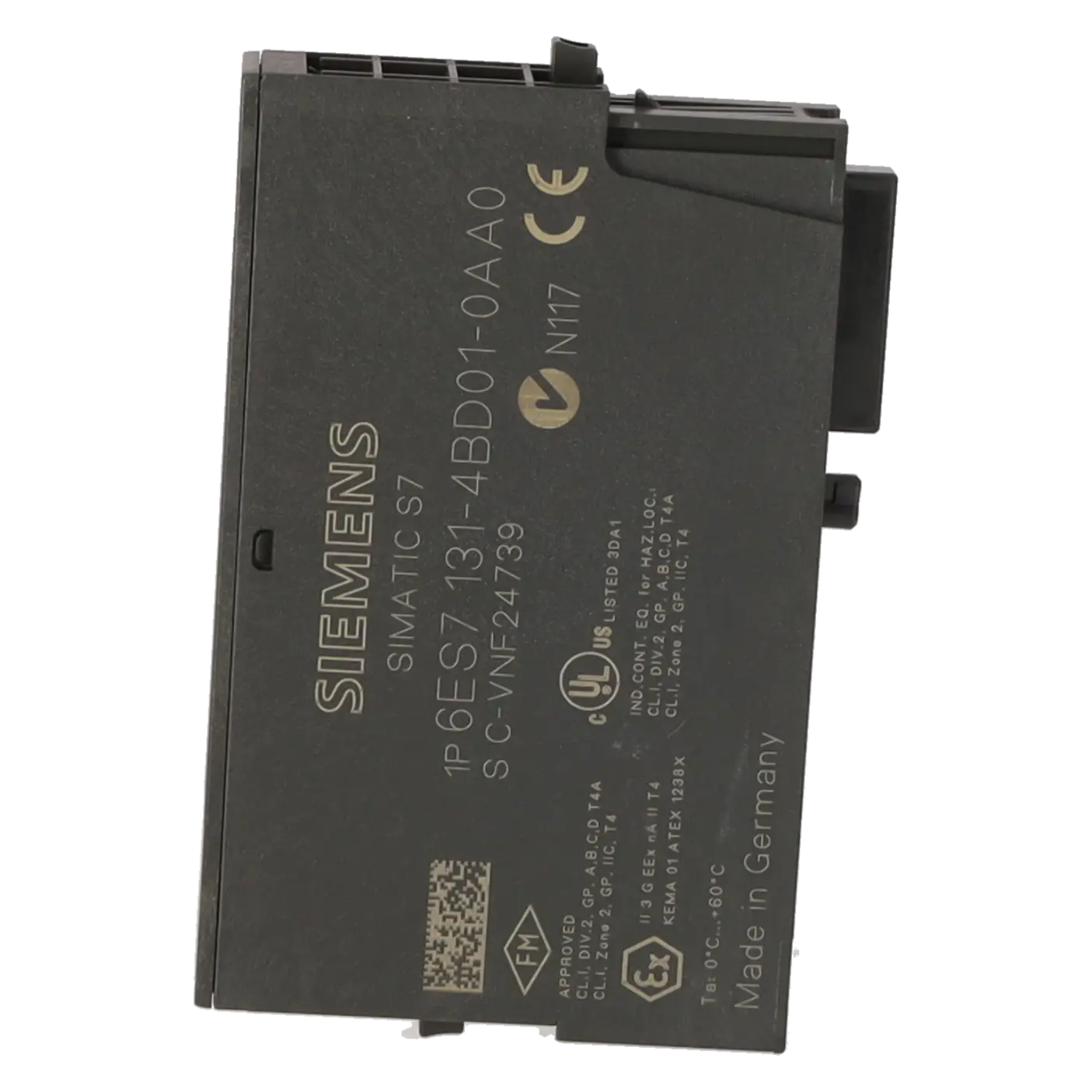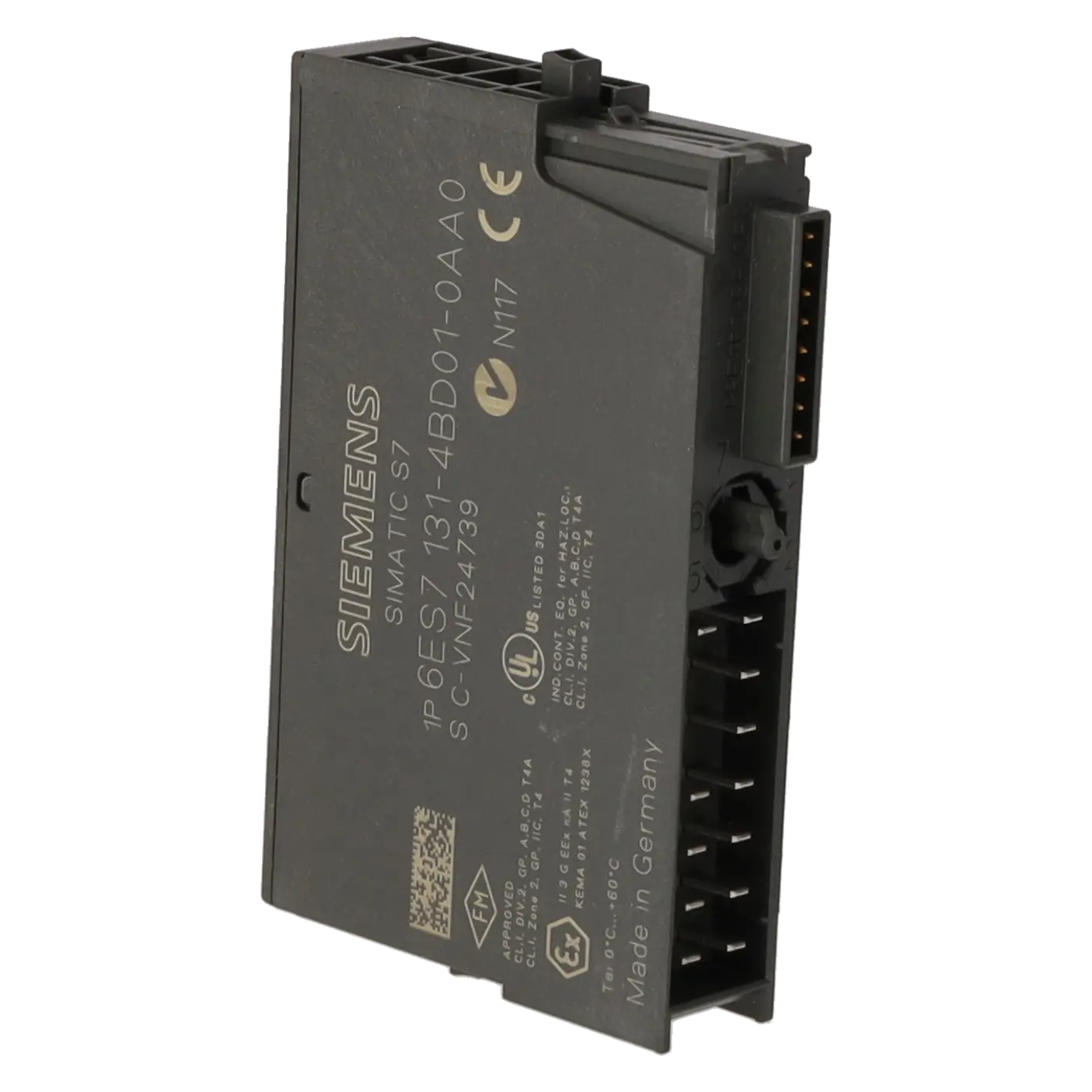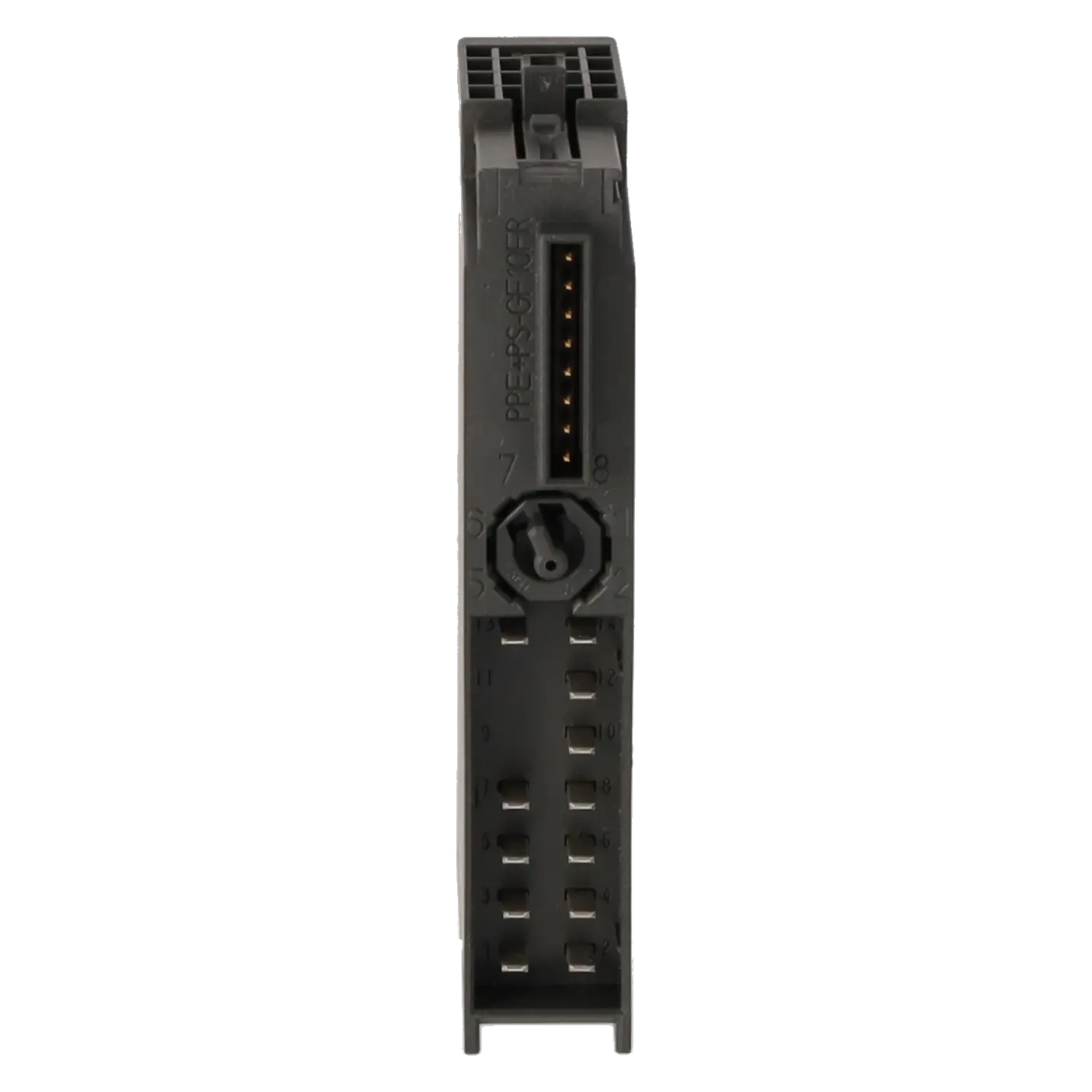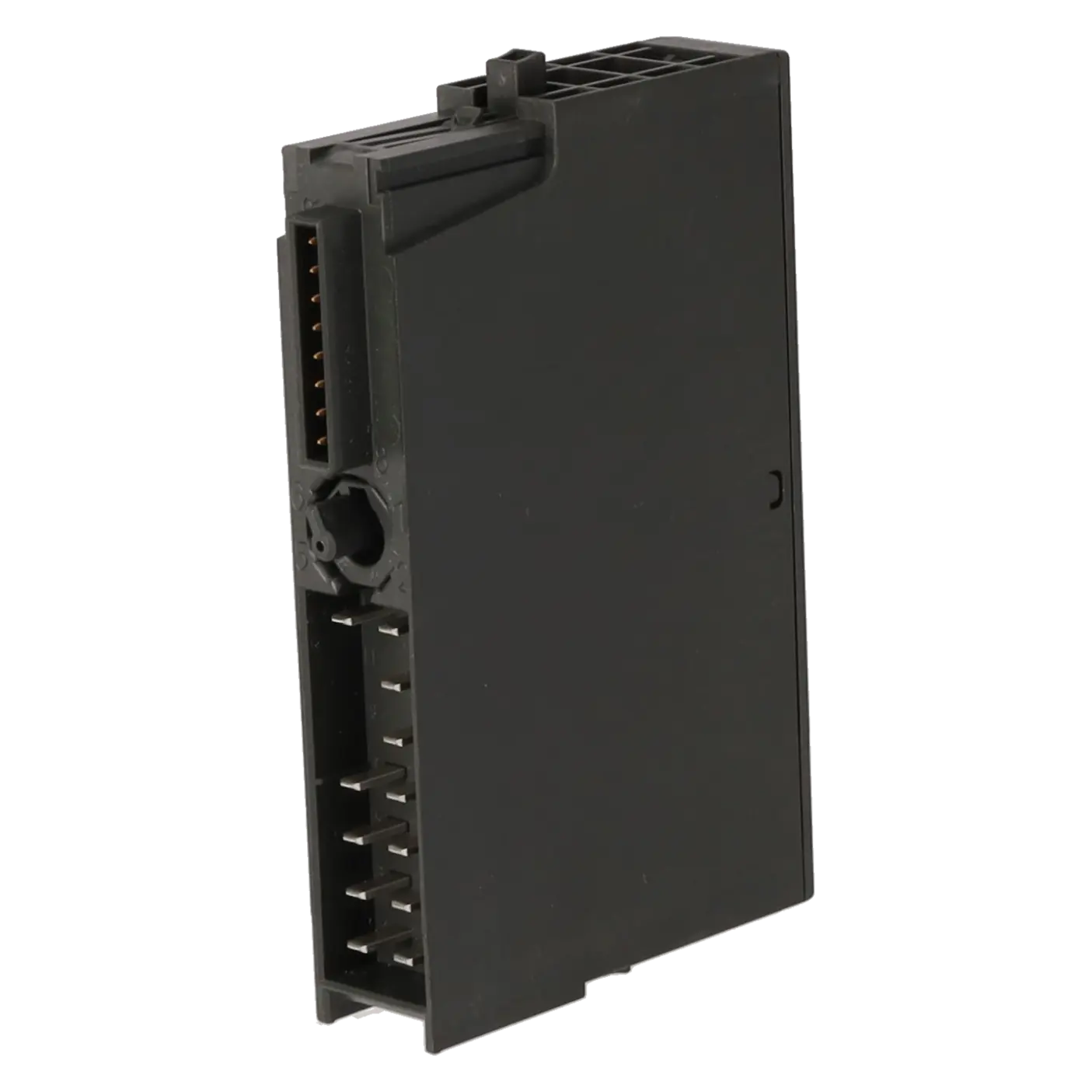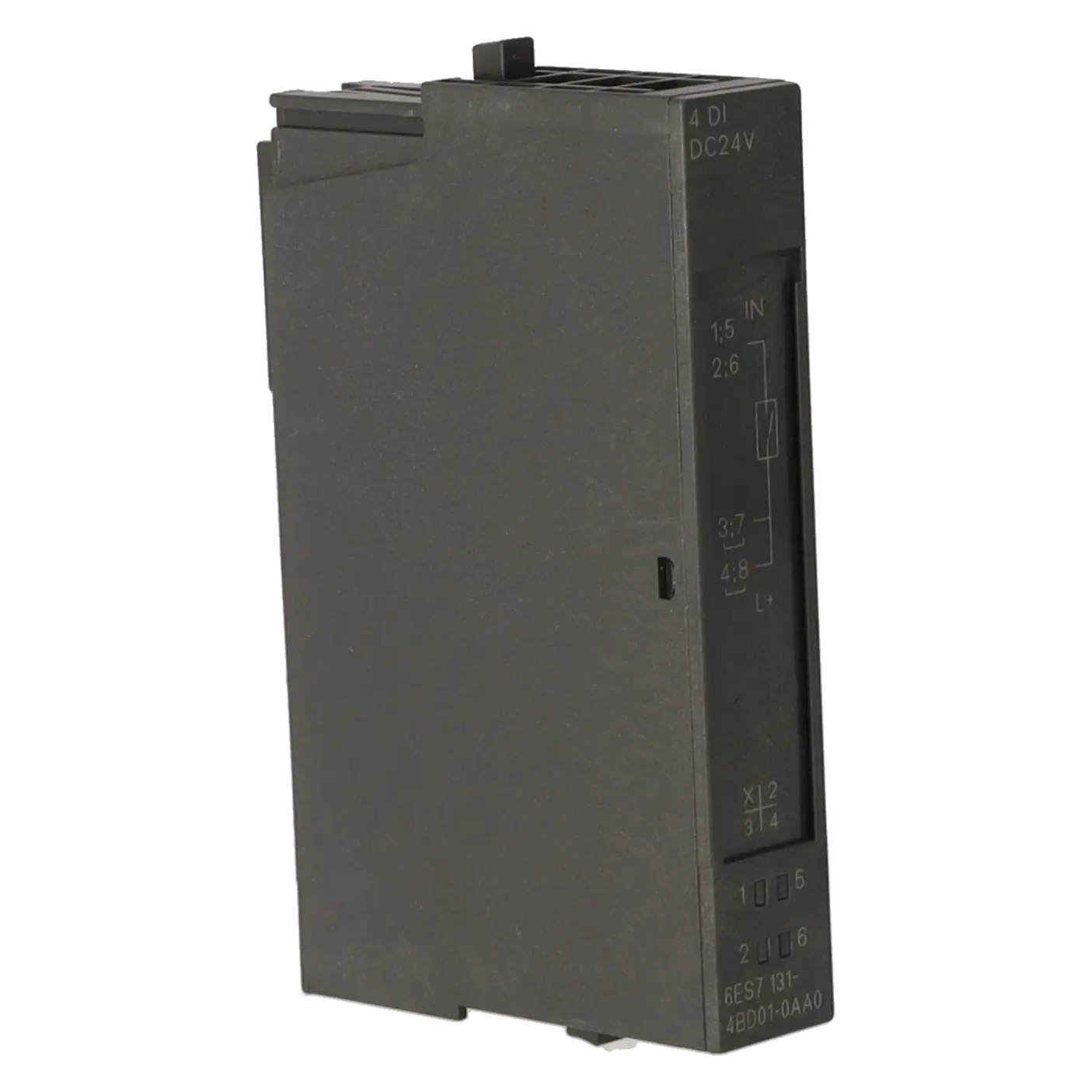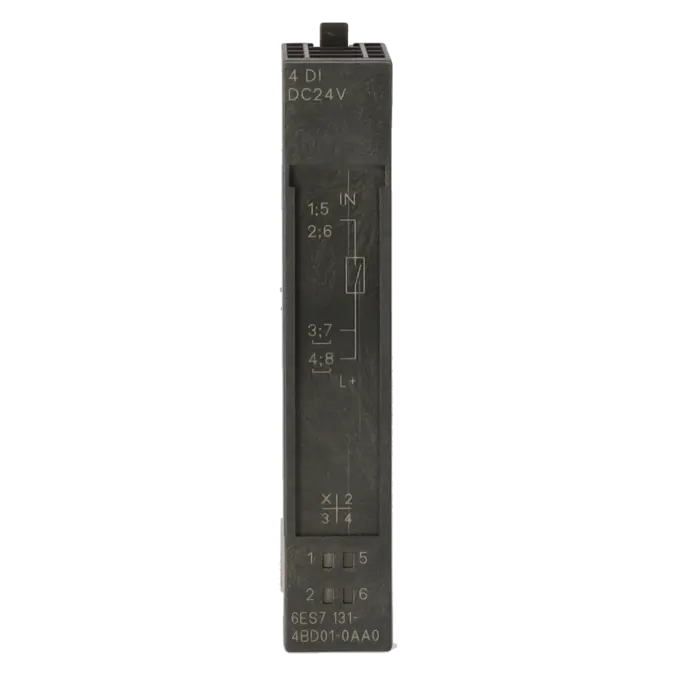
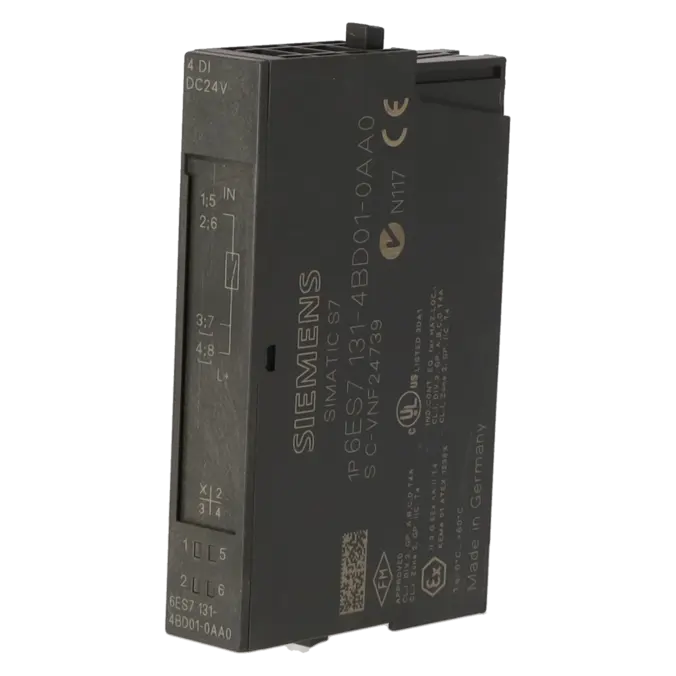
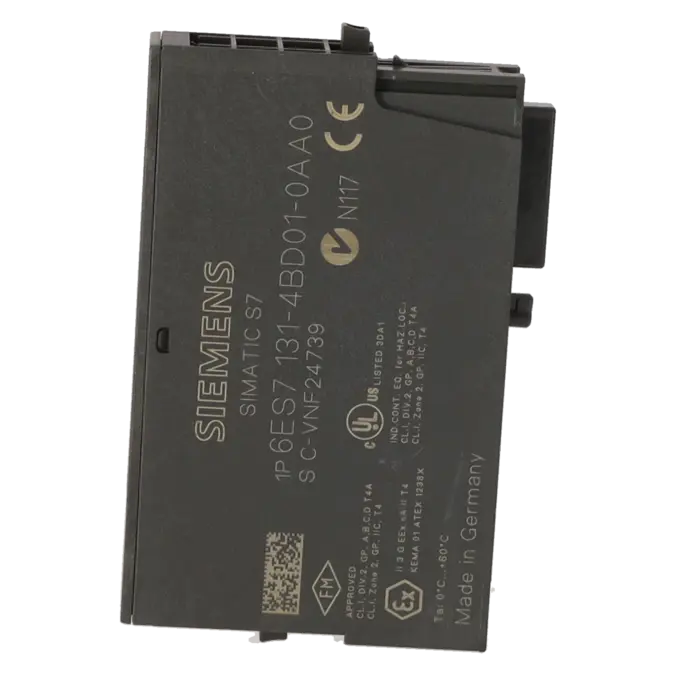
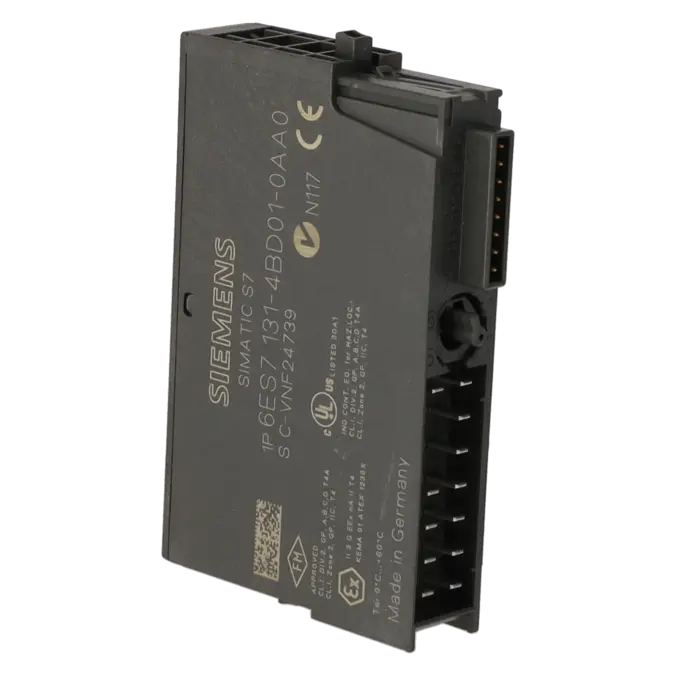
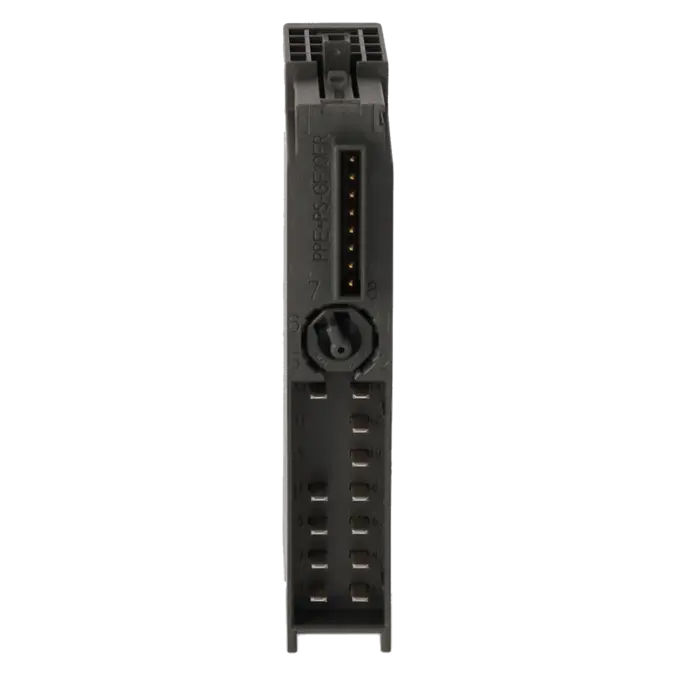
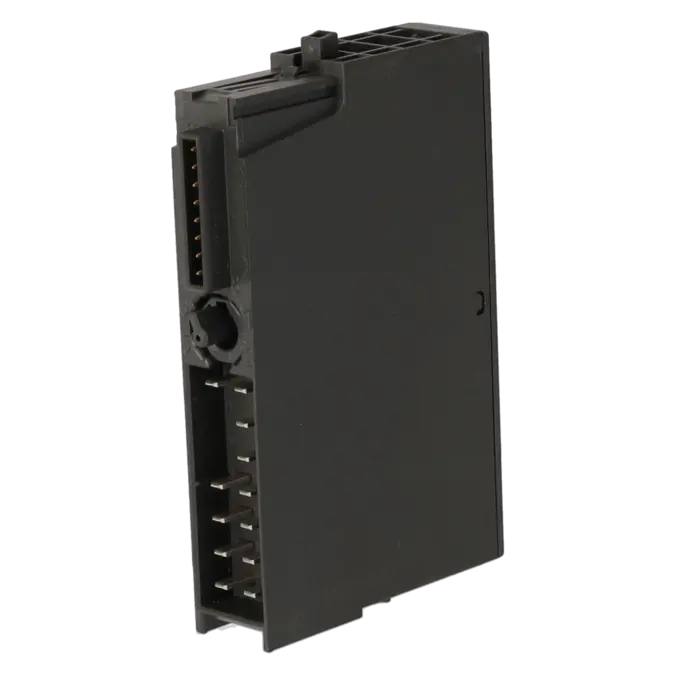
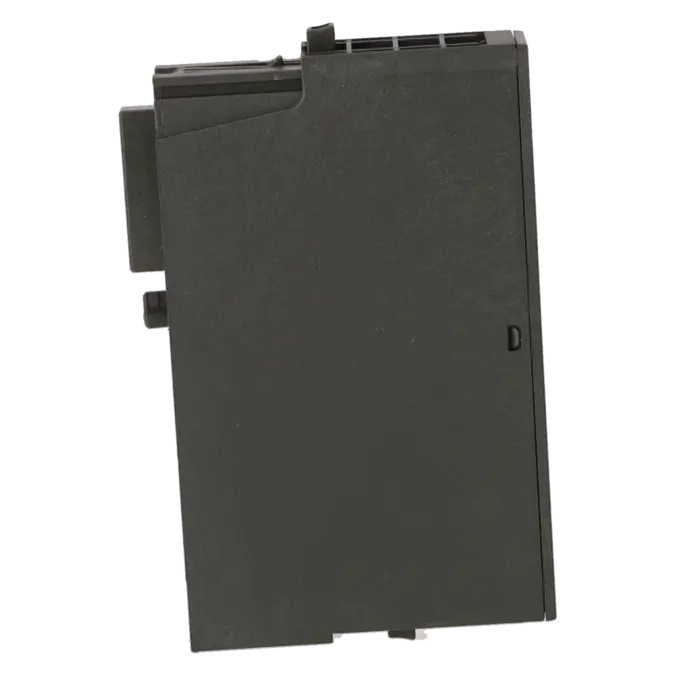
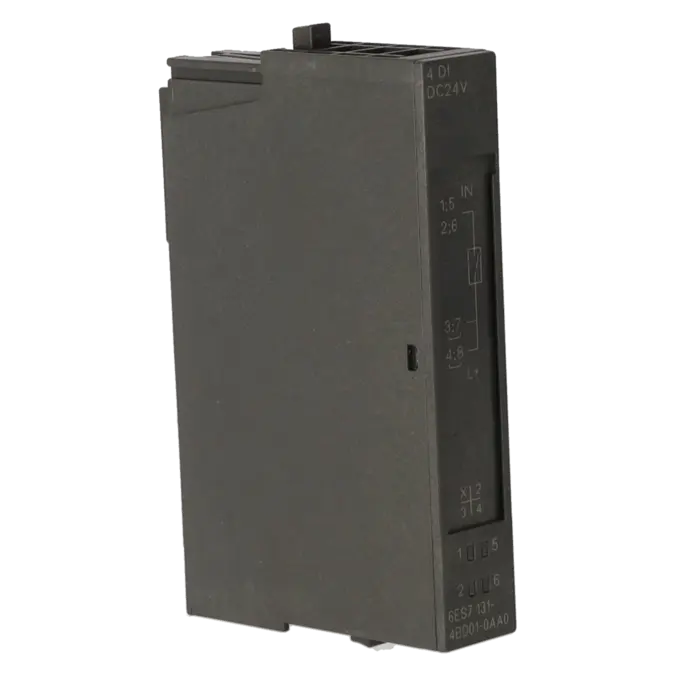
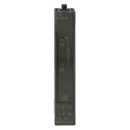
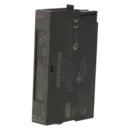
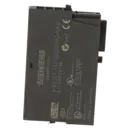
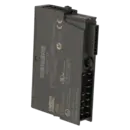
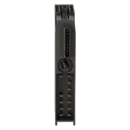
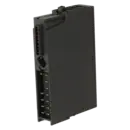
SIEMENS 6ES7131-4BD01-0AA0
- EICHLER-art.no.: K0140346
- EAN: 4025515072287
- UPC: 662643216974
Product description
SIMATIC DP, 5 ELECTRON. MODULES FOR ET 200S, 4 DI STANDARD 24V DC, 15 MM WIDTH, 5 PIECES PER PACKAGING UNIT
Services for SIEMENS 6ES7131-4BD01-0AA0
Repair
from 274,89 €
to 420,42 €
Replacement
124,20 €
117,99 €
Used
138,00 €
131,10 €
New
SIEMENS |
6ES7131-4BD01-0AA0 –
additional product information
| Delivery information | |||
|---|---|---|---|
| Export identifier | AL: N ECCN: EAR99H | ||
| Net weight | 0.174 | ||
| Quantity | 1 Stück | ||
| Packaging quantity | 1 | ||
| Additional product information | |||
|---|---|---|---|
| Product status | EOP: 2023-10-01 | ||
| EAN | 4025515072287 | ||
| UPC | 662643216974 | ||
| Static lot number | 85389091 | ||
| List indicator | ST76 | ||
| Product group | 4467 | ||
| Country of origin | CN | ||
| Compliance with the substance restrictions according to RoHS directive | Since: 20081231 | ||
| Product classifications | Version | Classification | |
|---|---|---|---|
| eClass | 4 | 27-24-21-05 | |
| eClass | 5.1 | 27-24-26-04 | |
| eClass | 6.0 | 27-24-26-04 | |
| ETIM | 3 | / | |
| ETIM | 4 | EC001599 | |
| ETIM | 5 | EC001599 | |
What is 6ES7131-4BD01-0AA0 and where is it used
6ES7131-4BD01-0AA0 is a digital input module for the decentralized SIMATIC ET 200S I/O system. The module records four binary 24 V DC signals and is typically used in machinery, conveyor systems, packaging lines, intralogistics, and general automation applications. It is designed for switches and proximity sensors and is suitable wherever compact, reliable standard signals need to be integrated into a PLC environment. With its slim 15 mm width, the module is well suited for control cabinets with limited space. Typical applications include the acquisition of end position switches, initiators, valve feedback signals, or simple status signals from field devices.
Overview of the key technical data and what it means
The module operates with a 24 V DC rated load voltage and provides 4 digital inputs. A signal is detected as logical “1” when +15 to +30 V is present at the input, while -30 to +5 V is interpreted as logical “0”. This is important for reliable sensor connection and correct switching threshold evaluation. The typical input delay of 3 ms makes the module suitable for standard signal processing, but not for very fast counting or pulse applications. The module supports 2-wire sensors, provided that the permissible no-load current does not exceed 1.5 mA. The address space is 1 byte, with 4 bits packed possible. The module has no diagnostic function and only provides green status LEDs for each channel.
Product status, life cycle, and obsolescence
For many operators, 6ES7131-4BD01-0AA0 is already an obsolescence-related spare part topic. On the EICHLER product page, the module is marked with product status EOP as of 01 October 2023. Siemens product information also states announcement of product phase-out: 01 October 2020 and product cancellation: 01 October 2023. For maintenance teams and purchasing departments, this means that the module is already part of an active obsolescence management, spare parts planning, and stock security strategy in many plants. Especially in ET 200S-based systems, it is important to secure available stock, tested used parts, exchange units, and repair options early in order to avoid unplanned downtime and costly retrofit decisions.
Available EICHLER services and when they are relevant in practice
When an ET 200S module fails during operation or must be secured as a critical spare part, fast and flexible sourcing options are essential. For 6ES7131-4BD01-0AA0, EICHLER currently offers repair, exchange, tested used units, and new on request. For maintenance teams, short turnaround times are especially relevant: exchange and used units are listed with 1–3 days, while repair is listed with 2–5 days. Repairs include technical cleaning, preventive maintenance, comprehensive functional testing, and at least 24 months warranty. For purchasing and production, this creates real operational value: faster recovery, reduced obsolescence risk, and improved supply security for legacy systems. These services are intended for business customers.
| Attribute | Value |
|---|---|
| Input current | |
| from supply voltage L+, max. | Dependent on encoder |
| from backplane bus 3.3 V DC, max. | 10 mA |
| Encoder supply | |
| Type of output voltage | min. L+ (-0.5 V), under load |
| Output current | |
| ● Rated value | 500 mA |
| ● permissible range, lower limit | 0 mA |
| ● permissible range, upper limit | 500 mA |
| Power loss | |
| Power loss, typ. | 0.7 W |
| Address area | |
| Address space per module | |
| ● Address space per module, max. | 1 byte |
| ● with packing | 4 bit |
| Digital inputs | |
| Number of digital inputs | 4 |
| Input characteristic curve in accordance with IEC 61131, type 1 | Yes |
| Input voltage | |
| ● Type of input voltage | DC |
| ● Rated value (DC) | 24 V |
| ● for signal "0" | -30 to +5 V |
| ● for signal "1" | +15 to +30 V |
| Input current | |
| ● for signal "1", typ. | 7 mA; at 24 V |
| Input delay (for rated value of input voltage) | |
| for standard inputs | |
| — parameterizable | No |
| — at "0" to "1", min. | 2 ms; typically 3 ms |
| — at "0" to "1", max. | 4.5 ms |
| — at "1" to "0", min. | 2 ms; typically 3 ms |
| — at "1" to "0", max. | 4.5 ms |
| Cable length | |
| ● shielded, max. | 1 000 m |
| ● unshielded, max. | 600 m |
| Encoder | |
| Connectable encoders | |
| ● 2-wire sensor | Yes |
| — permissible quiescent current (2-wire sensor), max. | 1.5 mA |
| Interrupts/diagnostics/status information | |
| Diagnostics function | No |
| Diagnostics indication LED | |
| ● Group error SF (red) | No |
| ● Status indicator digital input (green) | Yes; per channel |
| Parameter | |
| Remark | 1 byte |
| Potential separation | |
| Potential separation digital inputs | |
| ● between the channels | No |
| ● between the channels and backplane bus | Yes |
| Isolation | |
| Isolation tested with | 500 V DC |
| Dimensions | |
| Width | 15 mm |
| Height | 81 mm |
| Depth | 52 mm |
| Weights | |
| Weight, approx. | 35 g |
| Error description | Possible Solution |
|---|---|
| Why does an input not switch even though 24 V is present? | First check whether the sensor supply voltage is actually provided by the power module and whether the sensor is wired to the correct channel DI0 to DI3. The module only reliably detects a signal as “1” when at least +15 V is present at the input. Also verify whether the terminal module matches one of the approved TM-E15 variants and whether L+ is correctly routed to the sensor supply. |
| Why does an input remain permanently at 1 although the sensor is not switching? | With 2-wire proximity switches, leakage current is often the cause. The module supports 2-wire sensors only up to a maximum no-load current of 1.5 mA. If the sensor exceeds this value, the input may be permanently detected as active. In many cases, the solution is to use a suitable sensor with lower leakage current or to adapt the input strategy. |
| Why are fast pulses or short signal changes not detected reliably? | This standard module has a typical input delay of 3 ms and does not support isochronous or clock-synchronous operation. For very short pulses, frequency signals, or fast counting tasks, it may therefore be technically too slow. In such cases, signal acquisition should be implemented with a faster high-feature, high-speed, or counter module. |
| Why does the ET 200S station show BF or SF and the inputs do not deliver data? | Check the exact order number in the hardware configuration, the bus address, the correct connection at the DP port, and the bus wiring. In practical applications involving IM151 stations, even small deviations in the MLFB, PROFIBUS wiring, or station configuration can lead to communication failure. After changes to DIP switches or addresses, the station should also be restarted properly. |
| Why do the input addresses in STEP 7 or TIA not match expectations? | The module normally occupies 1 byte of address space even though it only has 4 inputs; 4 bits packed are possible. Within the ET 200S system, digital modules with less than 1 byte of process data can be packed together in STEP 7. If bits appear at unexpected addresses, the hardware configuration and address packing should be checked carefully. |
Is 6ES7131-4BD01-0AA0 still active or already discontinued?
The module is discontinued. Siemens specifies product phase-out as of 01 October 2020 and product cancellation as of 01 October 2023. The EICHLER product page additionally marks the module with EOP 01 October 2023. For operators of ET 200S stations, this means procurement, repair capability, and stocking strategy should not be left unresolved until a failure occurs. Tested exchange units and used modules therefore become significantly more important.
Why is the product often described as “5 electronic modules”?
The Siemens designation refers to the packaging unit. The official product description states in essence: 5 electronic modules for ET 200S, 4 DI Standard 24 V DC, 15 mm width. For purchasing and spare parts management, this is important because ordering and storage logic do not always match the immediate single-unit requirement in maintenance. If only one failed module needs to be replaced, users often search specifically for single-unit availability, exchange service, or tested used stock rather than ordering a complete packaging unit.
Which terminal modules are compatible with 6ES7131-4BD01-0AA0?
Siemens specifies several TM-E15 series terminal modules for use with this unit. These include variants such as TM-E15C26-A1, TM-E15C24-A1, TM-E15C24-01, and TM-E15C23-01, as well as corresponding spring-type and screw-type connection versions. This is important because not every terminal assignment is identical across all terminal module variants. For replacement and troubleshooting, both the MLFB of the electronic module and the MLFB of the terminal module should always be checked together. This reduces wiring errors and helps avoid unnecessary commissioning problems.
Does the module provide channel diagnostics or an SF fault message per module?
No. 6ES7131-4BD01-0AA0 is a standard DI module without integrated diagnostics. Siemens specifies only green status LEDs per channel; a red SF LED on the module itself is not provided. In practice, this means troubleshooting has to rely more heavily on wiring checks, sensor testing, station diagnostics, bus diagnostics, and hardware configuration validation. The module is therefore solid for standard applications, but it offers less diagnostic convenience than later high-feature modules.
Can I operate 2-wire proximity sensors with this module?
Yes, this is possible. Siemens explicitly states that the module supports the connection of 2-wire proximity switches. The critical point is the maximum permissible no-load current of 1.5 mA. If this value is exceeded, the input may be detected as active even when it should not be. For maintenance teams, this is an important factor when dealing with sporadic or difficult-to-reproduce faults. During modernization or sensor replacement, not only the mechanical fit but also the electrical compatibility should always be checked.
What is the best way to secure plant availability in the event of a failure?
For obsolete ET 200S modules, a multi-level spare parts strategy is usually the best approach. If the system must be back up and running quickly, an exchange unit is often the fastest option. If budget, stock strategy, or availability is the main focus, tested used modules can be an attractive solution. If the original module is still available and fundamentally repairable, repair service may be the most economical option. For 6ES7131-4BD01-0AA0, EICHLER currently offers exactly these options, including short lead times for exchange and used units as well as a 24-month warranty on repairs.