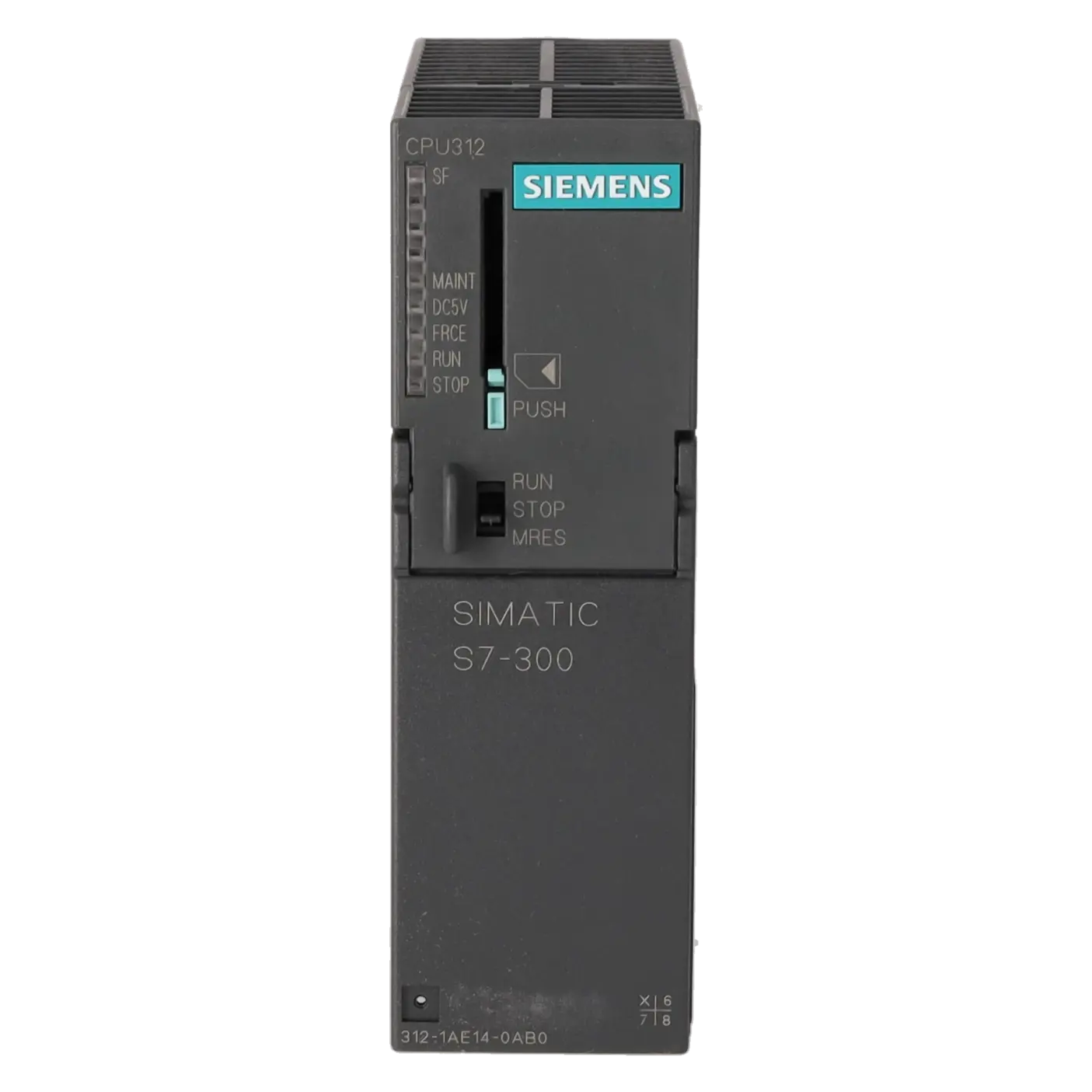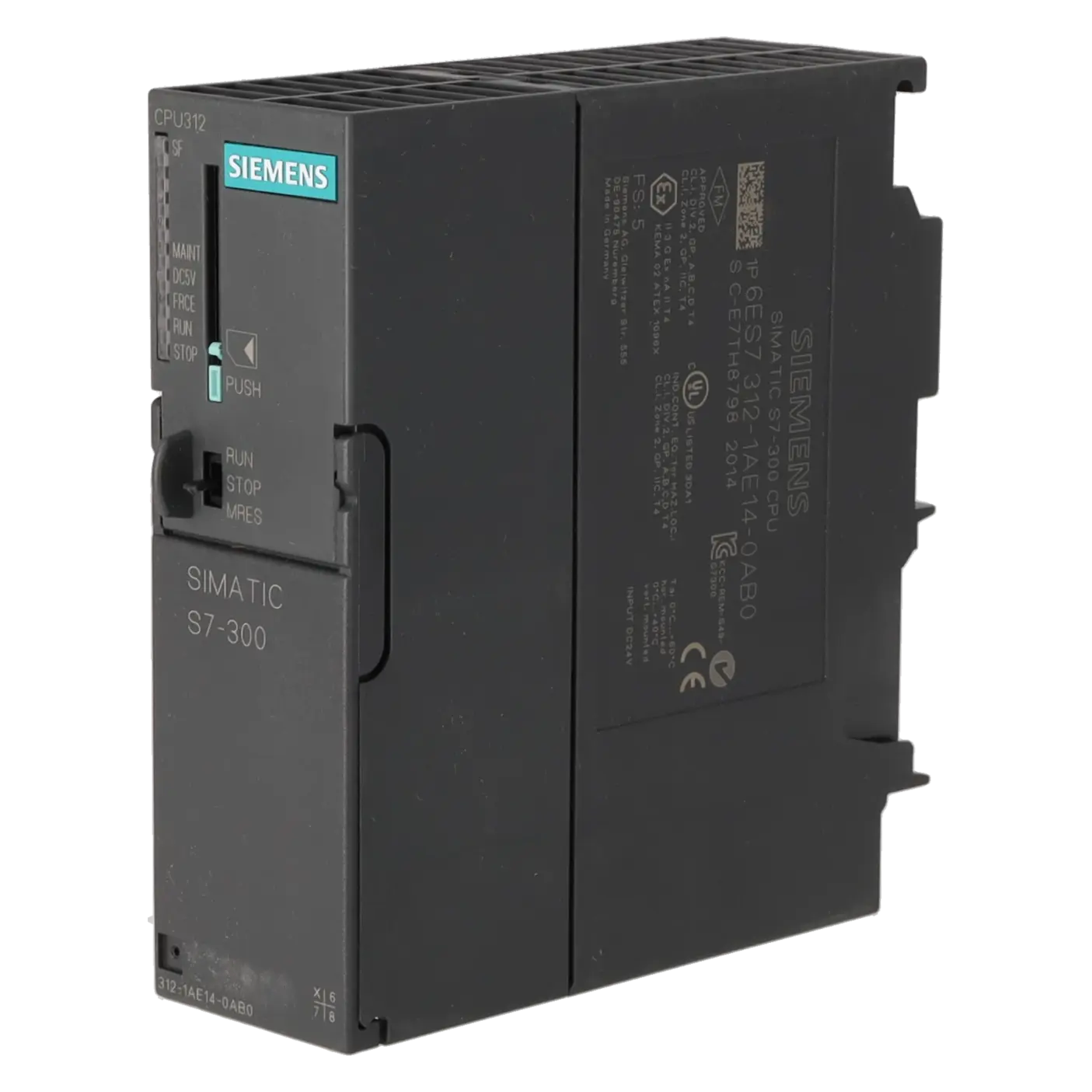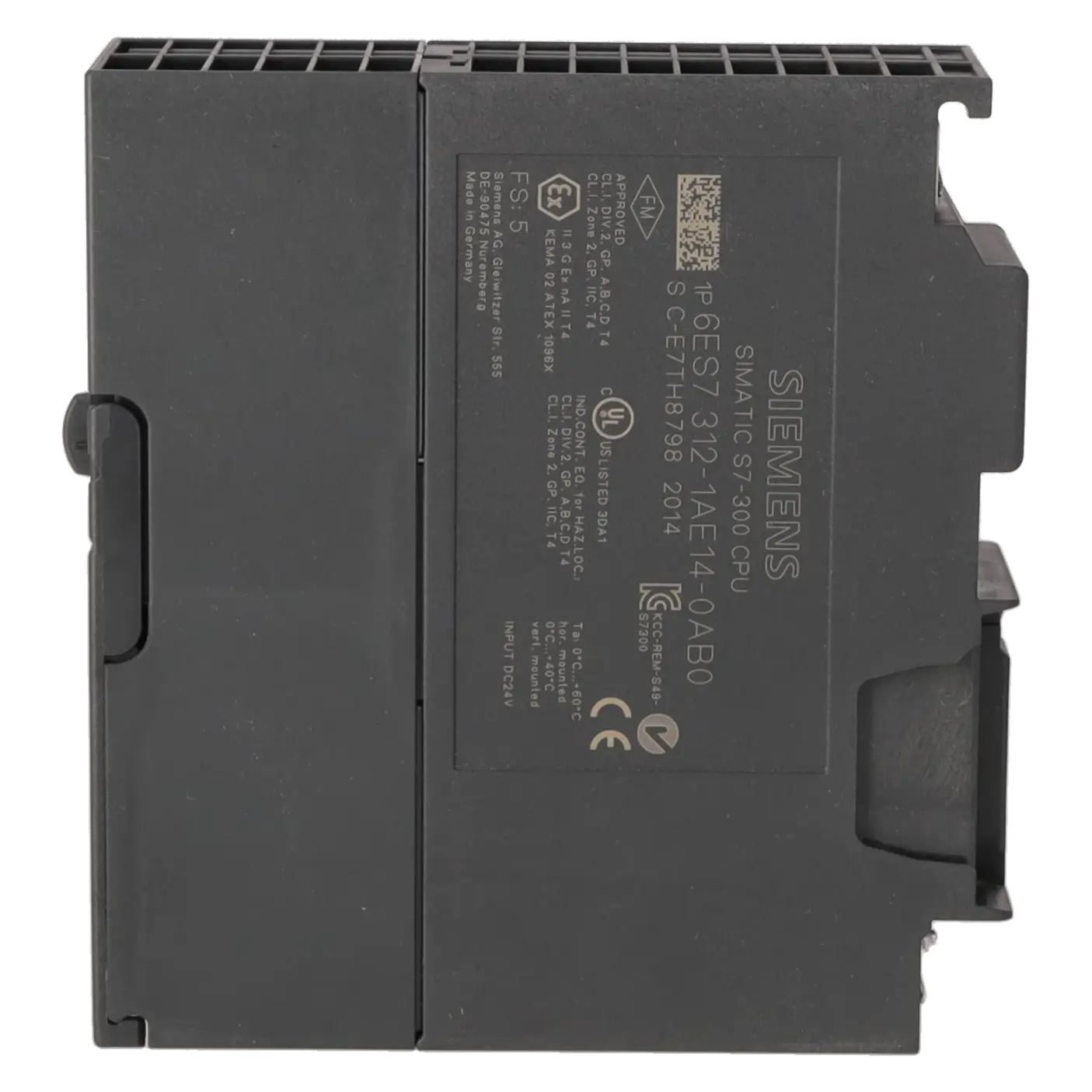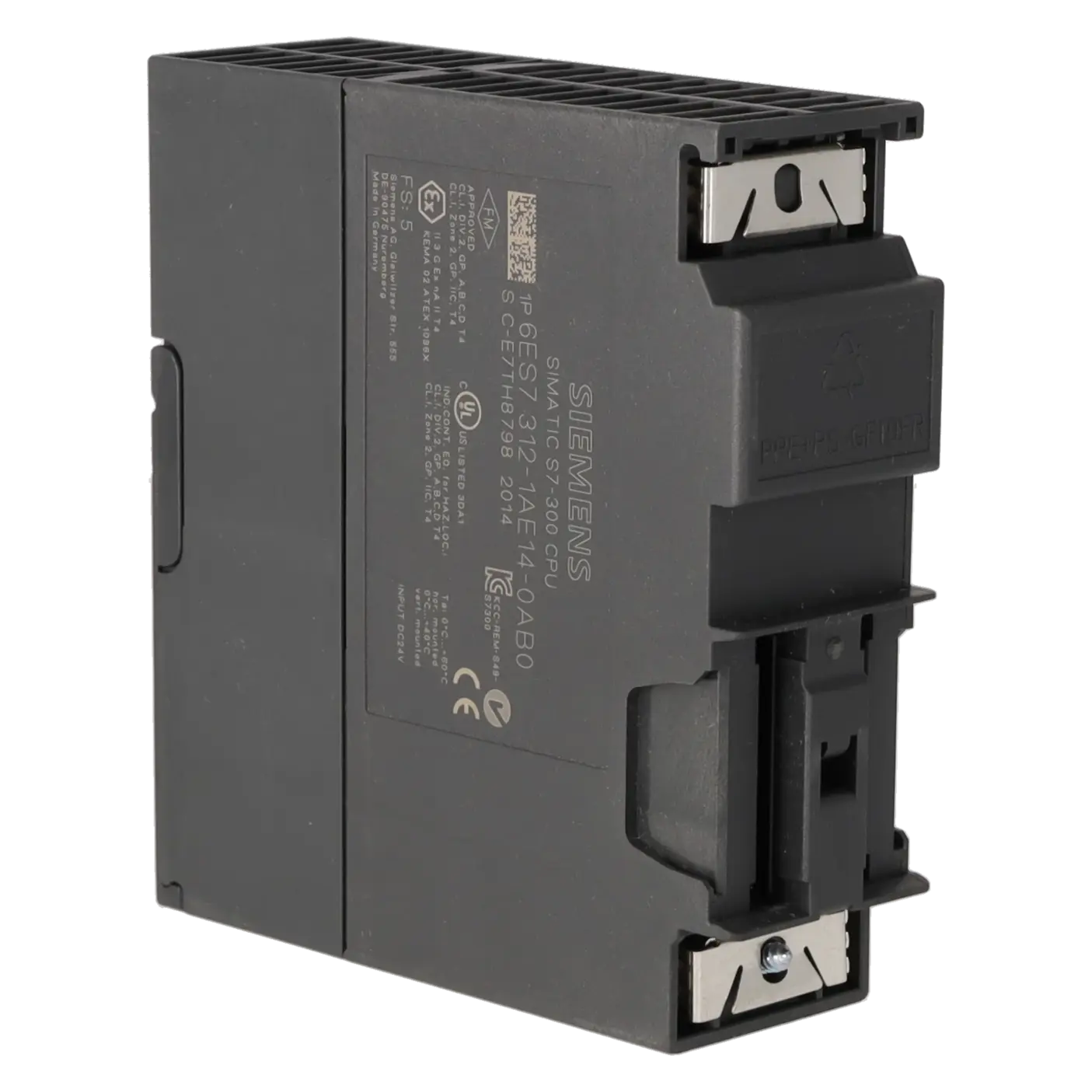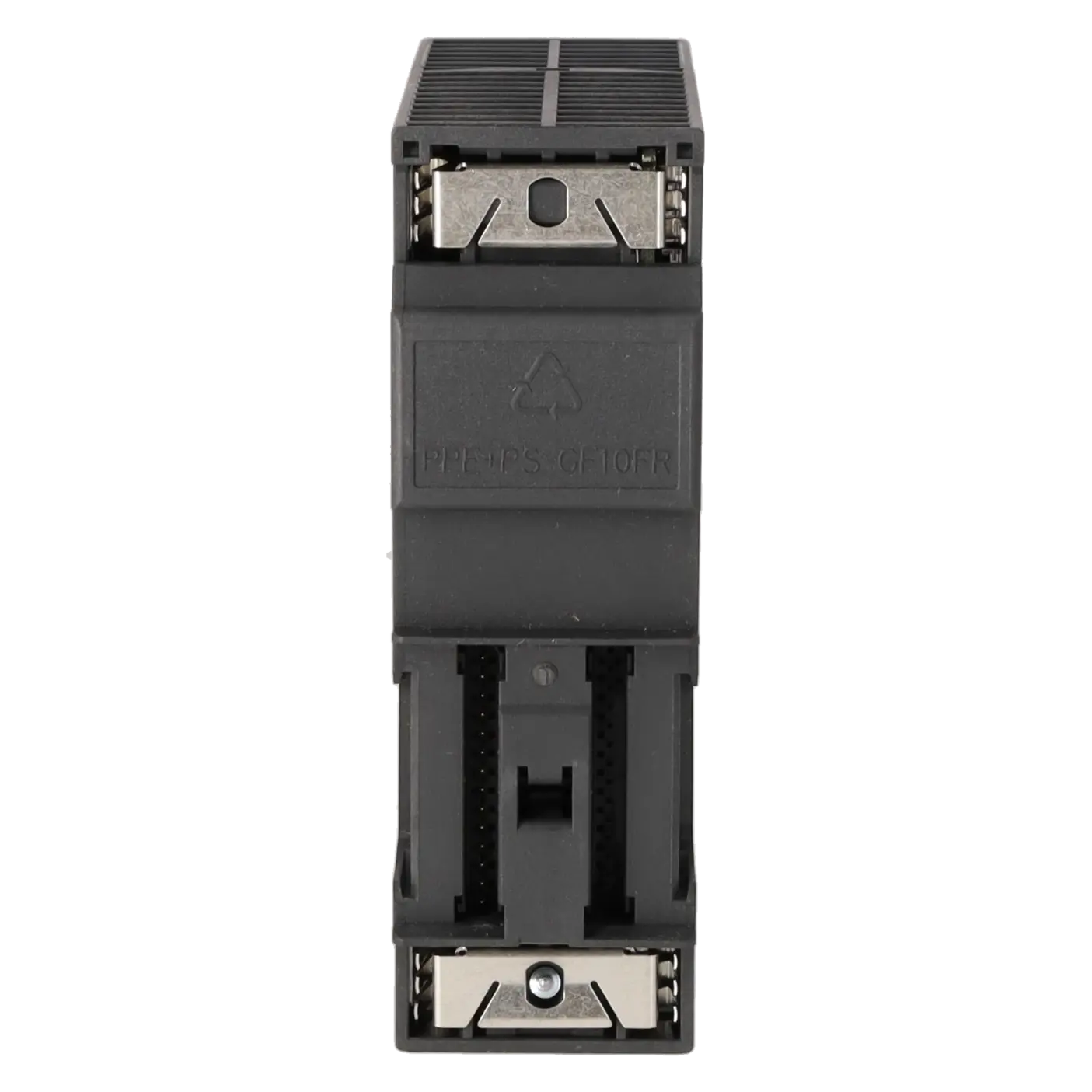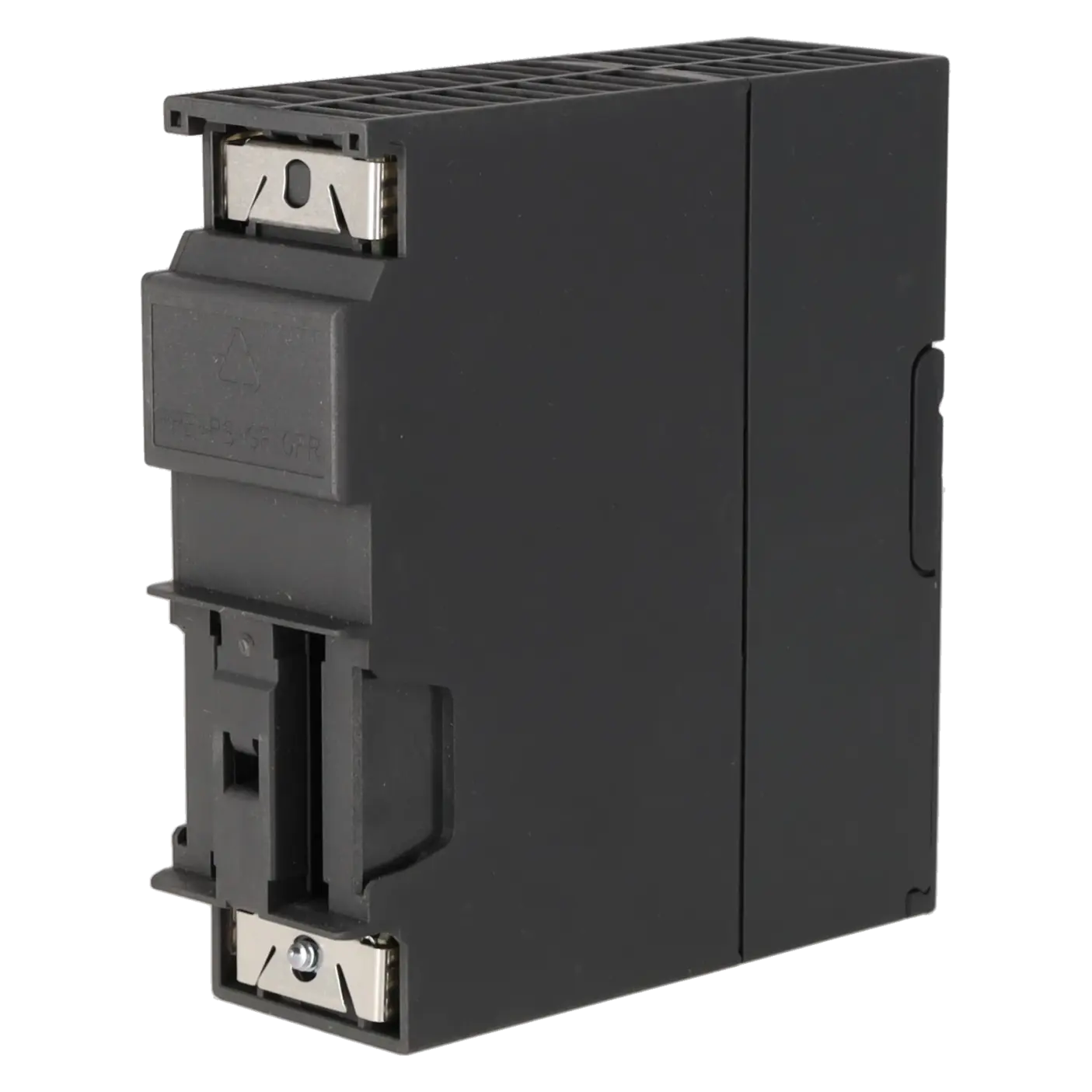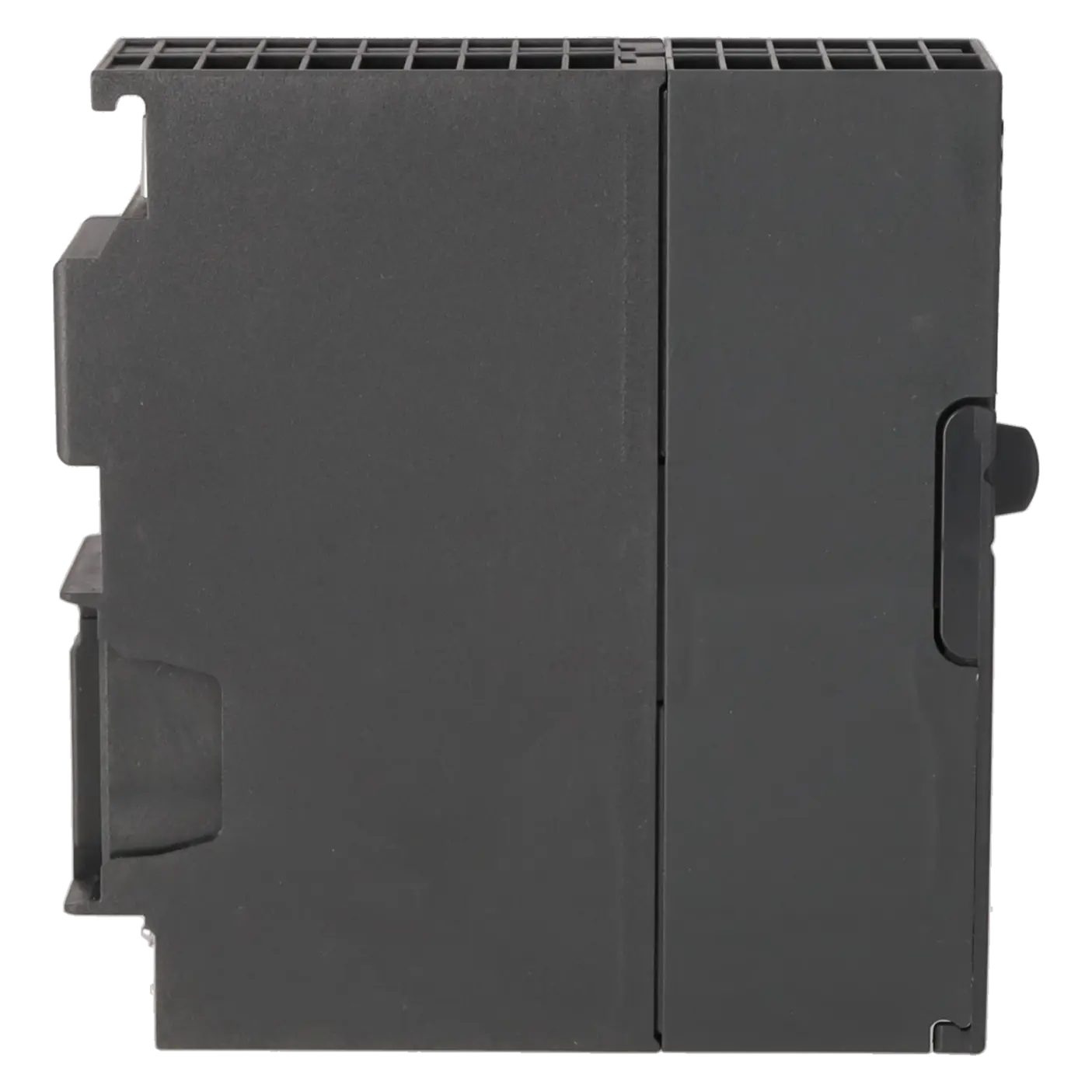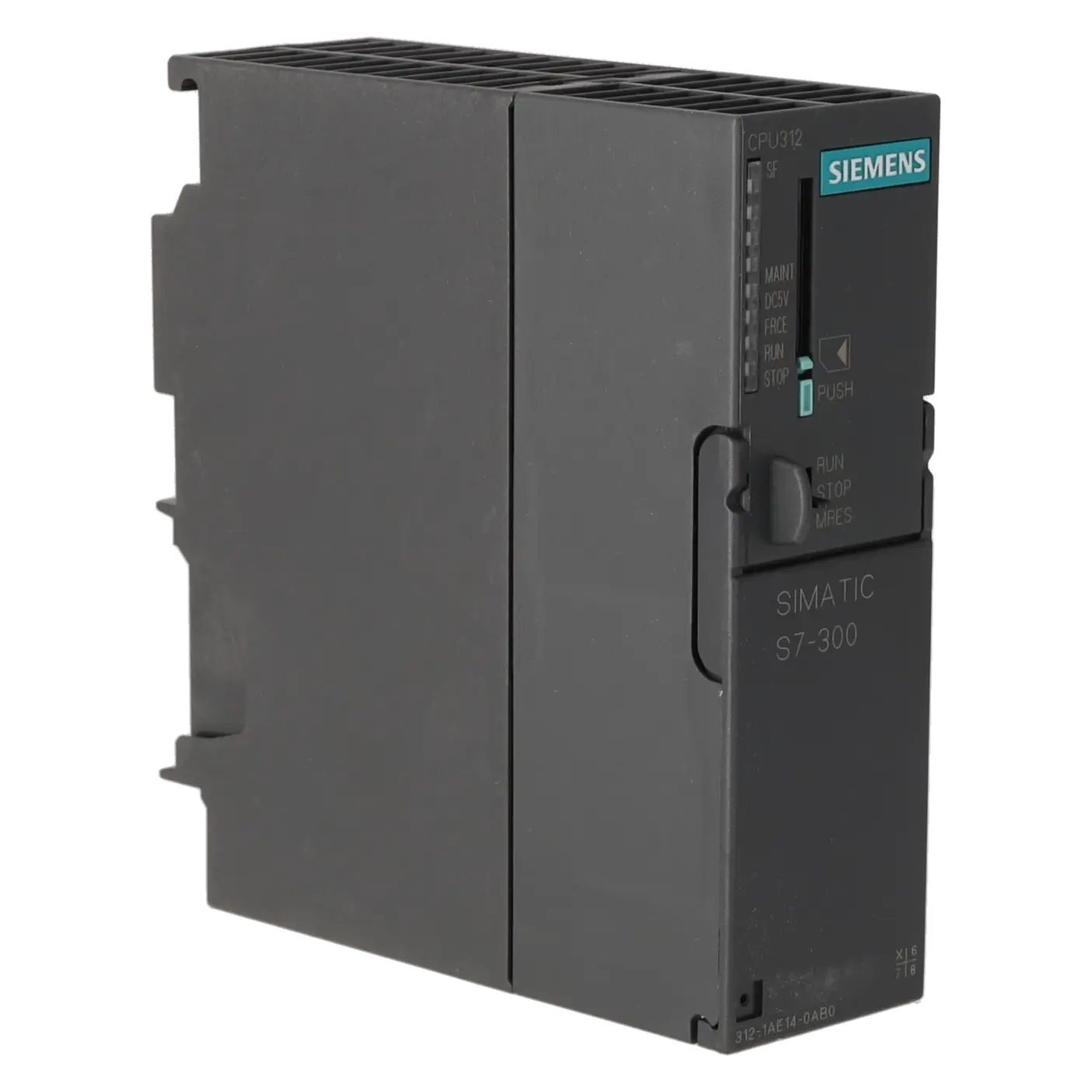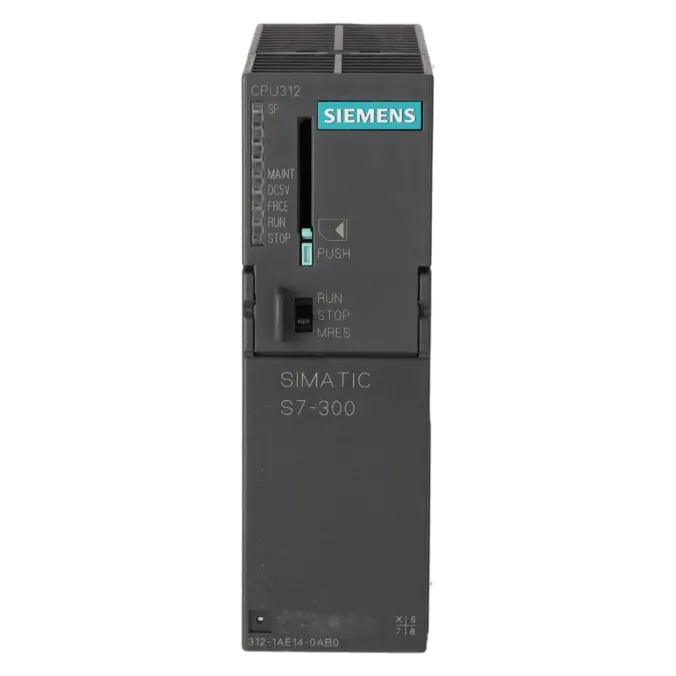
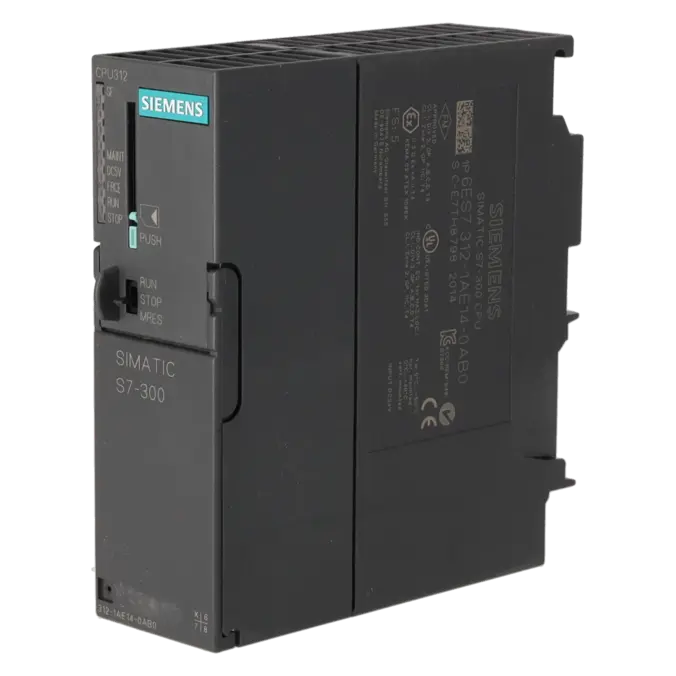

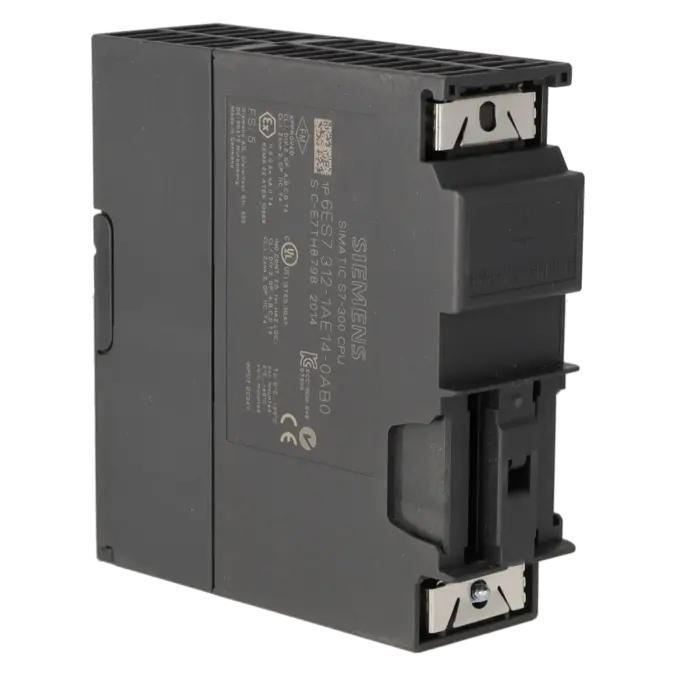
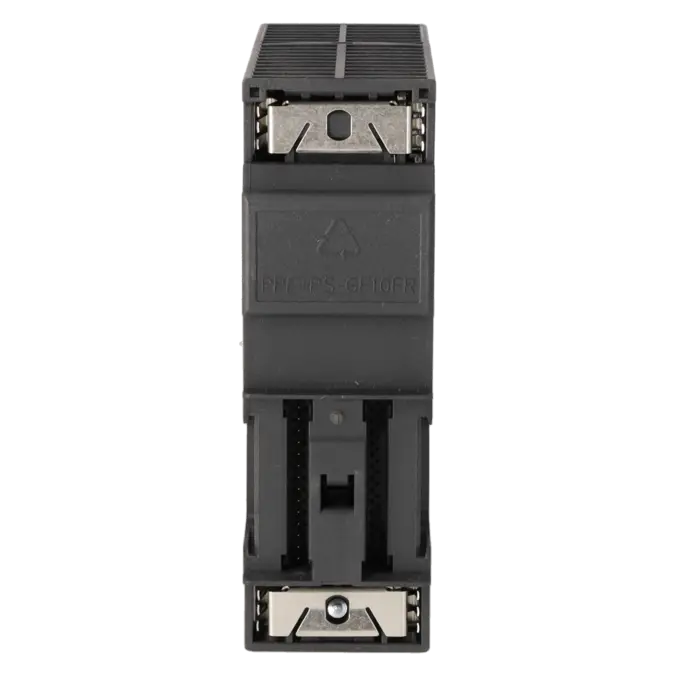
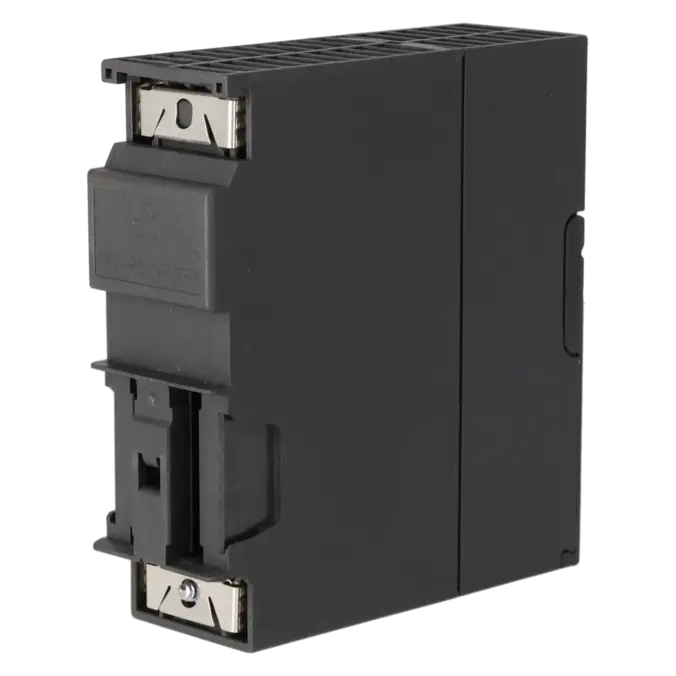
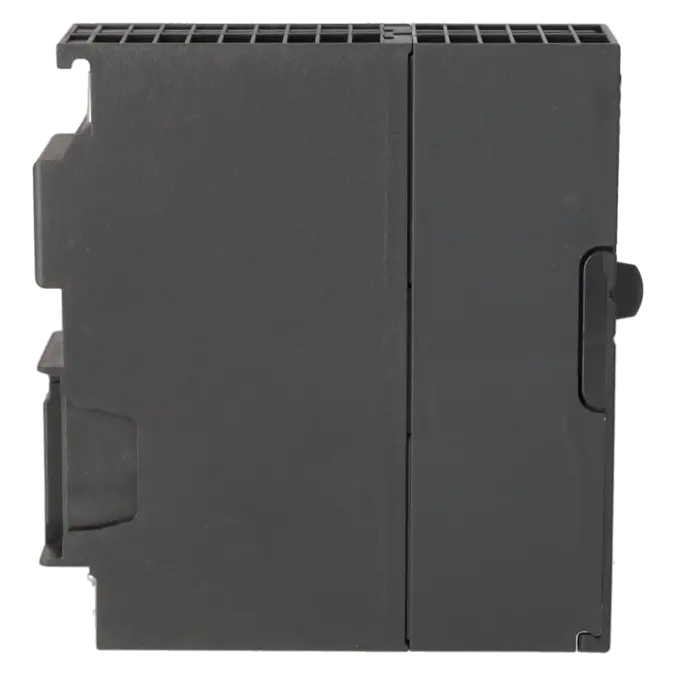
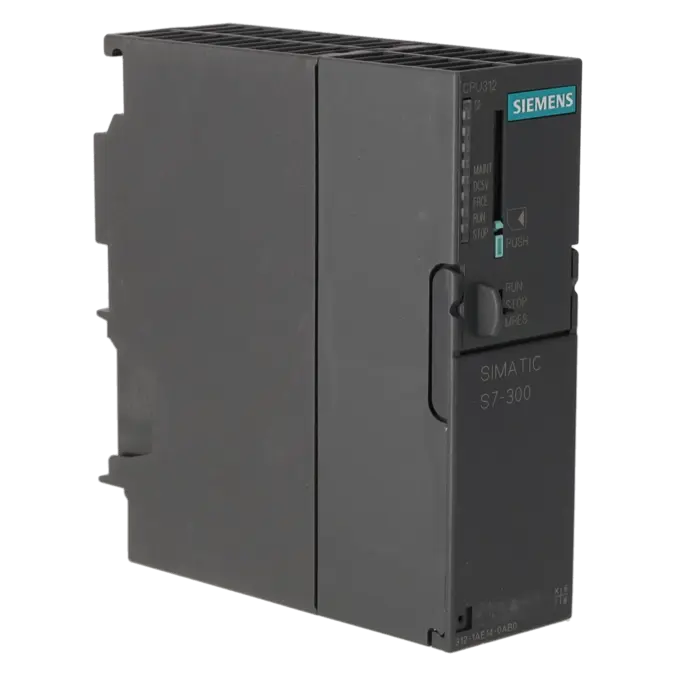
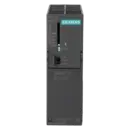
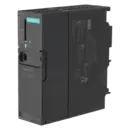
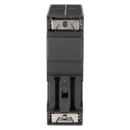
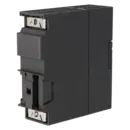
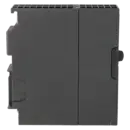
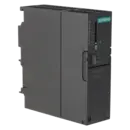
SIEMENS 6ES7312-1AE14-0AB0
- EICHLER-art.no.: K0252203
- EAN: 4025515077701
- UPC: 040892550283
Product description
SIMATIC S7-300, CPU 312 CENTRAL PROCESSING UNIT WITH MPI, INTEGR. POWER SUPPLY 24 V DC, WORK MEMORY 32 KB, MICRO MEMORY CARD REQUIRED
Services for SIEMENS 6ES7312-1AE14-0AB0
Repair
from 642,91 €
to 983,27 €
Replacement
Used
485,99 €
364,49 €
New
630,30 €
472,72 €
SIEMENS |
6ES7312-1AE14-0AB0 –
additional product information
| Delivery information | |||
|---|---|---|---|
| Export identifier | AL: N ECCN: EAR99H | ||
| Net weight | 0.305 | ||
| Quantity | 1 Stück | ||
| Packaging quantity | 1 | ||
| Additional product information | |||
|---|---|---|---|
| Product status | EOP: 2025-10-01 | ||
| EAN | 4025515077701 | ||
| UPC | 040892550283 | ||
| Static lot number | 85371091 | ||
| List indicator | ST73 | ||
| Product group | 4256 | ||
| Country of origin | DE | ||
| Compliance with the substance restrictions according to RoHS directive | Since: 20091125 | ||
| Product classifications | Version | Classification | |
|---|---|---|---|
| eClass | 4 | 27-24-03-02 | |
| eClass | 5.1 | 27-24-22-07 | |
| eClass | 6.0 | 27-24-22-07 | |
| ETIM | 3 | / | |
| ETIM | 4 | EC000236 | |
| ETIM | 5 | EC000236 | |
What is the 6ES7312-1AE14-0AB0 and where is it used?
The 6ES7312-1AE14-0AB0 is a SIMATIC S7-300 CPU 312 from Siemens. It is a central processing unit (CPU) with an integrated MPI interface, integrated 24 V DC power supply, and 32 KB of work memory. The CPU is used in traditional machine and plant control systems where proven and reliable S7-300 technology continues to operate productively. Typical applications include conveyor systems, packaging machines, smaller production lines, as well as retrofit projects and spare-part applications in existing installations. For maintenance and purchasing departments, the module is particularly relevant when existing S7-300 systems need to be stabilised quickly, a failed CPU must be replaced, or the availability of an older installation must be maintained despite its advanced life-cycle status.
Overview of the key technical data and what they mean
The CPU 312 is designed for compact S7-300 stations. It operates on 24 V DC with a permissible voltage range of 19.2 to 28.8 V, provides 32 KB of integrated work memory, and requires a SIMATIC Micro Memory Card (MMC) because it does not include an integrated load memory. Communication is handled via an integrated RS-485/MPI interface with transmission rates of up to 187.5 kbit/s. An important design consideration is that the CPU has no integrated digital or analogue inputs/outputs, supports only one rack, and allows a maximum of eight modules without expansion racks. For operators, this means the CPU is best suited to compact, stable S7-300 configurations with a straightforward communication and rack structure.
Product status, life-cycle status and obsolescence
The product status is particularly important for procurement planning. Siemens lists the 6ES7312-1AE14-0AB0 as a spare part, while EICHLER indicates a product status of EOP: 01.10.2025. Siemens search results also reference Product Cancellation and End Product Lifecycle. For operators of existing installations, this clearly places the CPU within the scope of obsolescence management, spare-part planning, and life-cycle management. Siemens does not identify a direct successor for this specific CPU in its migration documentation and instead recommends migration from S7-300 to S7-1500 platforms. As a result, maintaining availability is generally achieved through a combination of repair, replacement, exchange services, and a planned long-term migration strategy rather than relying on the purchase of a direct successor.
Available EICHLER services and when they are relevant
For maintenance engineers, purchasers and production managers, the services offered by EICHLER are particularly practical. Repair services are useful when an existing CPU needs to remain in service within the current system architecture and downtime must be minimised. The EICHLER product page specifies a typical repair turnaround time of 2–5 days. An optional test report can also be beneficial when documented proof of functionality is required for quality assurance, maintenance records or purchasing procedures. Exchange units, tested used CPUs, and new units are valuable when downtime costs exceed the waiting time for repair or when an immediate replacement strategy is required. Particularly in an obsolescence environment, these services help maintain the operational capability of existing S7-300 installations and bridge the gap until a future migration project is implemented.
| Attribute | Value |
|---|---|
| General information | |
| Product type designation | CPU 312 |
| HW functional status | 1 |
| Firmware version | V3.3 |
| Engineering with | |
| ● Programming package | STEP 7 V5.5 + SP1 or higher or STEP 7 V5.2 + SP1 or higher with HSP 218 |
| Supply voltage | |
| Rated value (DC) | 24 V |
| permissible range, lower limit (DC) | 19.2 V |
| permissible range, upper limit (DC) | 28.8 V |
| external protection for power supply lines (recommendation) | 2 A min. |
| Mains buffering | |
| ● Mains/voltage failure stored energy time | 5 ms |
| ● Repeat rate, min. | 1 s |
| Input current | |
| Current consumption (rated value) | 650 mA |
| Current consumption (in no-load operation), typ. | 140 mA |
| Inrush current, typ. | 3.5 A |
| I²t | 1 A²·s |
| Power loss | |
| Power loss, typ. | 4 W |
| Memory | |
| Work memory | |
| ● integrated | 32 kbyte |
| ● expandable | No |
| Load memory | |
| ● Plug-in (MMC) | Yes |
| ● Plug-in (MMC), max. | 8 Mbyte |
| ● Data management on MMC (after last programming), min. | 10 a |
| Backup | |
| ● present | Yes; Guaranteed by MMC (maintenance-free) |
| ● without battery | Yes; Program and data |
| CPU processing times | |
| for bit operations, typ. | 0.1 µs |
| for word operations, typ. | 0.24 µs |
| for fixed point arithmetic, typ. | 0.32 µs |
| for floating point arithmetic, typ. | 1.1 µs |
| CPU-blocks | |
| Number of blocks (total) | 1 024; (DBs, FCs, FBs); the maximum number of loadable blocks can be reduced by the MMC used. |
| DB | |
| ● Number, max. | 1 024; Number range: 1 to 16000 |
| ● Size, max. | 32 kbyte |
| FB | |
| ● Number, max. | 1 024; Number range: 0 to 7999 |
| ● Size, max. | 32 kbyte |
| FC | |
| ● Number, max. | 1 024; Number range: 0 to 7999 |
| ● Size, max. | 32 kbyte |
| OB | |
| ● Number, max. | see instruction list |
| ● Size, max. | 32 kbyte |
| ● Number of free cycle OBs | 1; OB 1 |
| ● Number of time alarm OBs | 1; OB 10 |
| ● Number of delay alarm OBs | 2; OB 20, 21 |
| ● Number of cyclic interrupt OBs | 4; OB 32, 33, 34, 35 |
| ● Number of process alarm OBs | 1; OB 40 |
| ● Number of startup OBs | 1; OB 100 |
| ● Number of asynchronous error OBs | 4; OB 80, 82, 85, 87 |
| ● Number of synchronous error OBs | 2; OB 121, 122 |
| Nesting depth | |
| ● per priority class | 16 |
| ● additional within an error OB | 4 |
| Counters, timers and their retentivity | |
| S7 counter | |
| ● Number | 256 |
| Retentivity | |
| — adjustable | Yes |
| — preset | Z 0 to Z 7 |
| Counting range | |
| — lower limit | 0 |
| — upper limit | 999 |
| IEC counter | |
| ● present | Yes |
| ● Type | SFB |
| ● Number | Unlimited (limited only by RAM capacity) |
| S7 times | |
| ● Number | 256 |
| Retentivity | |
| — adjustable | Yes |
| — preset | No retentivity |
| Time range | |
| — lower limit | 10 ms |
| — upper limit | 9 990 s |
| IEC timer | |
| ● present | Yes |
| ● Type | SFB |
| ● Number | Unlimited (limited only by RAM capacity) |
| Data areas and their retentivity | |
| Retentive data area (incl. timers, counters, flags), max. | 32 kbyte |
| Flag | |
| ● Size, max. | 256 byte |
| ● Retentivity available | Yes; MB 0 to MB 255 |
| ● Retentivity preset | MB 0 to MB 15 |
| ● Number of clock memories | 8; 1 memory byte |
| Data blocks | |
| ● Retentivity adjustable | Yes; via non-retain property on DB |
| ● Retentivity preset | Yes |
| Local data | |
| ● per priority class, max. | 32 kbyte; Max. 2 KB per block |
| Address area | |
| I/O address area | |
| ● Inputs | 1 024 byte |
| ● Outputs | 1 024 byte |
| Process image | |
| ● Inputs | 1 024 byte |
| ● Outputs | 1 024 byte |
| ● Inputs, adjustable | 1 024 byte |
| ● Outputs, adjustable | 1 024 byte |
| ● Inputs, default | 128 byte |
| ● Outputs, default | 128 byte |
| Digital channels | |
| ● Inputs | 256 |
| — of which central | 256 |
| ● Outputs | 256 |
| — of which central | 256 |
| Analog channels | |
| ● Inputs | 64 |
| — of which central | 64 |
| ● Outputs | 64 |
| — of which central | 64 |
| Hardware configuration | |
| Number of expansion units, max. | 0 |
| Number of DP masters | |
| ● integrated | 0 |
| ● via CP | 4 |
| Number of operable FMs and CPs (recommended) | |
| ● FM | 8 |
| ● CP, PtP | 8 |
| ● CP, LAN | 4 |
| Rack | |
| ● Racks, max. | 1 |
| ● Modules per rack, max. | 8 |
| Time of day | |
| Clock | |
| ● Software clock | Yes |
| ● retentive and synchronizable | No; Buffered: No, Can be synchronized: Yes |
| ● Deviation per day, max. | 10 s; Typ.: 2 s |
| ● Behavior of the clock following POWER-ON | the clock continues at the time of day it had when power was switched off |
| Operating hours counter | |
| ● Number | 1 |
| ● Number/Number range | 0 |
| ● Range of values | 0 to 2^31 hours (when using SFC 101) |
| ● Granularity | 1 h |
| ● retentive | Yes; Must be restarted at each restart |
| Clock synchronization | |
| ● supported | Yes |
| ● to MPI, master | Yes |
| ● on MPI, device | Yes |
| ● in AS, master | Yes |
| ● in AS, device | No |
| Digital inputs | |
| Number of digital inputs | 0 |
| Digital outputs | |
| Number of digital outputs | 0 |
| Analog inputs | |
| Number of analog inputs | 0 |
| Interfaces | |
| Number of PROFINET interfaces | 0 |
| Number of RS 485 interfaces | 1; MPI |
| Number of RS 422 interfaces | 0 |
| 1. Interface | |
| Interface type | Integrated RS 485 interface |
| Isolated | No |
| Interface types | |
| ● RS 485 | Yes |
| ● Output current of the interface, max. | 200 mA |
| Protocols | |
| ● MPI | Yes |
| ● PROFIBUS DP master | No |
| ● PROFIBUS DP device | No |
| ● Point-to-point connection | No |
| MPI | |
| ● Transmission rate, max. | 187.5 kbit/s |
| Services | |
| — PG/OP communication | Yes |
| — Routing | No |
| — Global data communication | Yes |
| — S7 basic communication | Yes |
| — S7 communication | Yes; Only server, configured on one side |
| — S7 communication, as client | No |
| — S7 communication, as server | Yes |
| Protocols | |
| PROFIsafe | No |
| Communication functions | |
| PG/OP communication | Yes |
| Data record routing | No |
| Global data communication | |
| ● supported | Yes |
| ● Number of GD loops, max. | 8 |
| ● Number of GD packets, max. | 8 |
| ● Number of GD packets, transmitter, max. | 8 |
| ● Number of GD packets, receiver, max. | 8 |
| ● Size of GD packets, max. | 22 byte |
| ● Size of GD packet (of which consistent), max. | 22 byte |
| S7 basic communication | |
| ● supported | Yes |
| ● User data per job, max. | 76 byte |
| ● User data per job (of which consistent), max. | 76 byte; 76 bytes (with X_SEND or X_RCV); 64 bytes (with X_PUT or X_GET as server) |
| S7 communication | |
| ● supported | Yes |
| ● as server | Yes |
| ● as client | Yes; Via CP and loadable FB |
| ● User data per job, max. | 180 byte; With PUT/GET |
| ● User data per job (of which consistent), max. | 240 byte; as server |
| S5 compatible communication | |
| ● supported | Yes; via CP and loadable FC |
| Number of connections | |
| ● overall | 6 |
| ● usable for PG communication | 5 |
| — reserved for PG communication | 1 |
| — adjustable for PG communication, min. | 1 |
| — adjustable for PG communication, max. | 5 |
| ● usable for OP communication | 5 |
| — reserved for OP communication | 1 |
| — adjustable for OP communication, min. | 1 |
| — adjustable for OP communication, max. | 5 |
| ● usable for S7 basic communication | 2 |
| — reserved for S7 basic communication | 0 |
| — adjustable for S7 basic communication, min. | 0 |
| — adjustable for S7 basic communication, max. | 2 |
| S7 message functions | |
| Number of login stations for message functions, max. | 6; Depending on the configured connections for PG/OP and S7 basic communication |
| Process diagnostic messages | Yes |
| simultaneously active Alarm_S blocks, max. | 300 |
| Test commissioning functions | |
| Status block | Yes; Up to 2 simultaneously |
| Single step | Yes |
| Number of breakpoints | 4 |
| Status/control | |
| ● Status/control variable | Yes |
| ● Variables | Inputs, outputs, memory bits, DB, times, counters |
| ● Number of variables, max. | 30 |
| — of which status variables, max. | 30 |
| — of which control variables, max. | 14 |
| Forcing | |
| ● Forcing | Yes |
| ● Forcing, variables | Inputs, outputs |
| ● Number of variables, max. | 10 |
| Diagnostic buffer | |
| ● present | Yes |
| ● Number of entries, max. | 500 |
| — adjustable | No |
| — of which powerfail-proof | 100; Only the last 100 entries are retained |
| ● Number of entries readable in RUN, max. | 499 |
| — adjustable | Yes; From 10 to 499 |
| — preset | 10 |
| Service data | |
| ● can be read out | Yes |
| Ambient conditions | |
| Ambient temperature during operation | |
| ● min. | 0 °C |
| ● max. | 60 °C |
| Configuration | |
| Configuration software | |
| ● STEP 7 | Yes; V5.2 SP1 or higher with HW update |
| Programming | |
| ● Command set | see instruction list |
| ● Nesting levels | 8 |
| ● System functions (SFC) | see instruction list |
| ● System function blocks (SFB) | see instruction list |
| Programming language | |
| — LAD | Yes |
| — FBD | Yes |
| — STL | Yes |
| — SCL | Yes |
| — GRAPH | Yes |
| — HiGraph® | Yes |
| Know-how protection | |
| ● User program protection/password protection | Yes |
| ● Block encryption | Yes; With S7 block Privacy |
| Dimensions | |
| Width | 40 mm |
| Height | 125 mm |
| Depth | 130 mm |
| Weights | |
| Weight, approx. | 270 g |
| Fault description | Possible solution |
|---|---|
| Why does the 6ES7312-1AE14-0AB0 not start without a Micro Memory Card? | The CPU 312 requires a SIMATIC Micro Memory Card (MMC) because it has no integrated load memory. Without a compatible MMC, the CPU cannot start correctly. First check whether a Siemens-compatible MMC is properly inserted, whether the card can be read, and whether the user program matches the CPU. If invalid card data is suspected, the MMC should be cleared or reinitialised in SIMATIC Manager, and the project should then be downloaded again. |
| Why does the CPU 312 remain in STOP after power-up or request a memory reset? | Common causes include a replaced MMC, invalid data on the card, RAM faults, or a project that exceeds the available work memory. Siemens also states that if the MMC is replaced while the CPU is powered off, the CPU may perform a memory reset after power-up and remain in STOP mode. A structured troubleshooting approach is recommended: read the diagnostic buffer, check the MMC, perform the memory reset procedure correctly, clear the card if necessary, and then reload the project together with the correct hardware configuration. |
| Why does the red SF LED light up and the CPU go into STOP due to diagnostic or program errors? | On S7-300 CPUs, the absence of the required error organisation blocks (OBs) often causes the CPU to enter STOP immediately. Siemens documents this behaviour, for example, for OB82 (diagnostic interrupt), OB121 (programming error), and OB122 (I/O access error). In practice, the diagnostic buffer should always be evaluated first to identify which OB was requested. Afterwards, check the affected module, the project configuration, and whether the corresponding error OBs are present in the program. Following hardware modifications or peripheral changes, it is also important to verify that the hardware configuration still matches the actual station layout exactly. |
| Why can I not establish an MPI connection to the CPU 312? | Typical causes include an incorrect MPI address, duplicate address assignments, a faulty or improperly terminated MPI cable, or an incorrect PG/PC interface configuration. Siemens recommends reserving MPI address 0 for the programming device and ensuring that all nodes on the subnet have unique addresses. When troubleshooting communication problems, check the adapter type, transmission rate, termination resistors, and the connection settings. In many practical cases, the CPU cannot be found online simply because of incorrect termination or an improperly configured PG/PC interface. |
Is the 6ES7312-1AE14-0AB0 still available or has it been discontinued?
The module is clearly in the late stage of its product life cycle. Siemens lists it as a spare part, EICHLER specifies a product status of EOP: 01.10.2025, and Siemens search results reference Product Cancellation / End Product Lifecycle. For purchasing and maintenance departments, this means that availability should no longer be taken for granted. Today, the focus is more on repair services, exchange units, tested used stock, strategic spare-parts stockholding, and a well-planned migration strategy for the affected installation.
Is there a direct Siemens successor for the 6ES7312-1AE14-0AB0?
According to the available Siemens information, there is no direct 1:1 successor for this CPU. Instead, Siemens refers to the migration path from S7-300/S7-400 to S7-1500 systems. In practical terms, this means that operators who need to keep an existing installation running in the short term generally require a repair or replacement solution. Those planning a medium- or long-term upgrade should not consider the CPU in isolation but should include the entire control architecture and communication structure in the migration project.
Which Micro Memory Card is required for the CPU 312?
The CPU 312 requires a SIMATIC Micro Memory Card (MMC) and, according to the technical specifications, supports MMCs of up to 8 MB. The card is not merely an accessory but a functional requirement because the CPU has no integrated load memory. When procuring replacement hardware, it is therefore important to verify not only the CPU part number but also the condition, compatibility, and content of the MMC. In older installations, it is highly recommended to back up the existing card and properly document all project versions before replacing hardware.
Which software is required to configure the 6ES7312-1AE14-0AB0?
According to Siemens and EICHLER documentation, the CPU can be configured with STEP 7 V5.5 + SP1 or later, or STEP 7 V5.2 + SP1 with HSP 218. This is important for service and procurement because maintaining older installations requires not only the correct hardware but also access to the appropriate engineering environment. Before carrying out service work, it should be confirmed which STEP 7 version was originally used, whether the necessary Hardware Support Packages (HSPs) are available, and whether the required service tools are compatible with the installed firmware.
Does the CPU 312 have integrated PROFINET or Ethernet?
No. The 6ES7312-1AE14-0AB0 includes an integrated MPI interface based on RS-485. It does not provide onboard PROFINET or Ethernet connectivity. This is an important consideration when selecting spare parts, as the CPU cannot be accessed directly via Ethernet like modern controllers. Network connectivity and remote-access requirements may therefore require additional communication modules or modified system concepts. In many retrofit projects, this limitation becomes a key reason for considering a broader modernisation rather than a simple hardware replacement.
How large can a station with a CPU 312 be?
The CPU 312 is intended for a compact S7-300 architecture. According to the technical specifications, it supports one rack with a maximum of eight modules and does not support expansion racks. This makes it suitable for small to medium-sized existing installations. However, as communication requirements increase, additional distributed I/O is added, or new functionality is required, the CPU eventually reaches its architectural limits. For this reason, repeated failures or planned system expansions often justify evaluating not only replacement hardware but also a more comprehensive migration or restructuring strategy.
Are firmware updates still available for the CPU 312?
Yes. Siemens provides a firmware update reference for the CPU 312 (6ES7312-1AE14-0AB0). This can be relevant for operators who need to investigate issues related to diagnostics, stability, or compatibility. Before performing a firmware update, it is essential to verify the currently installed firmware version, confirm compatibility with the available STEP 7 environment, and ensure that the MMC is prepared correctly. In productive legacy installations, firmware updates should only be carried out in a controlled manner, with a fully backed-up project and preferably during a planned maintenance window.