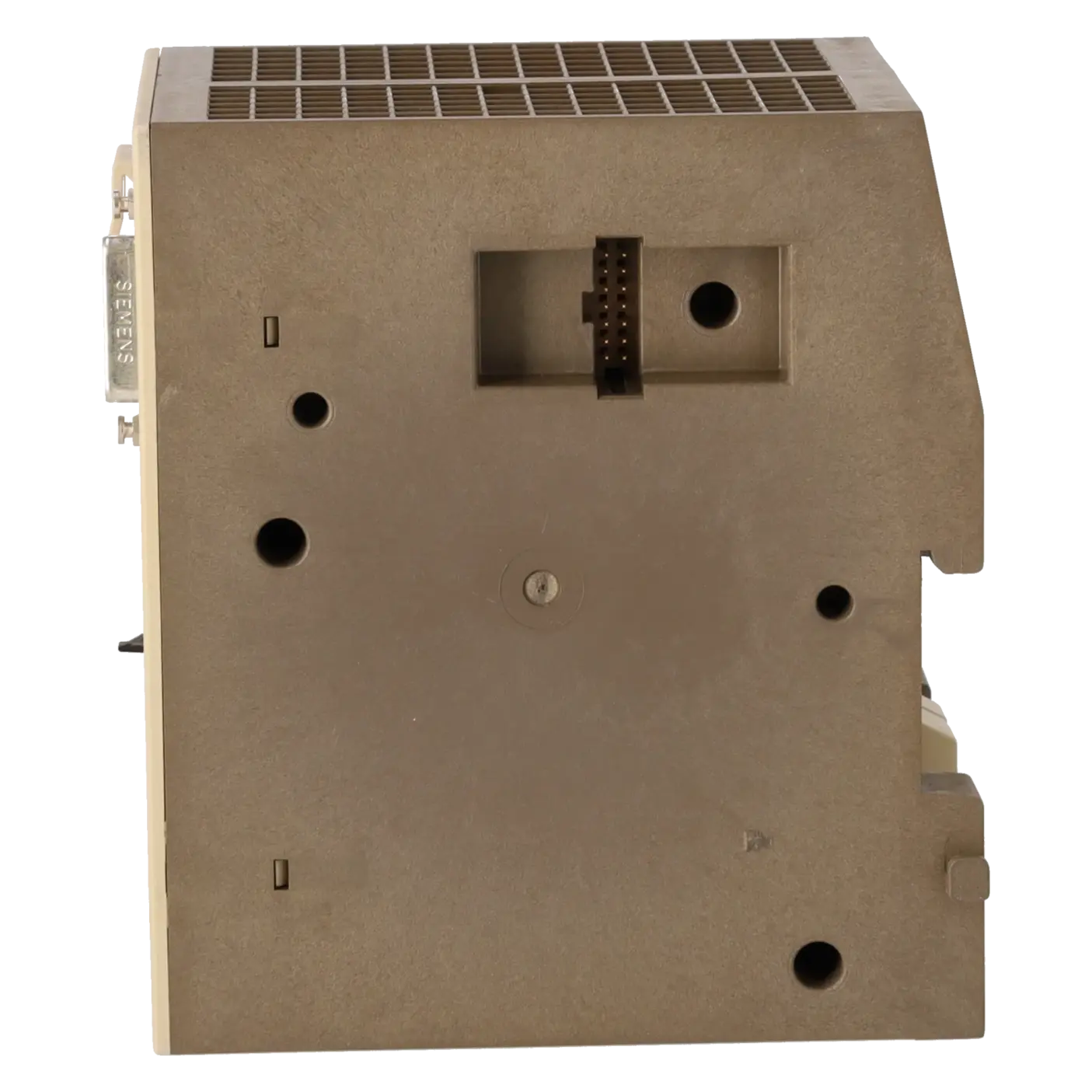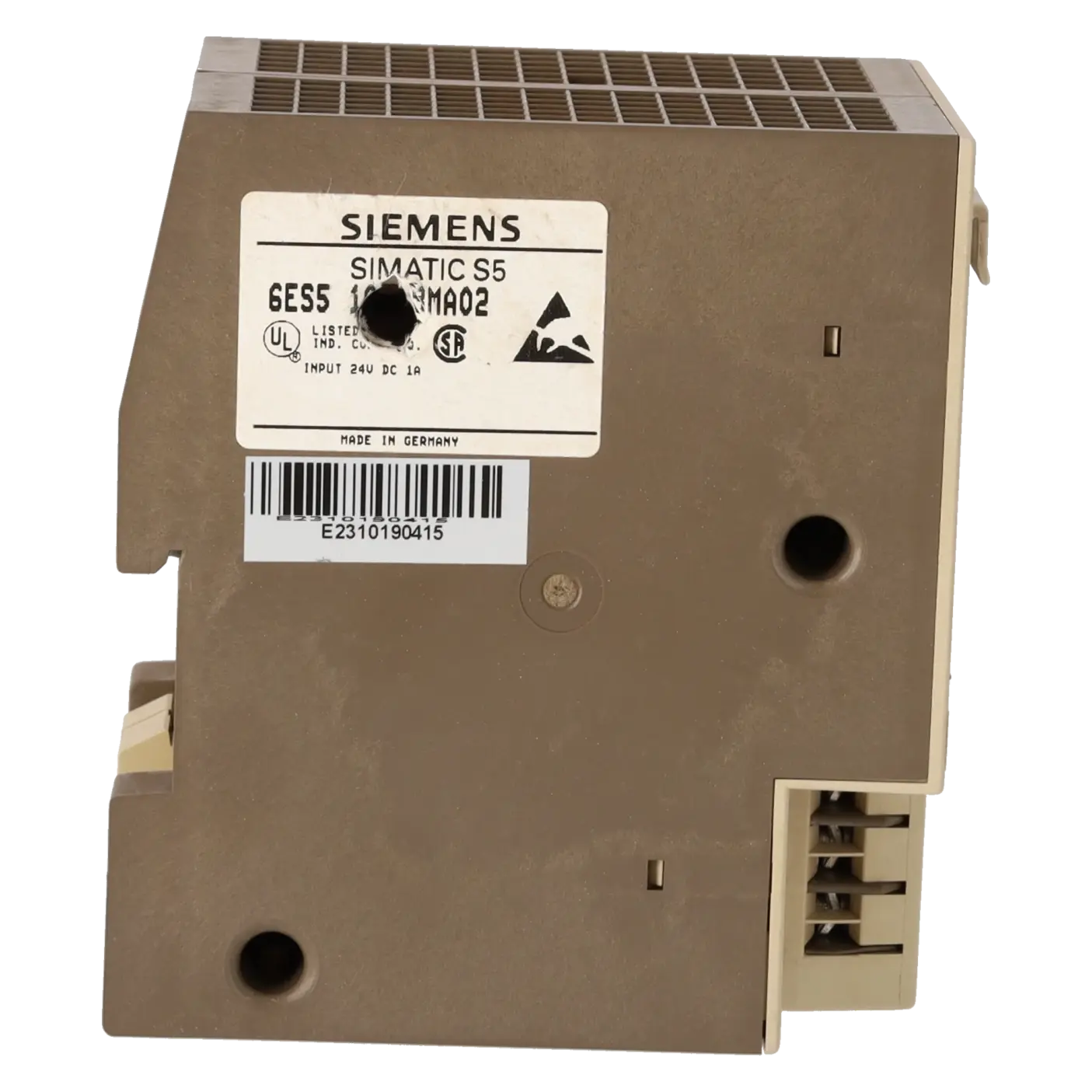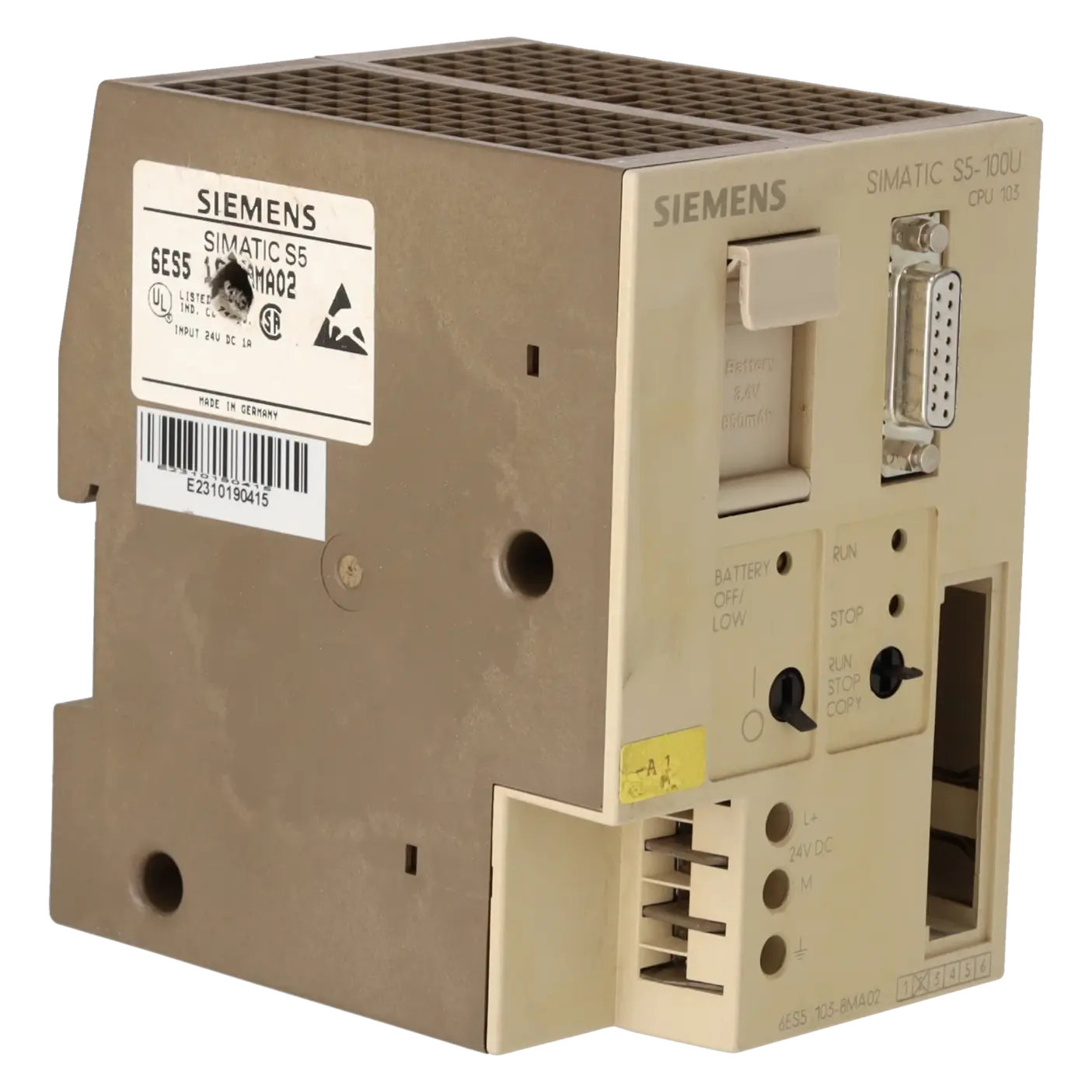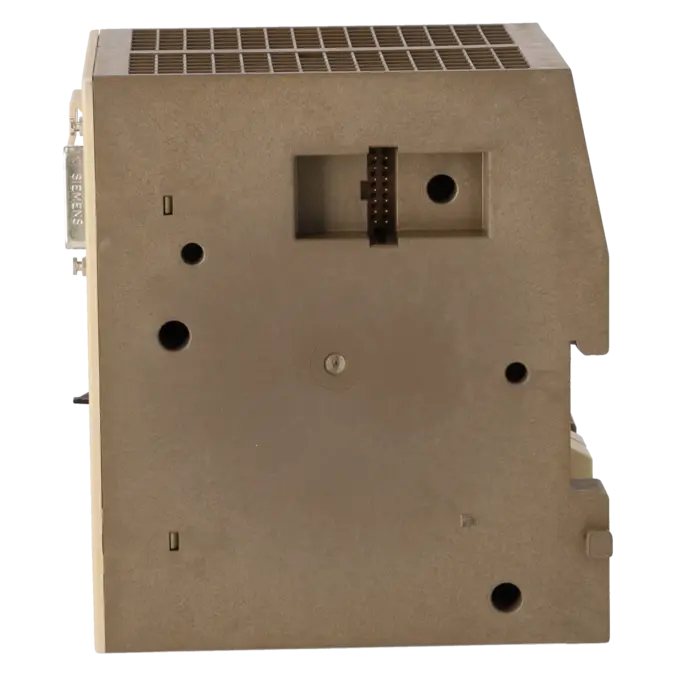
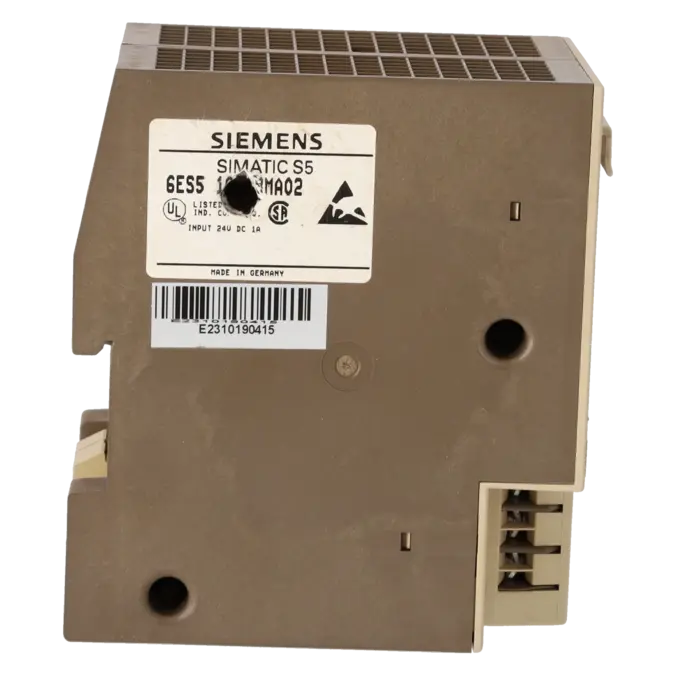
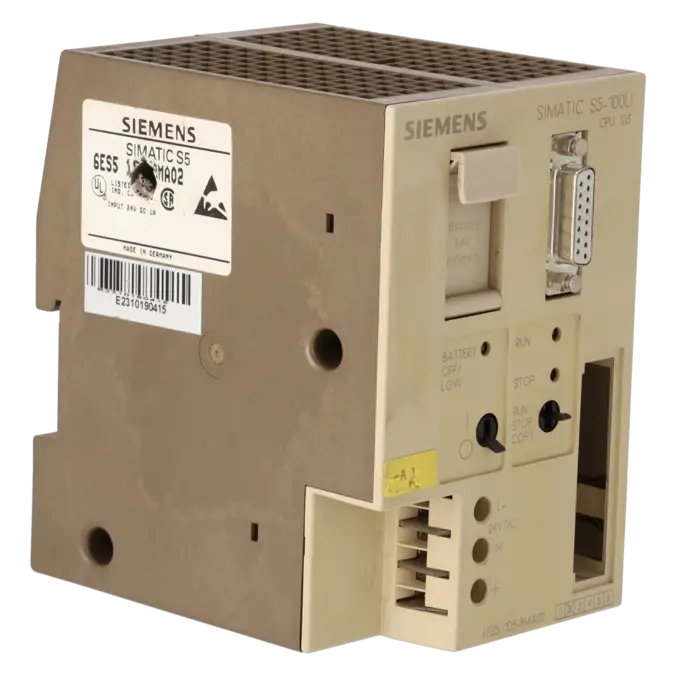
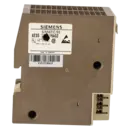
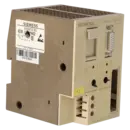
SIEMENS 6ES5103-8MA02
- EICHLER-art.no.: K0136313
- EAN: 4025515052630
Product description
SIMATIC S5, CPU 103 F.S5-100U PC W.POWER SUPPLY UNIT 24V/9V DC W/O MANUAL
Services for SIEMENS 6ES5103-8MA02
SIEMENS |
6ES5103-8MA02 –
additional product information
| Delivery information | |||
|---|---|---|---|
| Export identifier | AL: ECCN: | ||
| Net weight | 0.739 | ||
| Quantity | 1 Stück | ||
| Packaging quantity | 1 | ||
| Additional product information | |||
|---|---|---|---|
| Product status | EOP: 1993-05-01 | ||
| EAN | 4025515052630 | ||
| UPC | / | ||
| Static lot number | 85371091 | ||
| List indicator | / | ||
| Product group | / | ||
| Country of origin | / | ||
| Compliance with the substance restrictions according to RoHS directive | Since: / | ||
| Product classifications | Version | Classification | |
|---|---|---|---|
| eClass | 4 | / | |
| eClass | 5.1 | / | |
| eClass | 6.0 | / | |
| ETIM | 3 | / | |
| ETIM | 4 | / | |
| ETIM | 5 | / | |
What is 6ES5103-8MA02 and where is it used?
The SIEMENS 6ES5103-8MA02 is a CPU 103 central processing assembly for the SIMATIC S5-100U automation system with an integrated 24 V DC / 9 V power supply. It performs the central control functions within S5-100U systems and is therefore particularly relevant in legacy machines where the existing PLC architecture is to remain in operation. Typical applications include older production systems, packaging machines, conveyor systems, machine tools and retrofit projects in which the existing wiring, installed S5 assemblies and established programme structure should remain largely unchanged. For maintenance and purchasing departments, the article number is often the fastest way to identify a defective CPU and initiate a suitable replacement or repair process.
Overview of the most important technical data and what it means
For the CPU 103 platform, the S5-100U manual specifies a word/bit processor, RAM capacity for 10,240 instructions, 2,048 flags of which 512 are retentive, 128 timers, 128 counters, and support for up to 256 digital and 32 analogue inputs/outputs. The assembly operates from a 24 V DC supply with a permissible range of 18 to 34 V. In addition, it provides internal auxiliary voltages of +9 V for peripherals and +5.2 V for the programming device. In practice, this means that the assembly is designed for traditional compact to medium-sized machine control applications, offers sufficient performance reserves for time-critical standard automation tasks and integrates effectively into existing S5-100U environments. The EICHLER product page additionally specifies a net weight of 0.739 kg, EAN 4025515052630 and the relevant customs tariff number, which simplifies procurement and spare parts management.
Product status, life cycle status and obsolescence
For the 6ES5103-8MA02, EICHLER specifies an EOP date of 01.05.1993. From the manufacturer's perspective, the assembly has therefore long been part of the discontinuation and obsolescence landscape, yet it remains in demand because many S5-100U systems continue to operate productively in the field. As a result, the primary focus is no longer on new installations but on replacement, repair, exchange and ensuring long-term availability for existing machines. Siemens later introduced the 6ES5103-8MA03 as a newer and faster CPU 103 for the S5-100U, compared with the earlier 8MA02 version. This indicates a manufacturer-led development within the same CPU family; however, before implementing it as a replacement, the specific machine configuration should always be evaluated technically.
Available EICHLER services and when they are relevant
For the 6ES5103-8MA02, EICHLER offers repair, exchange, used equipment and new equipment services. Repair is particularly advantageous when the existing assembly and its established programme and system environment should be retained. According to EICHLER, the repair process includes technical cleaning, preventive maintenance, comprehensive functional testing and a minimum 24-month warranty; an optional test report is also available. Exchange services are especially attractive in the event of an urgent breakdown because they can restore machine availability more quickly. Used and new units are relevant when building a spare parts inventory, reducing operational risk or bridging repair lead times. Particularly following EOP, these service options help ensure the continued operation of older S5 systems in a cost-effective and predictable manner.
| Fault description | Possible solution |
|---|---|
| Why does my S5-100U CPU 103 remain in STOP after a battery replacement? | Siemens advises that the battery should preferably be installed or replaced while the controller remains powered. If the battery is replaced while the system is de-energised, an OVERALL RESET is often required at the next power-up. If there is no longer a valid programme available in RAM or on a memory module, the CPU will remain in STOP until the programme has been reloaded. |
| Why is the yellow BATTERY OFF/LOW LED illuminated on the 6ES5103-8MA02? | The yellow LED indicates a missing or discharged backup battery. Siemens states that the CPU continuously monitors the battery condition and that, on CPU 103 systems, OB34 can be processed before every cycle in the event of a battery fault. A prompt battery replacement, verification of data backup procedures and a clearly defined response to the BAU condition within the user programme are therefore recommended. |
| Why does the red LED flash continuously during programme loading or backup? | According to Siemens, this behaviour on the S5-100U indicates a fault during the loading or backup process, for example when no valid programme is present on the memory module. In typical service cases, an unsuitable or undersized EEPROM is also discussed as a possible cause. Therefore, the memory module type, programme validity, storage capacity and the complete loading procedure should all be checked carefully. |
| Why does the CPU 103 immediately switch back to STOP with a peripheral fault after being set to RUN? | Siemens identifies several possible causes, including disconnected expansion assemblies, I/O bus faults, unsupported modules or assemblies installed in incorrect slots. In specialist S5 forums, the same behaviour has also been reported when an incompatible combination of CPU and peripheral assembly is used. Therefore, the slot position, bus module, wiring, address space and approval status of the peripheral assembly for the installed CPU version should all be checked first. |
| Why does the CPU remain in STOP after modifications to DB1 or clock parameters? | According to Siemens, if the CPU detects a parameterisation error in DB1, it will remain in STOP even after switching from STOP to RUN, and the red LED will remain illuminated. In this situation, ISTACK or DB3 should be evaluated to determine which parameter address is incorrect or which limit values have been configured outside the permissible range. The corrected DB1 should then be downloaded again before attempting to restart the CPU. |
Is 6ES5103-8MA02 still available today, or is it only a service item?
Although the assembly is listed with an EOP date of 01.05.1993, it remains available on the market through repair, exchange, used equipment and, in some cases, new unit enquiries. From a procurement perspective, this means that the 6ES5103-8MA02 is no longer a standard catalogue item, but it can still be sourced through the appropriate service and spare parts channels. For companies operating S5 legacy systems, this is important because it allows breakdown risks and spare parts inventory strategies to be planned much more effectively.
What is the difference between 6ES5103-8MA02 and 6ES5103-8MA03?
Siemens describes the 6ES5 103-8MA03 as a newer and faster CPU 103 for the S5-100U compared with the earlier 8MA02 version. At the same time, the S5 documentation shows that features such as alarm-controlled programme execution, time-controlled processing using OB13 and CPU-103-specific enhancements already play an important role from the 8MA02 generation onwards. In practice, this means that the 8MA03 is the more recent CPU 103 version, but before replacing an 8MA02, the memory concept, project status, assembly configuration and machine approval requirements should be verified to ensure compatibility.
Can I load the programme into the CPU 103 from a memory module without a programming device?
Yes. Siemens describes both automatic and manual programme loading from a memory module into the CPU for the S5-100U system. The key requirement is that a valid programme must be stored on the memory module. If the programme is missing or incomplete, the CPU will remain in a fault condition and diagnostic procedures will be required. For operators of older machines, a tested memory module or a reliable backup is therefore often the most important safeguard against extended downtime.
What role does the backup battery play in the 6ES5103-8MA02?
The backup battery preserves critical CPU contents during power failures, including programme and data areas. The S5-100U manual specifies a minimum backup period of 1 year at 25 °C and an approximate battery service life of 5 years for the CPU 103 platform. For maintenance personnel, this is crucial because an unexpected battery failure without a valid backup can directly result in a STOP condition, data loss and significantly longer restart times.
Does every S5-100U peripheral assembly automatically work with this CPU?
No, this should not be assumed. Siemens specifically lists unsupported modules, assemblies installed in incorrect slots and I/O bus faults as potential causes of STOP conditions. In addition, the manual explicitly states that certain assemblies are only supported from CPU versions -8MA02 onwards. For purchasing and engineering departments, this means that not only the CPU part number but also the slot position, assembly version, addressing configuration and CPU compatibility approval must be considered together. Carrying out this verification helps prevent incorrect purchases and unnecessary downtime.
When is repair more sensible than direct replacement?
Repair is particularly advantageous when the existing assembly should continue to be used within the current machine environment and unnecessary changes to the programme, wiring or documentation are to be avoided. On the EICHLER product page, repair is described as including technical cleaning, preventive maintenance, functional testing and a minimum 24-month warranty. Exchange, by contrast, is generally the better option when production downtime must be resolved immediately. From an economic perspective, the decision is usually based on the combination of downtime costs, availability and the risk of a repeat failure.