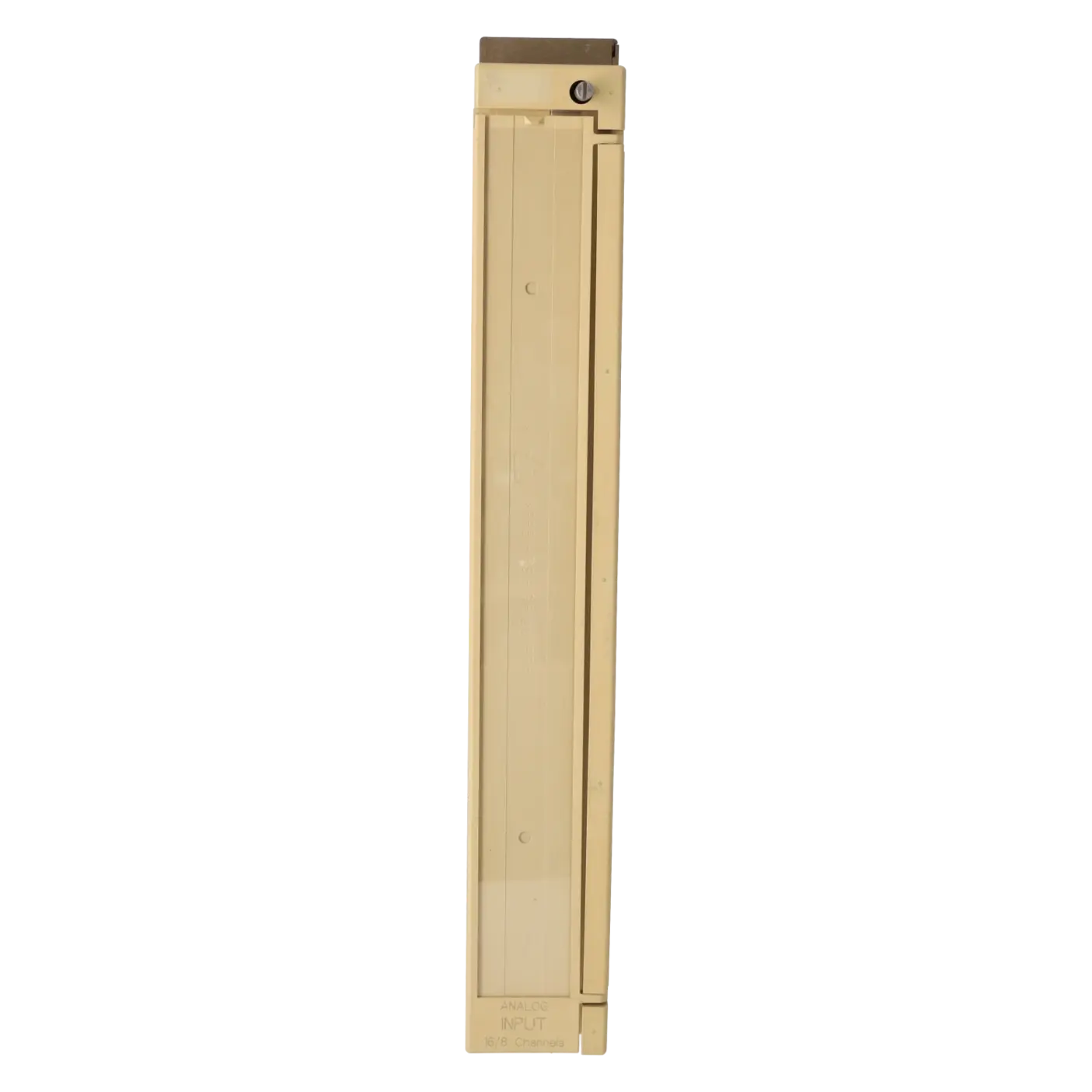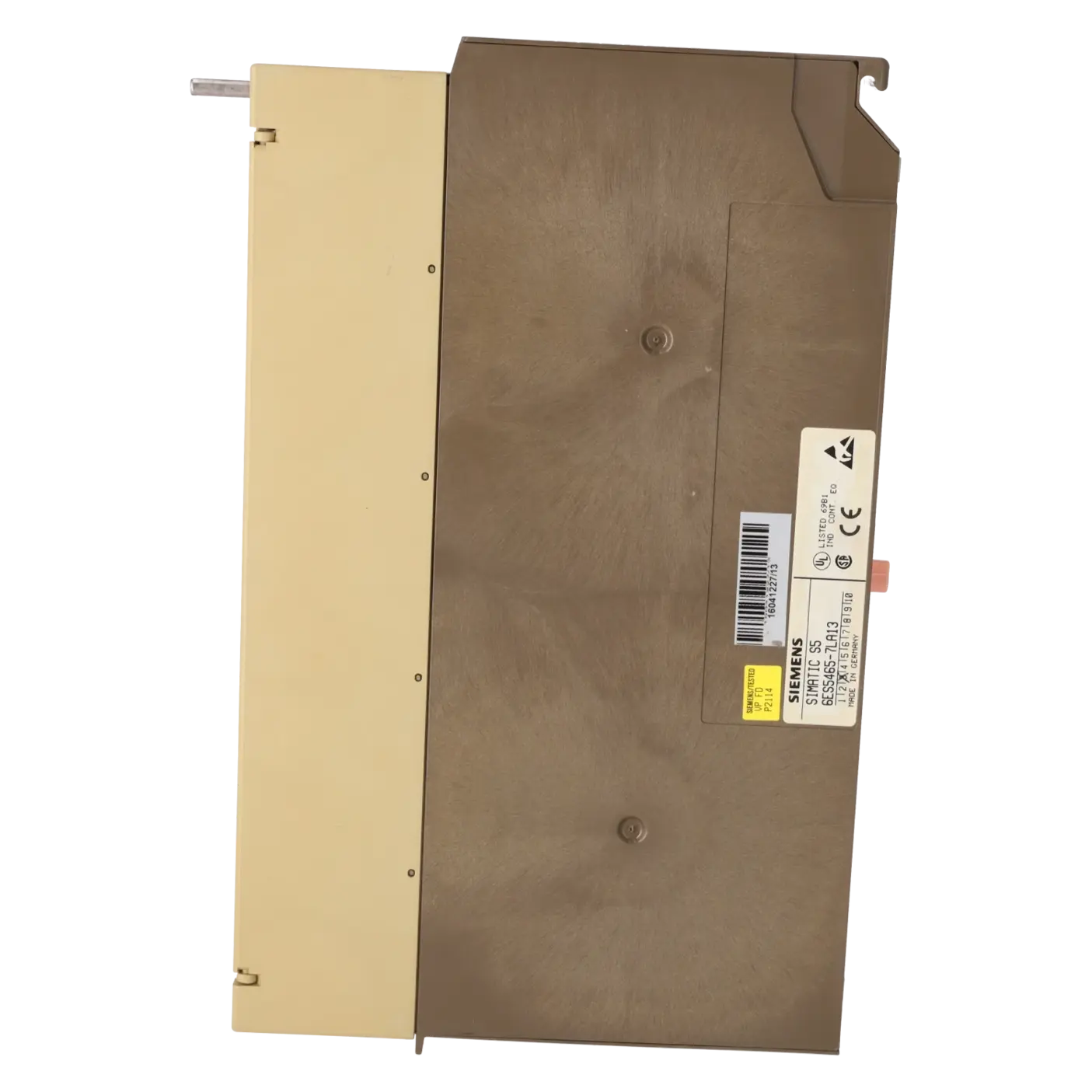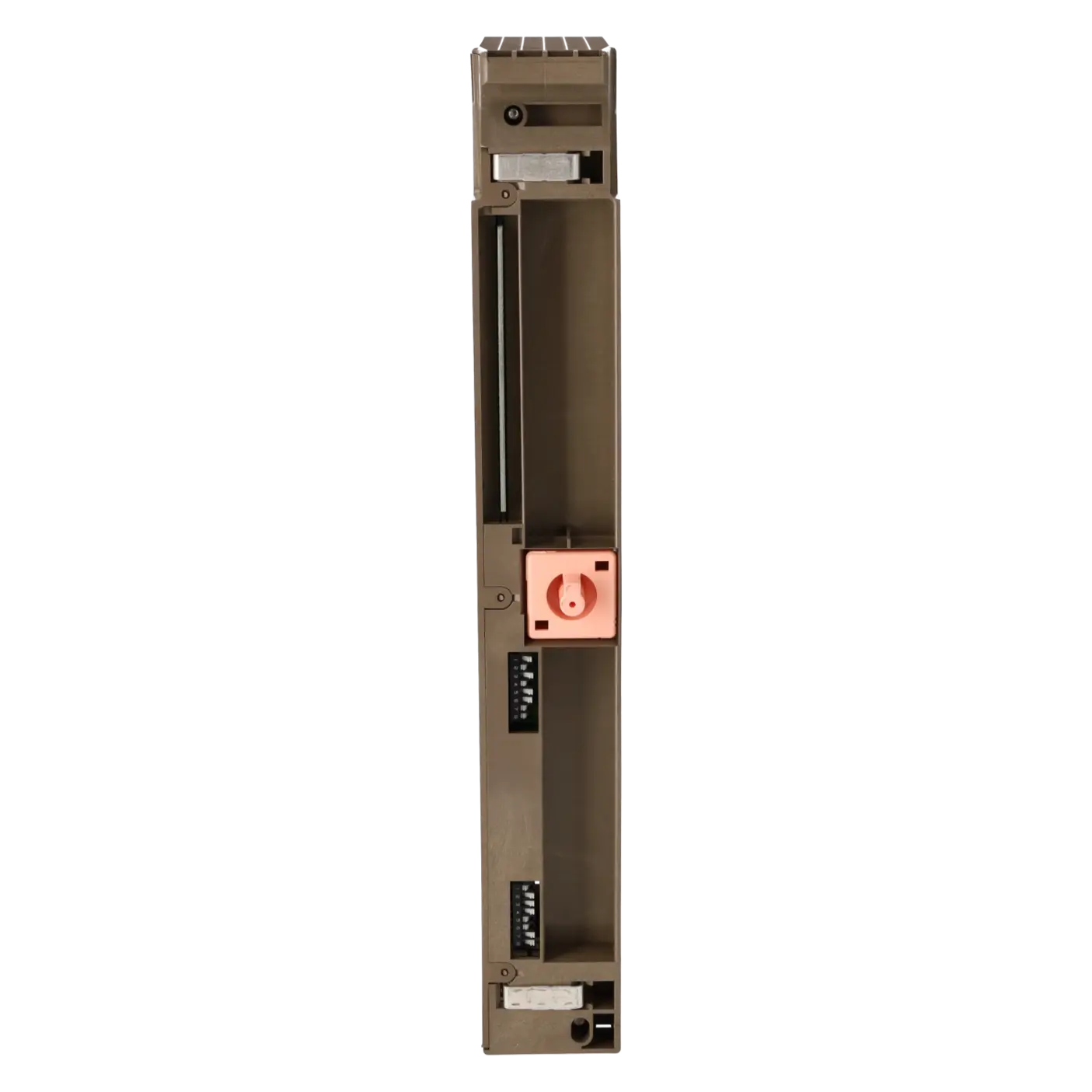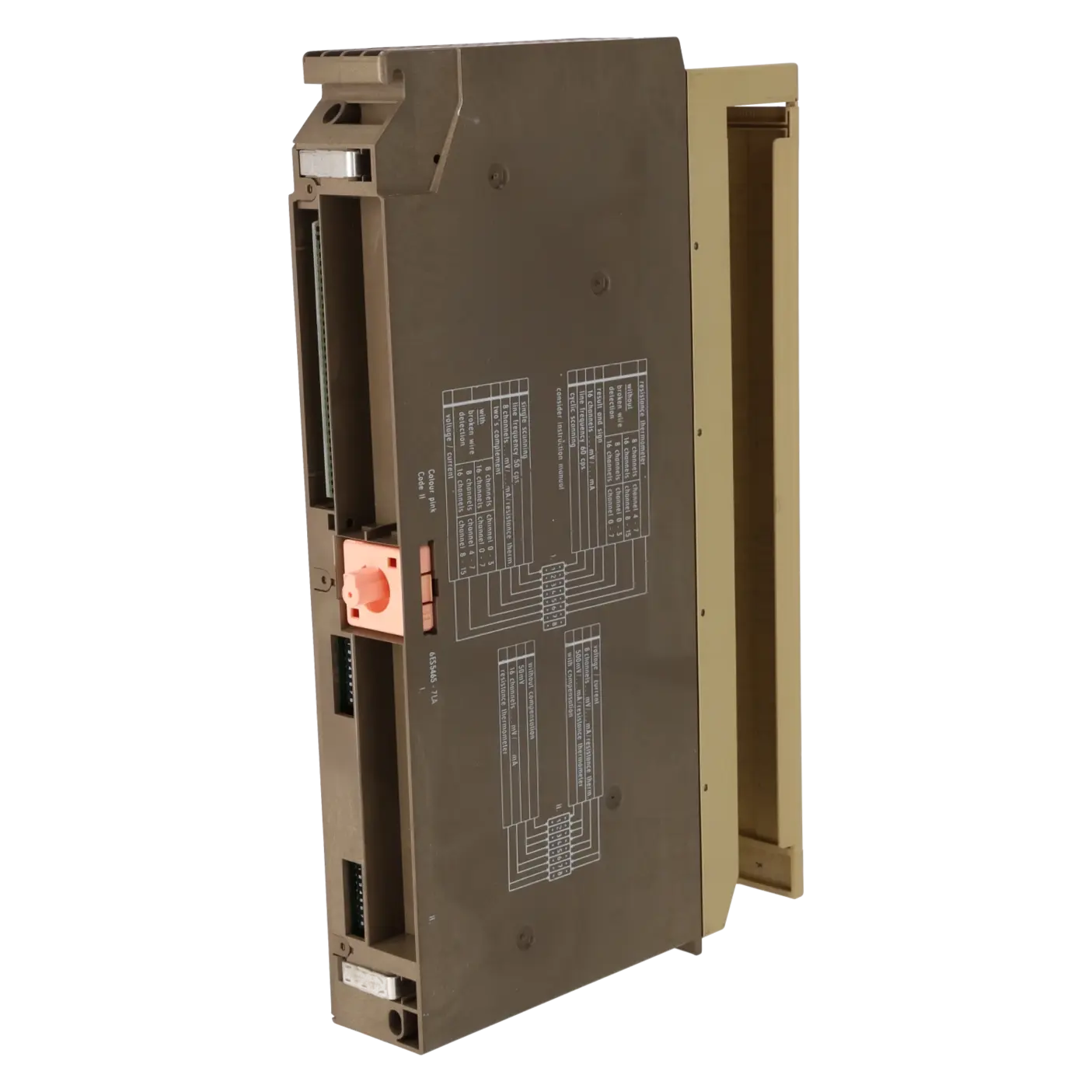
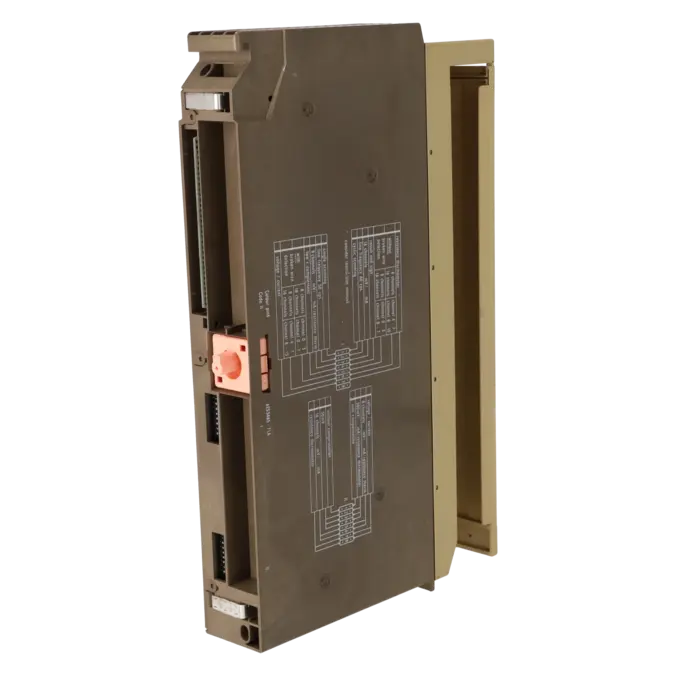
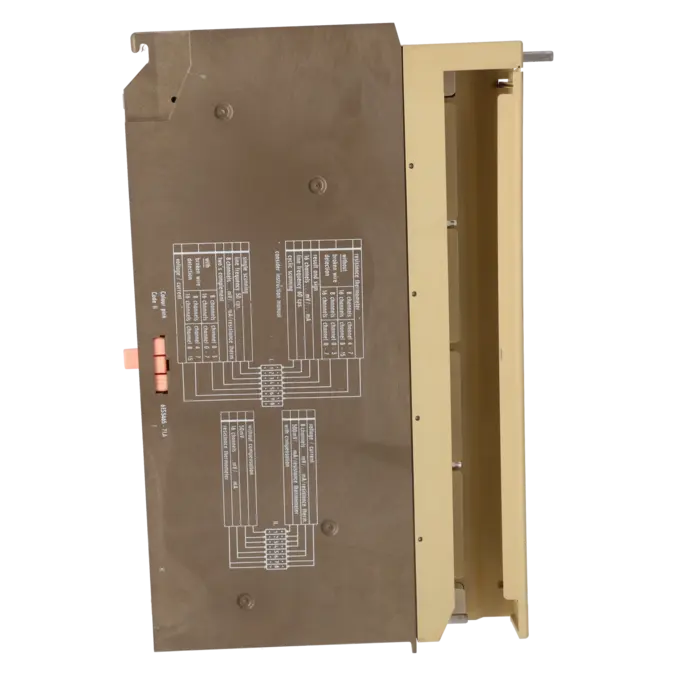




SIEMENS 6ES5465-7LA13
- EICHLER-art.no.: K0117578
- EAN: 4025515116257
Product description
SIMATIC S5, ANALOG INPUT 465-7 NON-ISOLATED 16 INPUTS MEASURING RANGE MODULES FOR S5-115U
Services for SIEMENS 6ES5465-7LA13
SIEMENS |
6ES5465-7LA13 –
additional product information
| Delivery information | |||
|---|---|---|---|
| Export identifier | AL: ECCN: | ||
| Net weight | 0.85 | ||
| Quantity | 1 Stück | ||
| Packaging quantity | 1 | ||
| Additional product information | |||
|---|---|---|---|
| Product status | EOP: 2005-10-01 | ||
| EAN | 4025515116257 | ||
| UPC | / | ||
| Static lot number | 85389091 | ||
| List indicator | / | ||
| Product group | 4235 | ||
| Country of origin | DE | ||
| Compliance with the substance restrictions according to RoHS directive | Since: / | ||
| Product classifications | Version | Classification | |
|---|---|---|---|
| eClass | 4 | / | |
| eClass | 5.1 | / | |
| eClass | 6.0 | / | |
| ETIM | 3 | / | |
| ETIM | 4 | / | |
| ETIM | 5 | / | |
What is 6ES5465-7LA13 and where is it used?
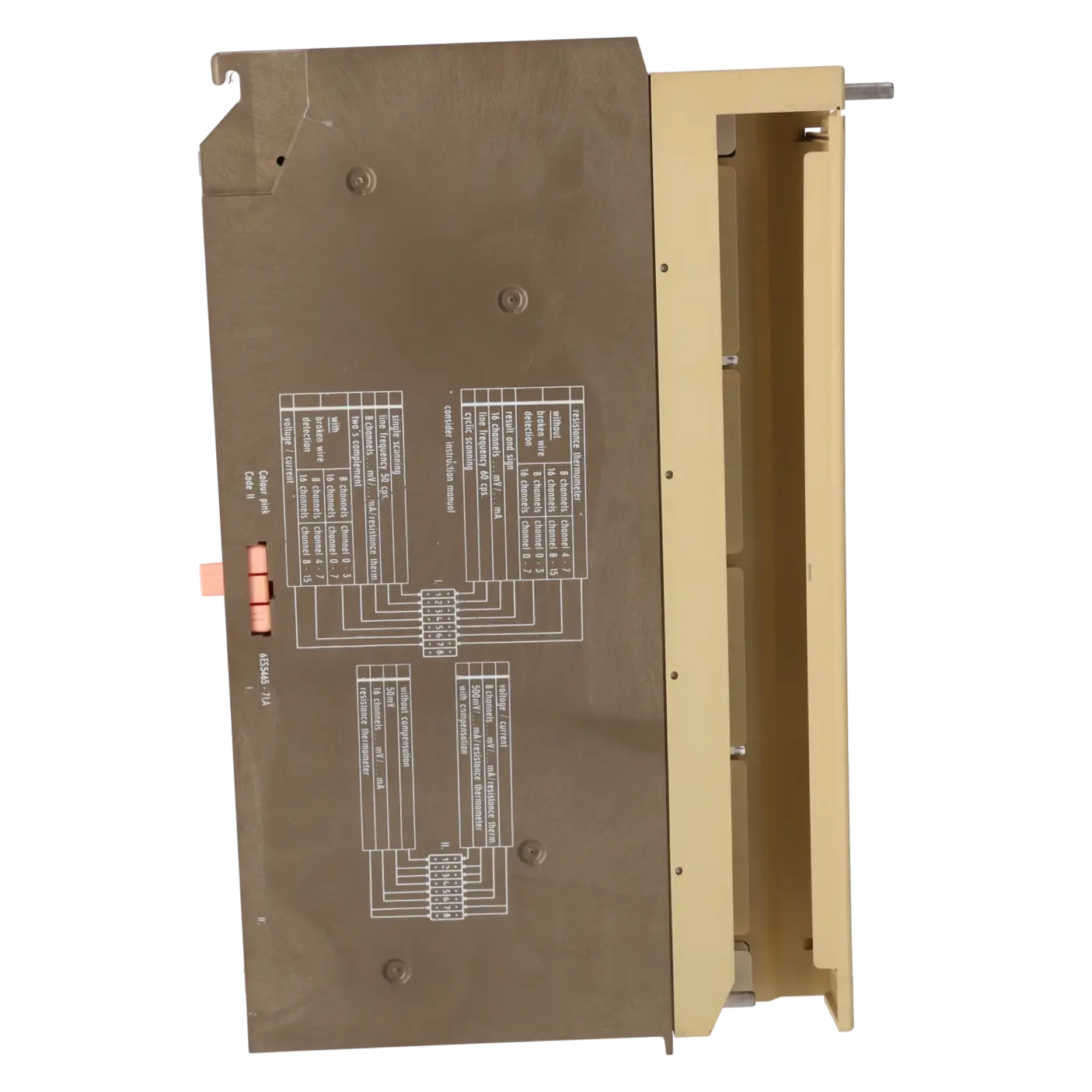
The 6ES5465-7LA13 is a SIEMENS SIMATIC S5 analogue input assembly for S5-115U systems. It acquires analogue field signals and makes them available to the PLC as digitally processable measurement values. Typical applications include legacy systems with pressure, temperature, level or general current/voltage signals where the existing S5 architecture is to remain in operation. The assembly is non-isolated, meaning it is not galvanically isolated. This is common in systems with a shared reference potential but requires careful wiring and signal routing. For maintenance and spare parts procurement, the assembly is particularly relevant when existing S5 installations must remain operational without a complete platform migration.
Overview of the key technical data and what they mean
The main technical characteristics clearly indicate the intended application of the assembly: 16 voltage/current inputs or 8 Pt100 inputs, measuring ranges of ±50 mV, ±500 mV, Pt100, ±1 V, ±5 V, ±10 V, ±20 mA and 4–20 mA, range modules for every 4 channels, 24 V DC supply, 12-bit plus sign or 13-bit two’s complement resolution, and a cyclic acquisition time of approximately 0.48 s with 8 channels and 0.96 s with 16 channels. In practice, this means the assembly is flexible enough for use with conventional transmitters and Pt100 applications, but requires the correct selection of range cards and proper parameterisation. With analogue S5 assemblies in particular, this combination is critical for obtaining stable and correctly scaled measurement values.
Product status, life-cycle status and obsolescence
For procurement purposes, it is important to note that the 6ES5465-7LA13 is a discontinued S5 assembly. The EICHLER product page lists a product status of EOP: 2005-10-01, while Siemens continues to classify the part as a spare part in SiePortal. This clearly places the assembly in the area of obsolescence management, repair, exchange and strategic spare parts stocking. There is no longer an active 1:1 successor in the S5 format. Siemens does, however, identify reference modules for modernisation projects in official migration documentation, including 6ES7531-7KF00-0AB0 for S7-1500 migration. Depending on the signal type, Siemens adapter documentation also references S7 solutions such as 6ES7331-1KF01-0AB0. These references should be regarded as migration paths rather than plug-compatible direct replacements.
Available EICHLER services and when they are relevant
When an analogue S5 assembly fails, the key question is how quickly reliable measurement capability can be restored. Repair is particularly appropriate when the existing card is to remain in the system and the application should continue operating unchanged. EICHLER specifies a turnaround time of 2–5 days, including technical cleaning, preventive maintenance, comprehensive functional testing and a minimum 24-month warranty. Exchange services are especially valuable when downtime costs are high and an immediate replacement solution is required. Used and new units help secure the continued operation of older S5 systems despite increasing obsolescence. The optional test report for analogue input/output assemblies is particularly useful in quality-critical applications, as it provides documented verification of analogue channel performance and functionality.
| Fault description | Possible solution |
|---|---|
| Why does the 6ES5465-7LA13 deliver incorrect values or implausible scaling? | First check whether the correct 6ES5498 range module is installed for each group of four channels and whether the selected measuring range actually matches the sensor. The assembly can only digitise signals correctly when the range module, sensor type and evaluation method are configured consistently. In older S5 systems, apparently plausible but incorrect values often occur when calculations are based on S7-style resolution or when the wrong range card is installed. |
| Why can't I measure Pt100 signals and 0–10 V signals on all 16 channels simultaneously with the 6ES5465-7LA13? | The assembly supports either 16 voltage/current inputs or 8 Pt100 inputs. In addition, each group of four channels is defined by a dedicated range module. For Pt100 applications, the number of usable channels is reduced and the associated configuration must be matched precisely to temperature measurement requirements. Before rewiring, verify which channel groups are intended for voltage, current or Pt100 operation. |
| Why does the assembly report overflow or wire breakage even though a sensor is connected? | According to Siemens, overflow and fault bits are set when the measuring range limit is exceeded or when the wire-break detection function responds. Check the sensor cable, line resistance, Pt100 wiring, compensation connections and the configuration of the wire-break monitoring function. With certain through-connection cards, unused inputs must be correctly short-circuited; otherwise, false diagnostic indications may occur. |
| Why do I receive a "peripheral acknowledgement delay" message or why can the 6ES5465-7LA13 not be addressed? | Check the rack, slot position, interface module and addressing configuration. Discussions in the SPS community indicate that, on certain S5-115U central systems, slot 0 cannot be used, that IM305 and IM306 use different addressing methods, and that a free IM slot requires an end cap with a jumper link. A correctly connected enable signal is also important. These points should be verified before assuming a fault in the analogue input assembly itself. |
| Why does the measured value fluctuate by a few counts or appear unstable? | On the 465-7LA13, the lowest three bits are not part of the actual process value but contain status information. If these bits are not masked out correctly during evaluation, the signal may appear unstable. In addition, loose terminals, poor connector contacts and normal digitisation noise can cause minor fluctuations. Therefore, both the signal-processing logic in the program and all terminal and connector connections should be checked carefully. |
Is 6ES5465-7LA13 still available or only as a spare part?
The 6ES5465-7LA13 is clearly a product from the obsolescence environment. Siemens continues to list it as a spare part, while the EICHLER product page shows an EOP (End of Product) date of 2005-10-01. Current market availability is typically based on repair services, exchange units, refurbished products, used parts and remaining stock. For purchasing departments, this means that availability is largely dependent on market conditions and product condition, making technical testing, warranty coverage and the supply model more important than the part number alone.
How many sensors can I actually connect to the 6ES5465-7LA13?
The assembly supports 16 analogue voltage or current inputs. When used with Pt100 sensors, the capacity is reduced to 8 inputs. This distinction is important during project planning, as applications with large numbers of analogue process signals require a different configuration from those with multiple temperature sensors. In addition, the input type is defined by range modules assigned to groups of four channels. When expanding or modifying an existing system, it is therefore essential to verify not only the slot position but also the installed range modules and the connected sensor types.
Which range modules are required for the 6ES5465-7LA13?
Siemens specifies 6ES5498 series range modules for use with the 465-7LA13. These range cards adapt the field signal to the input level required by the assembly and define the measuring range for each group of four channels. The documentation lists variants including -1AA11, -1AA21, -1AA31, -1AA41, -1AA51, -1AA61 and -1AA71. The correct module depends on whether voltage, current, 4–20 mA or Pt100 signals are being measured. For reliable procurement, the installed range card should always be compared with the actual field instrumentation in the system.
Is repair or exchange generally the better option for an analogue S5 assembly?
Repair is usually the more economical option when the existing assembly is fundamentally suitable for the application, the current parameterisation should be retained and no modification of the control system is desired. Exchange services are more focused on rapid restoration of operation when a failed card must be replaced immediately. According to the EICHLER product information, repairs include a 2–5 day turnaround time, technical cleaning, preventive maintenance, comprehensive functional testing and a minimum 24-month warranty. For operators of older S5 systems, this is particularly valuable because it helps maintain functionality despite obsolescence without immediately triggering a complete migration project.
Which official migration option does Siemens specify for the 6ES5465-7LA13?
In Siemens migration documentation for S5-115U/H/F systems, the 6ES7531-7KF00-0AB0 is referenced as the S7-1500 migration equivalent for the 6ES5465-7LA13. Additional Siemens adapter documentation also references S7 assemblies such as 6ES7331-1KF01-0AB0 and 6ES7331-7KF02-0AB0, depending on the measurement type and adapter concept. These references should be regarded as migration and retrofit recommendations rather than direct plug-compatible replacements. This is the point at which spare parts strategy and long-term modernisation planning begin to overlap.
Why is a test report useful for analogue input and output assemblies?
With analogue assemblies, it is not enough for a channel to simply function; the measured values must also be traceable and reproducible. For this reason, a test report is particularly valuable in quality-critical processes, applications with documentation requirements and situations involving recurring faults. EICHLER offers an optional test report for analogue input/output assemblies for this product. For purchasing and maintenance teams, this improves transparency during incoming inspection, reinstallation and fault diagnosis, while providing documented evidence of functional performance.